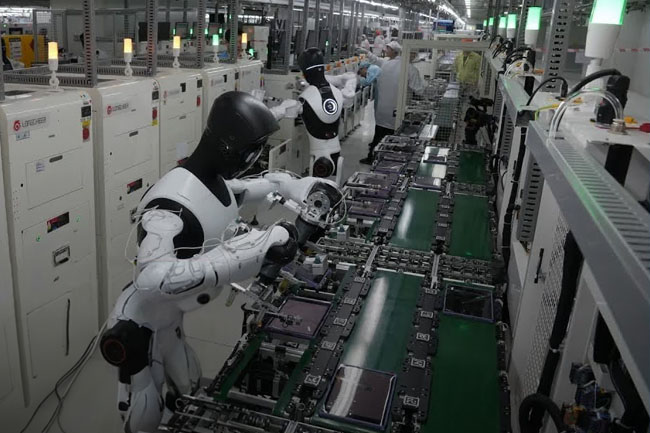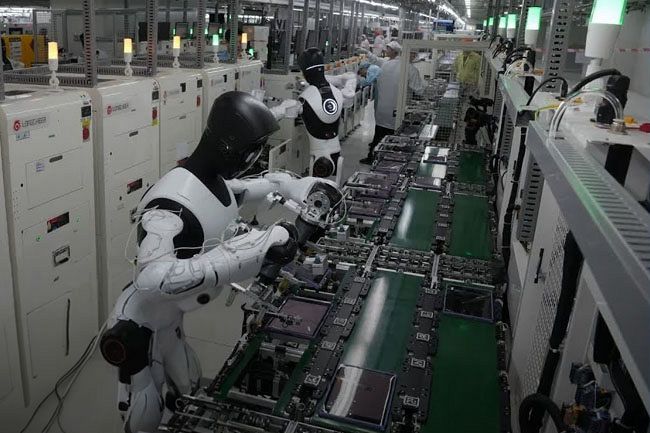
Artificial intelligence may boost productivity and profits, but without sufficient demand in the economy, technological progress alone cannot guarantee jobs or full employment, writes Graham White.
ENGLISH ECONOMIST David Ricardo wrote in his Principles of Political Economy, published in 1821:
‘I am convinced, that the substitution of machinery for human labour, is often very injurious to the interests of the class of labourers.’
The question Ricardo raises here is older than the mainstream of economics itself.
In a sense, artificial intelligence (AI) is but the most recent context for this question, though this is not to deny the importance of concerns about its employment impact, nor its role already in areas of medicine and science.
My concern here is with the objective economic impact of technical progress, specifically, the employment impacts.
For many, this is the economic and social issue associated with technical progress, be it the introduction of the steam engine or AI. For many dissenters within the economics profession, Ricardo’s instincts were a legitimate concern even if his reasoning did not impress.

What is technical progress?
It will suffice for this discussion to interpret it as the application of new methods of producing things, using less of at least some inputs and no more of any other input.
Interestingly, the great debates over technical progress in the economics profession over the last century revolved around the consequences for the distribution of income, primarily between wages and profits.
Technical progress means that the economy could potentially pay a higher real wage or a higher rate of return (profit) on production or both.
Thus, technical progress potentially allows for an increase in the size of the cake, so to speak. How a capitalist economy would distribute the extra slice of cake between labour and capital was the much more complex and controversial question.
The flip side and more concerning aspect is that traditionally, technical progress in capitalist economies is predominantly what economists call “labour-saving”. To produce the same output requires less labour than before. If the quantity of output to be produced does not increase, labour employment falls and unemployment rises.
Technical progress and unemployment
The issue is whether these unemployment effects are inevitable and long-lasting. Put another way, the issue is whether the “inherent” dynamics of capitalism can be relied on to prevent such negative consequences.
The mainstream and dominant answer to this from the profession has typically been that there exists “market” mechanisms to compensate for this potential rise in unemployment. If real wages and prices are sufficiently flexible, this should allow for labour to become more competitive, thus allowing the labour-displacing effects of technical change to be at least partially offset.
Additionally, as the cost of producing goods and services with the new technology falls and with it the price of these goods, this should also stimulate demand for those goods and thus, in turn, for labour. (A nice paper on these arguments is by Cesaratto et al in the Review of Political Economy, 2003).

Arguments of this sort are, in fact, at the heart of the long-held faith within the economics profession in the inherent ability of capitalist economies to converge towards full employment.
It is a safe bet that this argument or variations on it will be wheeled out in response to concerns about AI, particularly consequences for unemployment.
Most recently, for example, the chief economist of CommBank, Luke Yeaman, wrote:
‘Higher productivity doesn’t necessarily mean fewer workers. More often, it means workers doing more valuable work. AI is likely to augment most jobs, not replace them, especially by taking over routine tasks. Early evidence shows it is already saving time, freeing up capacity and allowing firms to do more with the same workforce.’
Note the words ‘freeing up capacity’. The new technology will allow the firm to produce more with the same or less.
And, so the argument goes, since more output can be produced with the extra capacity, the workers who would otherwise be laid off can be kept on. Alternatively, for the economy as a whole, the structural changes brought by technical progress facilitate new avenues of production offering employment opportunities for those adversely affected by the introduction of new technology.
Where is the extra demand?
What is assumed but left unsaid in this view is that there will be extra demand in the economy for goods and services underpinning the larger output that will supposedly negate the labour-displacing effects of technical progress.
Despite their popularity and dominance, these arguments have never been particularly strong, as debates within the profession throughout the twentieth century demonstrated. That markets left to themselves, however unfettered, will deliver whatever demand is required for full-employment, is, as Keynes suspected (and those debates confirmed), not a correct deduction from robust economic reasoning.

An alternative position exists. That alternative would approach the question we started with by asking how effective demand (as economists call it) and, as a result, production and labour employment could accelerate sufficiently to offset the tendency for new technology to require less labour.
And that brings us to the sources of effective demand: household consumption, investment, government spending and net exports
Without getting too technical, assuming that consumption and/or investment will accelerate sufficiently to mitigate the unemployment effects of technical progress is problematic.
The consumption impact will depend very much on how the spoils of technical progress are distributed between profits and wages.
On investment, installing new capacity requires an expectation of demand growth; the necessary acceleration of demand must be happening prior to any surge of investment.
Even the view that somehow innovation itself speeds up aggregate investment spending is something the jury is still out on in economics.
For the purposes of increasing growth in demand to offset the labour-displacing effects of technical progress, this, interestingly, leaves just government spending and net exports.
The net exports channel has always been deceptive. Suffice it to say, not all economies can experience export-led growth simultaneously. Export-led growth only benefits some economies, provided others are prepared to expand their domestic demand to suck in more imports.
One is left with government spending as a source of demand for the economy to at least ensure sufficient demand to deal with technical progress, where the private sector is unwilling to.
This should well and truly set the cat among the pigeons, given all the flailing and gut-wrenching in this country about supposed excess public sector spending.
Graham White is an associate professor in the School of Economics at The University of Sydney. He teaches macroeconomics and the history of economic thought. You can follow Graham on Twitter @heterodox_econs.
 This work is licensed under a Creative Commons Attribution-NonCommercial-NoDerivs 3.0 Australia License
Support independent journalism Subscribe to IA.


Related Articles
- AI is not just technology — it’s reshaping society in ways we don’t control
- Rising AI budgets, falling outcomes: Why enterprise initiatives keep stalling
- Armed with AI: Epicflow’s new Portfolio Optimiser enters trials with the Dutch
- Profits before people: How neoliberalism is hardwiring AI for chaos
- Australia’s AI paradox: Mass adoption, minimal strategy