The sudden emergence of One Nation as a potentially major party surely is a message for the Albanese Government that reform is knocking on the door, quite loudly, writes Dr Klaas Woldring.
IN 2003 AND 2004, a major inquiry was held in Australia to find out why the Republic Referendum in 1999 had failed.
That resulted in the quite extensive The Road To A Republic Report, which established that the main reasons were lack of public preparation and involvement prior to the Referendum and, particularly, lack of political education by most voters.
Thus, it was recommended that much more effort should be made to correct that situation, which, the principal researchers sadly found, would take at least 15 years.
Has any serious effort been made to correct and improve this situation? Sadly, it needs to be said, not at all.
Actually, in some ways, to the contrary. What is the Albanese Government going to do about this?
In high schools, little education of a political nature is provided. In universities, political science courses have actually declined during the commercialisation disaster of higher education.
The School of Political Science at the University of NSW, where I did my PhD on Apartheid Policy and worked as a full-time tutor in the early 1970s, doesn’t exist anymore.
Is this part of the explanation that serious political reform is avoided and that Australians now actually could elect a One Nation Government as a result?
Many Australians believe that their country has one of the best electoral systems. The ABC apparently does as well after recently airing
Annabel Crabb's Civic Duty television series on the Australian electoral system. Frankly, that was
most unhelpful because it was simply wrong where it mattered.
As far as the essence of the system itself is concerned, the
single-member district, which is responsible for the two-party system, is essentially undemocratic and unfair.
The working and administration of the existing election system is competent and responsible, but the underlying values are the real problem.
Fortunately, at the federal level, at least the system for the Senate is based on proportional representation (
PR). It was introduced by the
ALP in 1948, very late in its term of government, and has prevented disasters. The time has come now for that party to again present progressive reform.
The Australian electoral system, for lower houses, is based on single-member districts, with the later improvement of the
single transferable vote (1918).
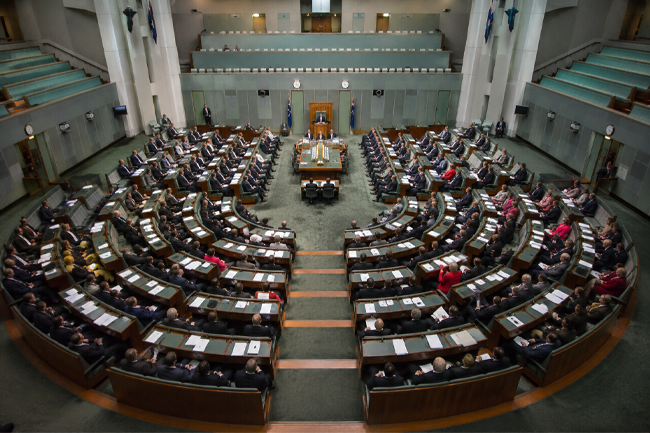
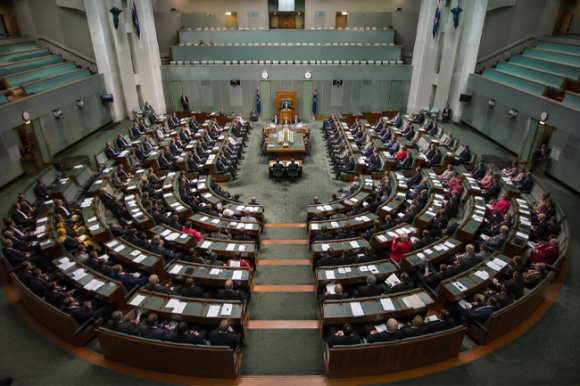
In spite of that improvement, which does not make it proportional, the system favours two major opposing parties. This is clearly limiting in itself, but this, combined with the seating arrangements, opposite to each other, suggests voters have essentially only two choices — the favoured party and the opposite one.
Originally, those two parties essentially represented the owners' class and the workers' class. The political debates are essentially based on this distinction and the options for voters are basically either one or the other, with a very few odd single members on the cross benches.
This oppositionism also shapes the leadership and the workers' representatives, seated opposite; all this started in the late
19th century in the UK.
That polarised class system has changed a fair bit during the 20th century, but the Anglo political representation system has not, at least not much in Anglo countries and their colonies.
It is easy to see that this system has problems for many immigrants from non-English-speaking countries, who are usually unfamiliar with the two-party system.
Even in both the UK and the U.S., strong
movements are busy to change the electoral systems to PR. Strangely, we never hear anything about that in the Australian media.
Listening to these debates, oppositionism characterises the system. This is significantly different in parliaments elected by PR.
There are perhaps four or five larger parties and possibly a few smaller parties in PR systems. After the PR election, they have to form a majority coalition government. Thus, we have a searching for coalition agreement period, not a polarising situation often artificially exaggerated as is common here in Australia.
The seating arrangements of Members of Parliament are always completely different compared with the polarising seating arrangements in the Westminster system. There simply is no formal Opposition Party!
In most PR systems, the voter just votes for one party from a list of candidates/potential members, in preferred order by the party that the voter can vote for. If a party received votes for ten members, the first ten on the list are in. The voter votes for one candidate for one party; that is it.
The voter can, in most PR systems, prefer one particular candidate. Most don’t.
PR systems are far more democratic and productive than the British single-member system. Ninety countries have them; none have wanted any other system.
Generally, a party needs to gain three to five per cent of the total vote to qualify for representation in the Parliament. This is done to prevent too many small parties from qualifying. New Zealand
introduced PR in 1996. Isn’t it high time that Australia progresses politically?
The sudden emergence of One Nation as a potentially major party surely is a message for the Albanese Government that reform is knocking on the door, quite loudly. They have two years to fix it.
Support independent journalism Subscribe to IA.




 This work is licensed under a Creative Commons Attribution-NonCommercial-NoDerivs 3.0 Australia License