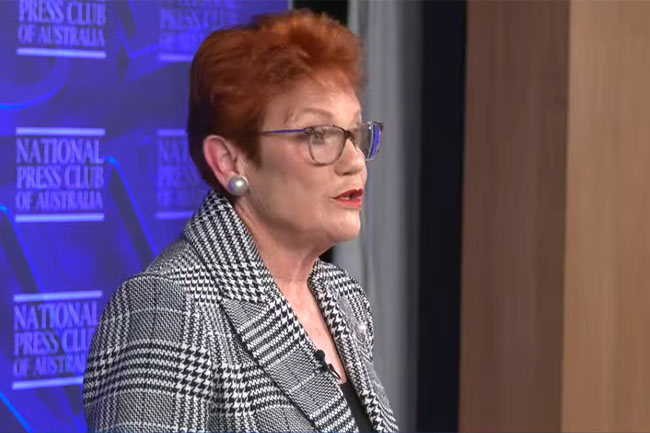
Pauline Hanson’s National Press Club speech has been widely reported as a glorious victory for the populist demagogue. Dr Martin Hirst explains why journalists seem to love Hanson’s politics of outrage.
IN HER FIRST National Press Club speech on Wednesday 17 June, Senator Pauline Hanson berated reporters from SBS and The Guardian for asking uncomfortable questions.
This has become her go-to move when put under pressure by a less-than-tame journalist. She then celebrated these moments in a highlights reel compiled by her expanding team of handlers, gophers and fluffers. What’s more telling is that not one other senior journalist in the room made any attempt to defend the journalists asking difficult questions. The Canberra press pack has the collective courage of a custard tart.
Hanson has always had an antagonistic relationship with the news media, but we’ve started to see this change in recent months. Her seeming popularity in opinion polls – that predict some remarkable results for One Nation in coming elections – is certainly a factor. As public support for Hanson climbs, it becomes necessary to devote more column inches and precious TV pixels to coverage of her.
But that coverage demands scrutiny and not obsequious flattery that borders on cheerleading.
As we might expect, the Murdoch media wrote up Hanson’s Press Club appearance as a triumph that put her “woke” enemies in their place.
The Nine media were close behind in painting Hanson’s speech as a game-changer that announced her arrival on the political mainstage:
‘By showing up today, Pauline Hanson passed the test... Hanson didn’t miss a beat in her speech, even when a protest banner unfurled behind her, and the transformation of One Nation into a mainstream political party continues apace.’
Not only are senior Press Gallery journalists shamefully giving Pauline Hanson a free ride, but they are also apparently very thin-skinned. Australia Institute economist, Greg Jericho, had his decade-long Press Gallery pass withdrawn after gently chiding the tame questioning of Hanson at the Press Club.
Gallery honcho Jane Norman explained Gericho’s axing as the result of an “audit” which showed Greg was no longer “entitled” to a parliamentary press pass. This excuse doesn’t pass the sniff test. It came less than two hours after Gericho’s post on X, making Norman’s reasoning highly suspect.
This incident also draws attention to the tight and unethical links between the press gallery leadership in Parliament House and the National Press Club leadership.
Another legendary reporter, Margo Kingston, was invited to ask the first question of Hanson and drove to Canberra from her mid-north coast NSW home. Somewhere near Goulburn, about two hours from the national capital, Kingston received another call withdrawing her invitation. The caller was National Press Club president Tom Connell from Sky News. Jane Norman is also a director of the National Press Club.
One final nail in the coffin of the elite political media that was driven home at the Hanson press club event is that they are a bunch of humour-deprived snitches.
The liberal-progressive activist group GetUP! carried out a funny ambush incident during Hanson’s speech: lowering a banner behind her as she talked about her (imaginary) pro-worker policies.
The banner was probably the most honest presence in the room during that lunchtime charade. However, it got up the snooty noses of the Press Club committee and, no doubt, led to a dressing down (a long whinge) by Hanson afterwards.
The Press Club’s response to the stunt was not to acknowledge it was a clever hack of their otherwise boring event, but instead to refer the matter to the Australian Federal Police for an investigation. The Club blamed and named GetUp!’s David Sharaz for the banner drop and offered a grovelling apology to Hanson.
The evidence is all around us; the press pack is openly showing its sympathy for Pauline Hanson. The question is: Why?
There are several theories about this and it’s fair to say that none of them is flattering to the nation’s senior journalists.
The least insulting suggestion is that news reporters like to focus on controversy and colourful characters. Hanson supplies controversy in spades and sees colours mainly in black and white. Coupled to this is the obvious rise in Hanson’s popularity, but the press pack is not willing to acknowledge its own role in fuelling this.
By simply repeating the populist line that Hanson “speaks” for the voiceless and powerless as just a commonsense observation, the dynamics of this situation are never brought into focus.
The conspiracy theory answer is also a simple one: the press pack hates PM Albanese and the ALP, and the traditional conservative parties are in terminal decline; therefore, the conservative press gallery will gravitate towards Hanson. I think there is some generational truth in this. The overarching worldview of the press pack in 2026 is conservative, which is a massive shift from my generation.
When I was working for the ABC and SBS in Sydney, Melbourne and Canberra in the 1980s, the majority of journalists would have been Labor in outlook, certainly left-leaning in terms of social consciousness and there was good union density in most of the big workplaces. Today, it is totally different. The Murdoch newspapers dominate the news agenda and News Corp exports reporters into senior positions across most other big news outlets.
Journalism education has also changed; any idealist young progressive going into J-school today won’t survive for very long. Hard-headed commercial cynicism is now the most important attribute a new recruit can take into their first newsroom job.
However, while the conspiracy theory answer is tempting, it is not satisfying.
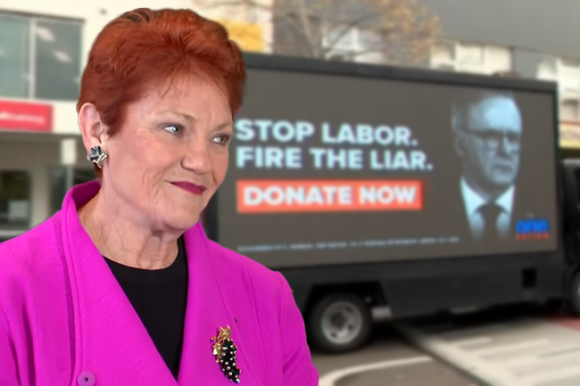
I favour a more complex explanation, one that stems from my Marxist class analysis of journalism and the news industry. The short version is that journalists are the popularisers and disseminators of ruling-class ideas (the hegemonic ideology). In this role as “organic” ruling class intellectuals, journalists adopt the political ideas of the capitalists as their own.
In terms of Hanson, this means something like the following:
The Australian ruling class wants a political option that is not the Labor Party, but it also recognises that the traditional custodians of ruling class interests – the Liberal-National Coalition – has run out of ideas and is no longer popular. It is unlikely that there will ever be another Liberal-National government in Australia.
Therefore, the ruling class needs another political champion and they may have found it in Pauline Hanson. Hanson is a populist demagogue who preaches fear, fire and brimstone. Hanson has no policies, but that doesn’t matter. With Gina Rinehart’s money, One Nation can buy-in policy expertise and shape some ideas into plausible policy documents.
The press gallery and the National Press Club, as the leading intellects of Australian journalism, understand their role is not to question authority and speak truth to power, but to do the bidding of the ruling class.
The ruling class needs Hanson and the press gang will deliver her.
Dr Martin Hirst is a journalist, author and academic. You can follow him on Twitter @ethicalmartini.
 This work is licensed under a Creative Commons Attribution-NonCommercial-NoDerivs 3.0 Australia License
Support independent journalism Subscribe to IA.


Related Articles
- Why Pauline Hanson’s small business message falls flat
- What Hanson should be asked at the National Press Club
- A day in the life of Pauline Hanson
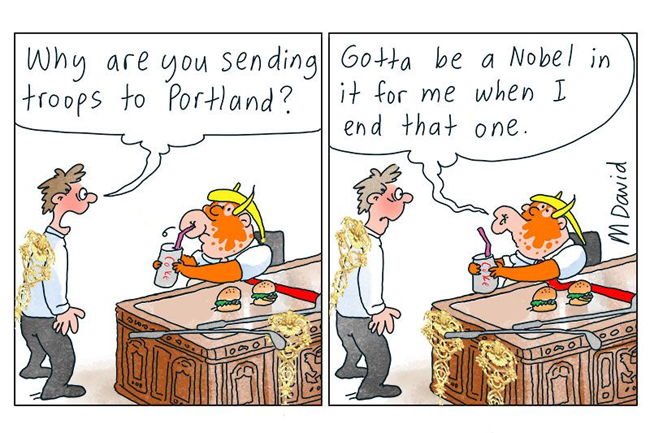
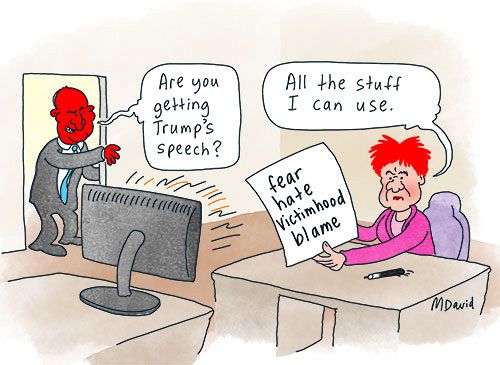
- CARTOONS: Pauline Hanson is gaga for Trump and MAGA
- EXCLUSIVE: Meta and Murdoch make AI pact and push Pauline's polls