Australia’s migration numbers are falling, but the major parties’ competing targets reveal a widening gap between political promises and policy reality. Dr Abul Rizvi writes.
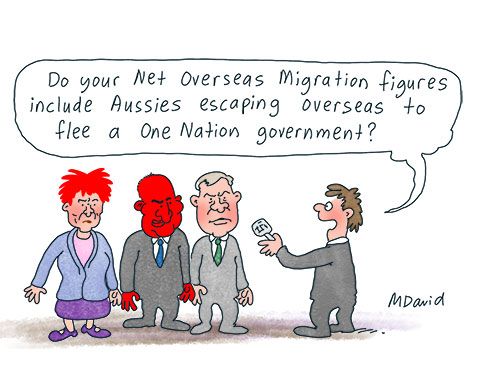
WITH LABOR, the Coalition and One Nation all now publicly committed to their respective Net Overseas Migration (NOM) targets, how NOM is tracking will be a point of much public debate.
While the Coalition and One Nation can get away with pretending their currently announced policies will enable them to reduce NOM to their respective targets (they won’t come close), the Government does not have that luxury.
After three years of the NOM outcome significantly overshooting Treasury forecasts, the Government has at last started treating those forecasts as targets (better late than never). That was desperately needed for reinstating public confidence in the Government’s ability to manage immigration.
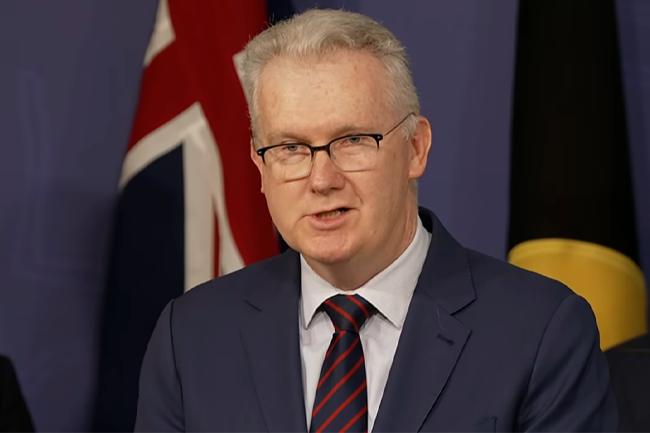
In December 2026, the Australian Bureau of Statistics (ABS) will publish its preliminary estimate of NOM for 2025-26. That is likely to show that the NOM outcome was below the final Treasury forecast. An outcome of around 285,000 compared to a final forecast of 295,000 is likely, according to Immigration Minister Tony Burke.
The data suggests that is plausible, unlike much of the rubbish published by the Institute of Public Affairs (IPA) and its acolytes in the Murdoch press as well as various shock jocks who, using net permanent and long-term movements data, tried to suggest a NOM outcome in 2025-26 of around 470,000. The Liberal Party went along with that myth-making.
Growth in the stock of temporary entrants in Australia to end September 2026 has slowed significantly, particularly for students where the stock is now falling (see Table 1). Students are the key driver of long-term changes in the stock of temporary entrants.
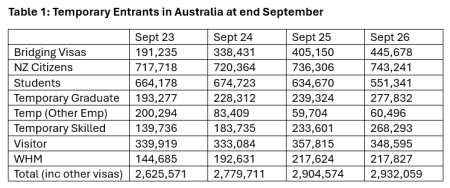
The growth in temporary entrants in Australia slowed markedly in the last 12 months (around 28,000) compared with the two previous 12-month periods (125,000 and 155,000 respectively). A clear sign that NOM is falling.
Trends in key temporary entry groups are:
- Bridging visa stocks continue to rise. While these will fall in the December quarter, the Government will be hoping that the usual rebound in the March quarter is smaller than in recent March quarters due to the recent tightening of onshore visa policy.
- New Zealand citizen stocks continue to grow due to Australia’s relatively stronger labour market, higher pay rates and streamlined access to Australian citizenship since 2023.
- Student stocks are now over 100,000 down from the peaks in 2023-24 and even below the level pre-COVID. Given the further policy tightening recently announced and high refusal rates, that trend will continue into 2027.
- Temporary graduate stocks continue to grow despite many temporary graduates securing skilled temporary visas as well as permanent residence. The change in policy preventing certain temporary graduates from including partners/dependent children with temporary graduate visa applications may slow this trend, but I suspect the Government may tighten policy further.
- Temporary Skilled visa stocks also continue to rise. There are not enough places in the permanent skilled program to accommodate demand from this group plus temporary graduates. The Government may not act on this, given Coalition policy is to accelerate growth in this visa very significantly.
- Growth in Working Holiday Maker stocks has plateaued and will fall as tighter policy for WHMs seeking second and third visas starts to take effect and the labour market weakens.
While the changes made to WHM policy will bring down the contribution to NOM of these visas from the 53,000 in 2024-25, possibly by around 20,000 in a full year if the labour market continues to weaken, it is the changes to student visa policy that will be the big driver of the reduction in NOM promised by the Government.
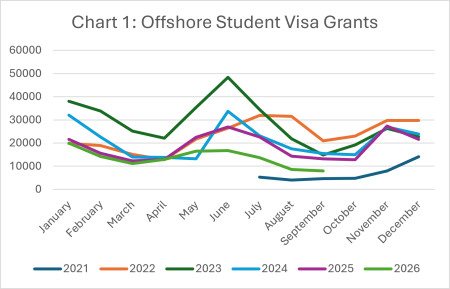
Since November 2025, the Government has significantly ramped up offshore student refusal rates, leading to offshore student visa grants falling to levels only slightly above that in 2021 (during COVID) and prior to that to levels not seen since 2012. Offshore student visa grants have fallen from 342,237 in 2023; 251,318 in 2024; and 223,987 in 2025. These are likely to fall again in 2026 to around 170,000 to 180,000, assuming between 50,000 and 60,000 offshore student visa grants in the December quarter of 2026.
Onshore student visa grants will fall sharply from 2027. Onshore student visa grants have been averaging around 10,000 per month in recent years, with the onshore student backlog at both primary and review levels building up significantly (see Chart 2).
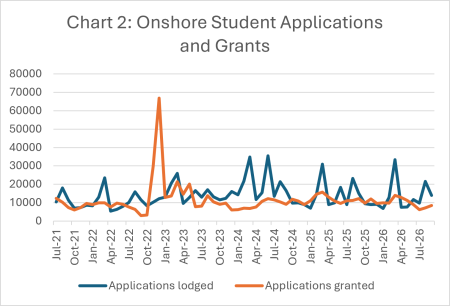
It will take time to reduce the onshore student application backlog, but the policy changes recently announced will deliver that, including eventually reducing the large student refusal backlog at the Administrative Review Tribunal (the worry will be what happens to the asylum application rate).
Due to the high offshore student refusal rate and a further increase in student departures, the student contribution to NOM in 2025-26 may have fallen to around 80,000 compared with 108,000 in 2024-25. On currently announced policy settings, this will fall further in 2026-27 and 2027-28.
In some ways, Labor’s policy on students is now more restrictive than that announced recently by the Coalition, which maintains it has a target of 240,000 new student commencements each year. Labor still pretends to have a new student commencements planning level of 295,000 per annum. It has no intention of delivering that planning level as it would be inconsistent with its NOM target.
Labor’s policy will still deliver an annual student visa outcome above One Nation’s cap of 115,000 student visas per annum. However, One Nation’s annual student visa cap and its much more generous working holiday maker policy have to fit within a NOM target of below zero for three years in a row rather than within Labor’s NOM target of 225,000 per annum.
But One Nation’s negative NOM target was always just political propaganda for its core followers, who won’t be at all fussed about the policy detail as long as they hear the words negative NOM.
Dr Abul Rizvi is an Independent Australia columnist and former Deputy Secretary of the Department of Immigration. You can follow Abul on Twitter @RizviAbul or Bluesky @abulrizvi.bsky.social.
 This work is licensed under a Creative Commons Attribution-NonCommercial-NoDerivs 3.0 Australia License
Support independent journalism Subscribe to IA.


Related Articles
- Student visa crackdown puts international students and families in limbo
- NSW DAMA to test One Nation and the Coalition
- Coalition and One Nation migration plans built on false assumptions
- Coalition boxed in by working holiday visa policy
- Monty Python homage: What have migrants ever done for us?