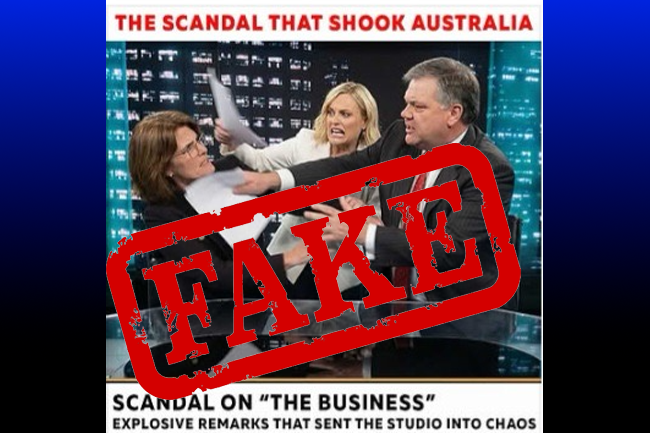
IA’s star economist Stephen Koukoulas explains how, despite being the fourth most impersonated person in Australia, Meta refuses to take down damaging fake AI Facebook videos of him, despite his appeals.
This is the third part of an eye-opening Independent Australia investigation. Before Stephen completes the trilogy further down, Independent Australia gives a bit of the backstory. (Read Part One and Part Two for more.)
IA: WHY KOUKOULAS’ STORY IS SO IMPORTANT... AND DISTURBING!
Artificial intelligence is fast becoming the most important and lucrative technological development of our times. As the value of these tech tools skyrockets and their uses, many worthy and beneficial, reach into almost every corner of our society, misgivings are just as quickly multiplying.
The well-documented dangers range from existential doom, such as malevolent computer minds turning upon their creators; to authors and artists having their intellectual property expropriated; to students using it to write their essays; to film and images being so perfectly fabricated that it is next to impossible to distinguish the real from what is not.
It is this last issue, specifically the use of AI to generate footage to provide a guise of authenticity to fake news stories, that this news publication has found most concerning today. Because the spread of fake news means the public can be manipulated to accept a version of reality that is, literally, not real. And when people can't agree on what is true and what is bogus, bad actors can spread misinformation more easily for their own ends. These might be financial gain, such as scamming consumers, or for other even more malign purposes, such as subverting democracy and stealing elections.
The subversion of democracy by spreading fake news using technology is not a theoretical danger and is not even a purely post-AI phenomenon. Notoriously, in 2016, Russian bot factories spread such a torrent of targeted fake news into specific American Facebook users’ accounts that it secured Donald Trump’s presidential victory despite him not winning the popular vote. It did this by Facebook assisting these bot programmers by providing them with detailed user data – likes, dislikes, preferences, demographic details and so on – such that enough voters in swing states were tricked into turning to Trump.
After that election upset, investigative journalists exposed the tech company behind this brazen scam, Cambridge Analytica, as well as Facebook's shady role. It caused a worldwide furore, leading to Facebook founder and CEO Mark Zuckerberg fronting angry U.S. legislators to answer for the actions of his firm. Initially defiant under interrogation, a more repentant Zuckerberg was later reported as admitting fake news stories were a problem on Facebook. To rectify the problem, he reportedly promised to add a stringent reporting process to his platform to weed out the fakes.
It didn’t. At least not in Australia, as IA was the first to reveal.
Firstly, in a groundbreaking exposé in February 2026 by Dan Jensen, IA’s digital editor. Jensen revealed that AI-generated images had been used to support an article documenting an ABC studio interview involving Pauline Hanson and Prime Minister Anthony Albanese — that never happened. It appeared as a sponsored (paid to Facebook) post promoting an article under the ABC logo, which was attributed to the ABC, but which the ABC never produced, let alone endorsed.
Then the following month, IA founder Dave Donovan revealed Facebook had been up to its old tricks, allowing bot farms to place a mountain of misleading News Corp articles into unsuspecting users’ feeds to promote Pauline Hanson’s One Nation party.
Donovan further followed up Jensen’s investigation to reveal he had used Facebook’s reporting process to alert them about the AI-assisted fake news article concerning Hanson, Albanese and the ABC, only for the social media giant to refuse to take any action. Facebook told IA they had found insufficient evidence to determine if the article was, in fact, fake news — despite Donovan providing abundant categorical and irrefutable evidence it was.
So in case you were wondering about the inexplicable sudden popularity of Pauline Hanson and her One Nation party, this sort of chicanery by Facebook, and other parties, may in no small part provide your explanation.
Independent Australia can now provide perhaps the most damning proof of the chicanery and bad faith of Meta, the owner of Facebook.
The following is the verbatim account of Independent Australia’s high-profile economics correspondent Stephen Koukoulas, who was economics advisor to Kevin Rudd during the period when that Prime Minister saved Australia from the GFC. This towering figure explains how, after being informed by ASIC that he was the fourth most spoofed person on Facebook in Australia, after he reported that he was being impersonated in a fake news story on their platform, they again refused to take any action.
Which reveals, alarmingly, that even if you are a highly prominent and influential victim of an AI deepfake scam, Meta may still refuse to remove the fake news story.
Sayonara facts, hasta la vista reality, the oligarchs are now in charge.
And now for Stephen Koukoulas' true story, in his own words:
KOUKOULAS: META WON’T STOP PUBLISHING DEEPFAKES OF ME…
… OR TAKE THEM DOWN
It was a shock when I first discovered that someone had made a deepfake video of me for the purpose of “marketing” a share trading scheme.
Initially, the shock was partly humorous, somewhat benign, perversely flattering — me!
But shortly after that initial surprise, I started getting messages from strangers on my social media pages and email. One prominent person called to ask if it was fake after hearing that a friend of theirs had sunk and lost some money in the sham.
Some were checking to see if it was a real scheme that involved me; others were asking how they could get their money back, having been told by the organisers that all of the money invested had been lost.
This was deeply worrying.
In the interim, I had contacted Scamwatch to see what I could do, worried about the potential damage to my reputation as an economist and fearing that innocent people would lose money to the shysters and criminals using my good name.
The best thing I could do, they said, was to highlight the scams to as many people as possible. Repeat the warnings regularly and hope that the scammer would go away.
I had already done this, but ramped up the warnings to my social media followers. This generated more feedback from some tempted by the scheme, which was encouraging.
It was around this time that I learnt others in the financial community had suffered similar experiences to me. The likes of Saul Eslake, Alan Kohler, Tom Pitrowski and Alan Oster had their identities faked and used by fraudsters to sell investment plans to an unsuspecting public.
They had advertised the fact to their followers on various social media platforms.
After my social media posts highlighting the presence of the fraudsters, I was contacted by ASIC, who were concerned that these schemes were becoming more frequent, more sophisticated and more successful in scamming people out of their money.
After several conversations with them in the weeks ahead, ASIC reported back, saying that a large part of the solution to this fraud would be for the platforms being used to promote such schemes, especially Meta, to take down the offending material. Even better if they could look into the people who set up the fake accounts with them.
Meta, which was the platform where the vast bulk of the WhatsApp messages used by the fraudsters were carried, informed ASIC they would not delete the fakes. And that nor would they use their internal information on these fraudulent accounts to try to track down the criminals involved.
Afterwards, I heard that Meta had issued similarly disappointing responses to others caught up in such scams.
I understand that Meta benefits financially from these sorts of fraudulent accounts, particularly when they build up followers and activity, a view shared by astute finacial reporter Michael Pascoe:
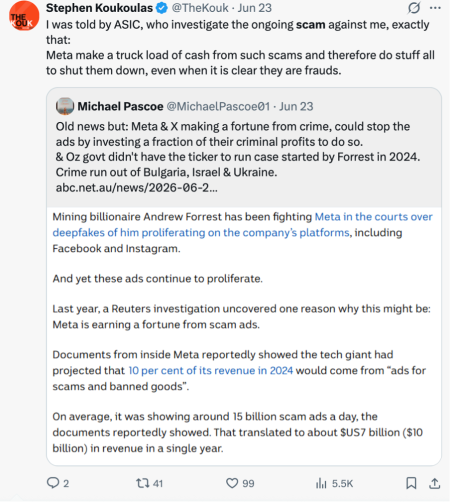
In a recent press release, warning the public of the increasing prevalence of scams such as mine, ASIC stated it had somehow removed 19,400 fake news articles, though the powers it used to do so, other than simply pressuring the parties it managed to identify, are not apparent. In any case, mine was not among them and nor were, presumably, most other victims of Facebook fakes, given Meta’s intransigence in identifying the perpetrators.
A solution?
Regulations forcing the owners of the platforms to take down fraudulent posts / closing their accounts seem the simplest solution. Meta would therefore be legally obligated to reveal the identity of the fraudster and remove the post after the victim – in this case, me – reported the impersonation scam.
It sounds simple — obvious, even. But Meta is now so titanic, it acts almost as if it is a law unto itself. We shall see.
This editorial was originally published as part of the Independent Australia weekly newsletter. Subscribe to IA to access all our work from as little as $1.15 per week and help power our journalism in 2026.
Stephen Koukoulas is one of Australia’s most respected economists, a past chief economist of Citibank and senior economic advisor to an Australian Prime Minister. You can follow Stephen on Twitter/X @TheKouk and on Bluesky @thekouk.bsky.social.
 This work is licensed under a Creative Commons Attribution-NonCommercial-NoDerivs 3.0 Australia License
Support independent journalism Subscribe to IA.