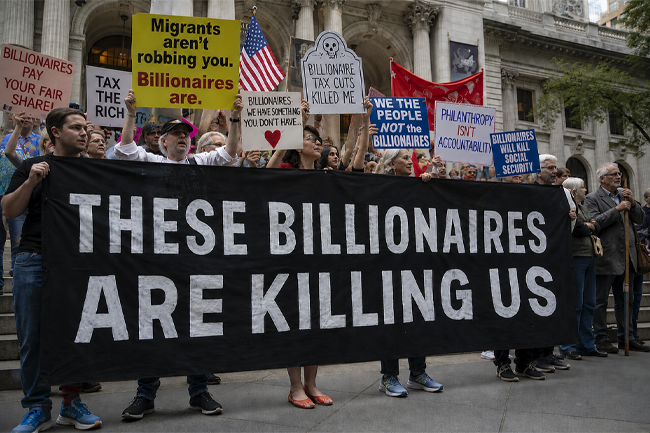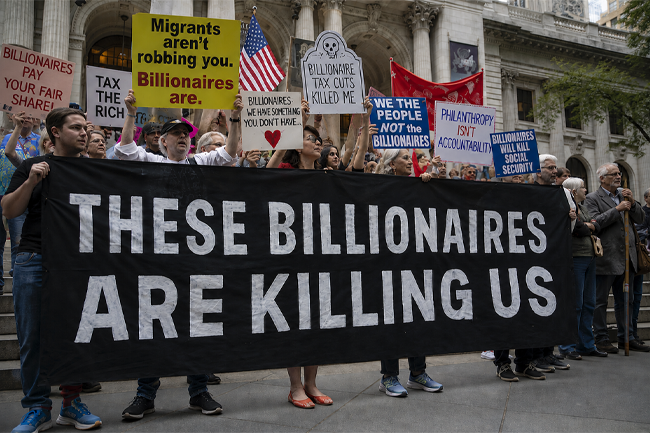
The billionaire class is retreating behind bunkers, philanthropy and PR as the social order that created its obscene wealth begins to fracture, writes Dr James Schuurmans-Stekhoven.
FOR DECADES, the ultra-wealthy have confidently commanded that we believe in the comforting (for them) fairytale of meritocracy — the notion that a billionaire is simply someone who worked a million times harder than a nurse, a teacher, or a cleaner.
Yet, if you spend even a casual afternoon reviewing the architectural, media and psychological footprints of the actions of the global “elite” over the past 40 years, a profoundly different narrative emerges.
They are not the self-assured and serene masters of human destiny that they pretend to be. They are terrified.
Beneath the sleek veneer of Davos panels, private space programs and meticulously scrubbed digital footprints lies an acute, grinding panic: the terrifying realisation that the rest of us have figured them out. They know that we know.
The architecture of paranoia
When any demographic becomes so profoundly detached from the foundational constraints of social reality, they no longer build monuments to their community; they build escape hatches. As cultural commentators and investigative journalists have exhaustively documented, the trend of luxury doomsday prepping among tech titans and hedge fund managers has transformed from a quirky fringe hobby into a multi-billion-dollar panic room industry.
Consider The Guardian’s deep dive into Silicon Valley survivalism, which revealed how elites treat New Zealand lifestyle blocks and subterranean bunkers as existential lifeboats. Media theorist Douglas Rushkoff famously detailed how these magnates sit in high-security compounds asking variations of a deeply telling question: ‘How do I maintain authority over my security force after the event?’
It is a masterclass in psychological projection. They assume that because their entire lifestyle rests on the extraction of public value and the abuse of workers, any future collapse must inevitably involve the rest of us coming for their canned goods with pitchforks.
The philanthropic shield and neo-feudal indulgences
Of course, before these bunkers there are the PR teams. Over the last 30 years, as wealth concentration has exploded to neo-feudal proportions, we have witnessed a miraculous metamorphosis: the billionaire “giving pledge”.
Let us call this what it actually is: the modern-day equivalent to indulgence-buying. Much like the medieval Catholic Church selling pardons to clear a path through purgatory, today’s mega-philanthropists pour billions into private foundations, climate initiatives and vanity space races not out of pure altruism, but as a psychological hedge against the guillotine.
They are deliberately buying community goodwill to absolve themselves from what sociologist Paul Piff’s socioeconomic research demonstrates — the steady erosion of empathy and perspective-taking due to extreme accumulation.
When your daily feedback loop consists entirely of sycophants and yes-men, your moral compass inevitably defaults to such Machiavellian utilitarianism. You view human beings purely as instrumental variables.
The frantic rebranding of billionaires as “saviours of humanity” via Mars colonisation or artificial intelligence singularity is a textbook defence mechanism – specifically, it’s a reaction formation designed to quiet the nagging, midnight realisation that no one is buying their tired old “job creators” spiel – certainly not in the era of data centres, large-language models and generative AI.
People are increasingly recognising these uber-meisters for the clear and present danger that they are: systemic parasites denuding the environment and bleeding the public coffers dry (not to mention demanding bail-outs when the supposedly infallible market fails).
Epistemic hubris and the erasure of trace
Another glaring “tell” of elite panic is the obsessive scrubbing of personal footprints. Try finding a residential record, an untracked superyacht, or an unmanaged Google search result for a multi-billionaire today. Entire legal and public relations firms exist solely to bury critical coverage, weaponise non-disclosure agreements and threaten defamation lawsuits against anyone daring to suggest, just maybe, the emperor has no clothes.
This hyper-fixation on digital and physical invisibility is driven by persecutory anxiety. When you require a private intelligence agency to monitor online sentiment and social media threats against your family, the pretence of carefree confidence evaporates.
Compounding this is epistemic hubris — the dangerous delusion that financial triumph translates into universal competence. Whether it is tech founders attempting to redesign public education, media platforms, or public health architectures overnight, their interventions scream of a class terrified that if they stop dictating the terms of reality, someone might notice they have no actual domain expertise whatsoever.
The game is up
The psychological trajectory of the ultra-rich over the past 40 years has traced a very clear and steady arc from the unapologetic, cocaine-fueled hubris of 1980s corporate raiders to today’s deeply anxious, bunker-hiding, reputation-scrubbed fragility.
They know the social contract is broken because they broke it. They know we see them. And no amount of PR spin, messianic foundation work, or deep-earth concrete bunker can shield them from the most terrifying reality of all: history has always found a way to eventually balance the books.
Dr James Schuurmans-Stekhoven has a career defined by high-level academic rigour, a polymathic approach to research and a commitment to strategic optimisation across multiple disciplines.
 This work is licensed under a Creative Commons Attribution-NonCommercial-NoDerivs 3.0 Australia License
Support independent journalism Subscribe to IA.