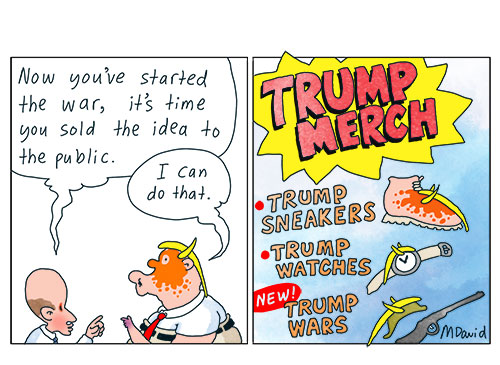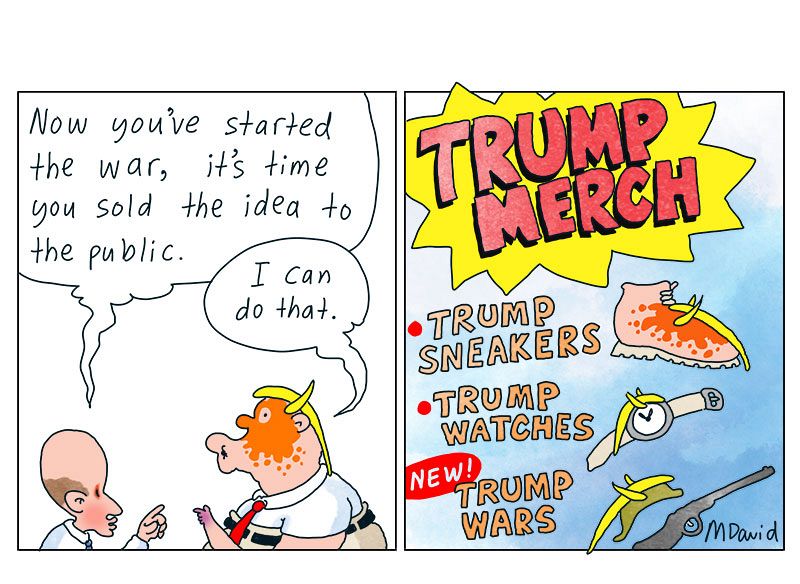
The Iran war has generated billions in energy-sector gains, raising difficult questions about political finance, wartime decision-making and conflicts of interest, writes Amir Naser Hojati.
WHEN Senator Elizabeth Warren accused Donald Trump of presiding over a war with Iran while oil companies earned windfall profits, the easiest response was to ask whether she had proved corruption.
She had not.
The publicly available evidence does not establish that oil-industry campaign contributions caused the United States to enter the conflict, or that energy companies bought military policy. But that is not the only question worth asking.
The war has generated substantial gains for parts of the energy and refining industries. Some important industry figures and companies had previously supported Trump politically. At the same time, the conflict has had major consequences for oil and fuel prices, refining margins, freight costs and household energy bills.
That does not prove a conspiracy. It does create a legitimate conflict-of-interest question.
A chokepoint becomes an economic shock
The economic story starts with the Strait of Hormuz. Before the conflict, about 20.9 million barrels of oil per day moved through the strait — roughly one-fifth of global petroleum-liquids consumption.
Saudi Arabia and the United Arab Emirates together had only about 4.7 million barrels per day of available pipeline capacity capable of bypassing it.
That imbalance explains why disruption matters so quickly. By the second quarter of 2026, oil flows through Hormuz had fallen to 4.9 million barrels per day on average, according to the U.S. Energy Information Administration (EIA).
The consequences spread far beyond crude oil. Higher fuel and transport costs reach airlines, manufacturers, retailers and households. Reuters has reported that the Iran war drove higher transport fuel surcharges in the United States and produced additional profits for some carriers as well.
War inflation rarely arrives with the word “war” printed on the receipt.

The corporate results are difficult to ignore
Second-quarter earnings show how dramatically the economics of energy changed.
ExxonMobil reported earnings of $14.5 billion, compared with $7.1 billion a year earlier. Its filing says higher crude realisations increased upstream earnings by $4.65 billion, although Middle East disruption simultaneously reduced earnings by about $1.06 billion.
Chevron reported $12.1 billion in quarterly earnings. ConocoPhillips earned $3.9 billion, compared with $2 billion a year earlier. Occidental reported $2.8 billion in net income attributable to common stockholders and said higher realised crude prices were a major driver of improved oil-and-gas earnings.
The refiners show the effect even more clearly. Marathon Petroleum earned $5.1 billion, up from $1.2 billion a year earlier, while its refining and marketing margin rose from $17.58 to $36.33 per barrel. Valero reported $3.7 billion in quarterly net income, compared with $714 million a year earlier. Phillips 66 reported $3.8 billion in earnings and more than $3 billion in refining pre-tax income.
These numbers need careful interpretation. No quarterly result can be attributed to one geopolitical event alone. Production, acquisitions, maintenance, operating costs and company-specific factors all matter.
But it is equally difficult to argue that a severe energy shock had nothing to do with the profitability of businesses whose margins are directly exposed to crude prices, product scarcity and refining spreads.
Profit is evidence of economic consequence. It is not evidence of political causation.

Then comes the political money
The governance question becomes more uncomfortable when financial beneficiaries also have established links to political power.
During the 2024 campaign, Trump sought oil-industry support while promising a more favourable policy environment for fossil-fuel development.
One documented example is Continental Resources. Congressional investigators noted that the company contributed $1 million to Make America Great Again Inc., a super PAC supporting Trump, and that founder Harold Hamm was a significant Trump supporter.
More controversially, House Democrats investigated reports that Trump asked oil executives to raise $1 billion for his campaign while discussing regulatory and energy policies favourable to the industry.
Those facts do not establish that later military decisions were purchased. Political donors routinely support candidates whose policy preferences align with their commercial interests.
But military conflict is not an ordinary regulatory dispute. A decision capable of moving global commodity prices can transfer billions of dollars among companies, governments and consumers in a matter of weeks.
The strongest counterargument
Any serious analysis should also acknowledge evidence that complicates a simple “war for oil profits” narrative.
Trump has publicly criticised oil companies over high profits and has pushed refiners and retailers to help lower pump prices. Higher petrol prices are politically damaging: they reduce household purchasing power, feed inflation and give voters an immediate measure of economic pain.
Oil companies have not benefited uniformly either. Exxon is a useful example: higher crude prices increased upstream earnings, while Middle East disruptions reduced them by more than $1 billion.
These facts weaken the argument that the conflict was launched or prolonged simply to enrich the energy industry.
They do not eliminate the governance issue.
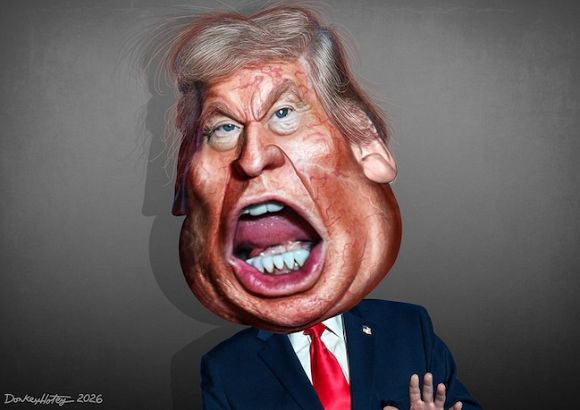
Conflict of interest is not the same as corruption
Political debate often treats the issue as binary: either corruption can be proved, or there is supposedly nothing to investigate.
That is the wrong standard.
Conflict-of-interest safeguards exist precisely because democratic systems should not wait for proof of a corrupt transaction before reducing incentives – or appearances – that could undermine confidence in public decisions.
By July, the Pentagon said the Iran war had cost the United States $37.5 billion, including projected expenses through September. Consumers were also paying more for fuel, while parts of the energy, refining and transport sectors were reporting exceptional results.
The relevant question is therefore not whether an oil company “bought a war”. There is no evidence sufficient to establish that claim.
The better question is whether institutional barriers are strong enough when industries that can gain from government decisions are also important political financiers.
Three safeguards worth considering
Three reforms could reduce the appearance of conflict without assuming wrongdoing.
First, governments could require faster disclosure of meetings between senior national-security officials and major donors from industries materially affected by an ongoing conflict.
Second, presidents and other senior decision-makers could be required to divest individual corporate securities or place assets in genuinely independent blind trusts.
Third, significant lobbying expenditure and political contributions from industries receiving extraordinary wartime gains could be disclosed on an accelerated timetable during military emergencies.
None of these measures assumes corruption. That is their advantage. Good institutional design reduces the need to guess at private motives.
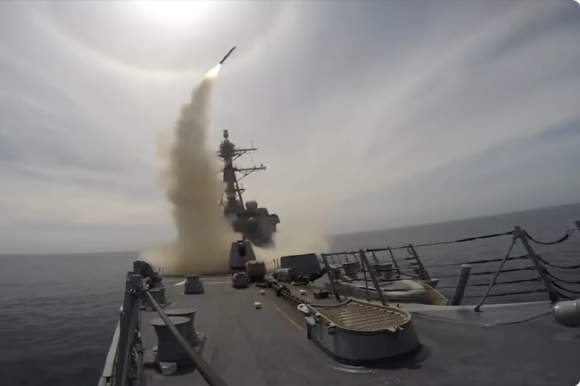
Follow the incentives
Warren’s allegation attracts attention because it is dramatic. The underlying economic issue matters because it is structural.
The Iran conflict has redistributed large amounts of money. Consumers and governments have absorbed higher costs, while parts of the energy, refining and transport sectors have captured substantial gains. Some people and companies in those sectors also helped finance the political movement now controlling the White House.
That does not demonstrate that the war was undertaken for their benefit.
But democracies should not require proof of conspiracy before asking whether the boundaries between political finance, private wealth and public power are strong enough.
Markets will continue to price war. Democratic institutions should ensure that political power cannot be priced quite so easily.
Amir Naser Hojati is a futures trader and fintech entrepreneur. He writes about market structure, financial risk, algorithmic trading and the economic impact of geopolitical events.
 This work is licensed under a Creative Commons Attribution-NonCommercial-NoDerivs 3.0 Australia License
Support independent journalism Subscribe to IA.


Related Articles
- U.S. arsenal stretched as Australia weighs alliance risks
- The strait of human life: When oil matters more than children
- Epic Fury, strategic failure: America’s Iran debacle
- The Iran nuclear lie and the warning signs Australia must not ignore
- America’s Iran war for oil signals environmental disaster