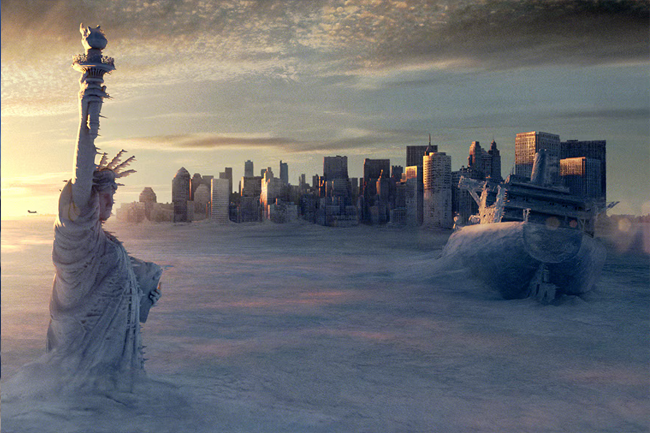
Twenty-two years ago, a film about catastrophic climate change created a stir. Its message is now more compelling than ever, writes Jeff Peck.
IN THE 2004 MOVIE The Day After Tomorrow, paleoclimatologist Jack Hall, played by Dennis Quaid, warns a United Nations conference that his research indicates that continued warming of the planet due to the burning of fossil fuels could, paradoxically, lead to a new ice age.
This is something, Hall explains, that happened around 10,000 years ago when there was an abrupt collapse of the Atlantic meridional overturning current, or AMOC, the ocean circulation that keeps the climate temperate in Europe and North America. While he estimates a new collapse is unlikely to occur for hundreds or even thousands of years, the climate is fragile and action to reduce carbon emissions should be undertaken at once.
The American Vice President, who’s also present at the conference (and bears a striking resemblance to Dick Cheney, the actual Vice President at the time), dismisses the warning. The costs of such action would pose the much more immediate threat of world economic collapse.
Soon after, however, it becomes clear that catastrophic climate change is happening far more quickly than predicted.
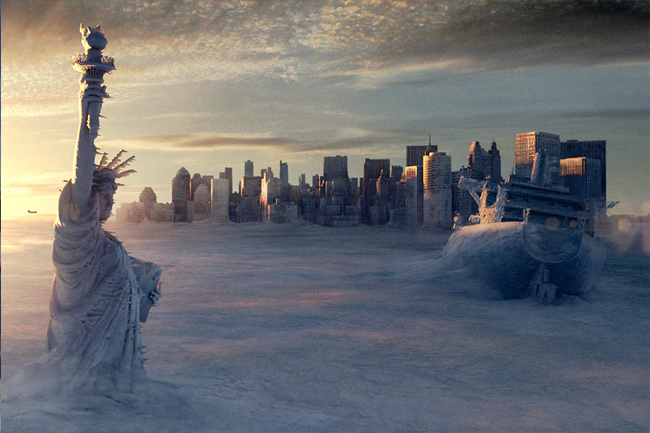
Research buoys in the North Atlantic show an alarming drop in temperature, while at the same time freak blizzards break out in India; massive hailstones wreak havoc in Tokyo; swarms of monster tornadoes rip through Los Angeles; sea levels rise in a tsunami-like wave that floods New York City; and, ultimately, as three continent-wide superstorms form around the planet, the entire northern hemisphere descends into a new ice age.
As Americans flee across the Rio Grande to become climate refugees in Mexico, our hero travels by snowshoe across a frozen landscape from Washington to Manhattan to rescue his son, who has been trapped there by the deadly cold, snow and ice.
As an action-adventure, the film was a runaway success, with the box office topping $550 million (almost $1 billion today). The scientific community, however, was not impressed. The scenario was roundly criticised as being exaggerated at best and ridiculous at worst. One review argued that what happens in the film ‘violates every known law of thermodynamics’.
Climate change is incremental and the AMOC simply cannot collapse that fast; storms of the scale and severity shown in the movie are physically impossible; sea levels rise by the millimetre, not in great waves; a change in Atlantic currents might alter the climate in parts of the northern hemisphere but would not produce an ice age.
That was in 2004. Now, 22 years later, let’s look back at that scenario and see just how unrealistic it was.
In 2008, four years after the film was released, the term “tipping point” began to be applied to the study of climate change. Scientists had determined that global warming could trigger abrupt and irreversible planetary changes. Even small changes could push elements of the ecosystem beyond a threshold after which a rapid breakdown would occur.
Further, one tipping point being crossed could create a domino effect, leading other elements of the ecosystem to cross their tipping points, potentially leading to widespread and catastrophic climate change.
Studies have shown that the AMOC is already slowing and at a rate faster than previously predicted, raising the possibility that it could reach a tipping point as early as 2060, after which it could go into a steep decline and stop entirely by the end of the century. This is, of course, a far longer timeframe than the few days depicted in the movie, but it’s also much shorter than models predicted in 2004.
So, while the movie’s scenario is exaggerated for dramatic effect, it’s less exaggerated than scientists thought at the time.
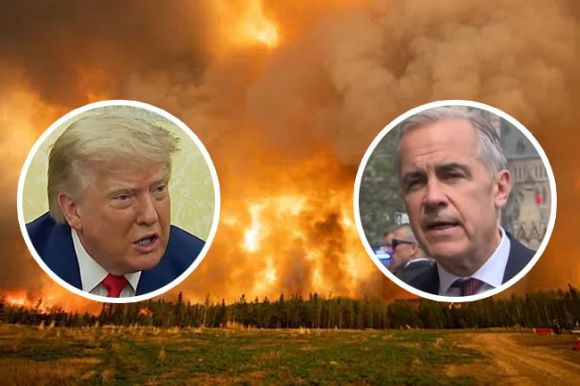
But what about the freak blizzards, monster hail, tornadoes, flooding and superstorms? In January of this year, temperatures in northern India dipped to 34 degrees Fahrenheit. Delhi was colder than some Himalayan hill stations. In 2021, hailstones up to 16 centimetres pummeled northern Queensland, shattering windscreens and destroying roofs and crops. On a single day in June, a record swarm of 52 tornadoes swept across the American Midwest, causing widespread destruction.
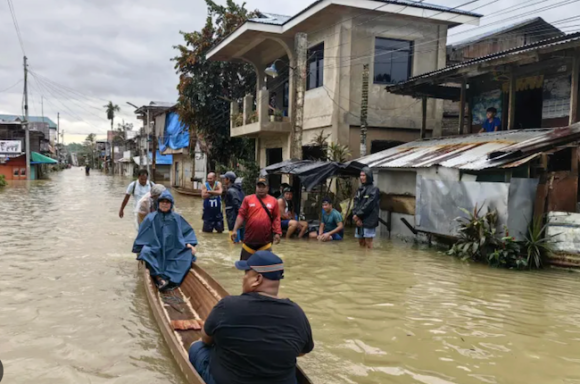
As for flooding, New York City isn’t going to be hit by a huge wave of water surging down Fifth Avenue, but it is facing more floods more often due to global warming — sea level rise resulting from the melting of glaciers and the Greenland ice sheet; “thermal expansion” of the ocean as it absorbs heat; the build-up of water along the eastern seaboard due to changes in ocean circulation patterns; increased rainfall as a result of a warmer atmosphere holding more water; and greater storm surges from more powerful storms.
The city has experienced catastrophic floods at least three times in the last 15 years, flooding subway stations and causing billions of dollars in damage.
Continent-spanning superstorms haven’t developed yet but, due to climate change, tropical cyclones are getting bigger and stronger, faster. And with ocean temperatures this summer reaching a level not seen for 12,000 years, we can expect that trend to continue, with some climatologists suggesting that we’re now at the point of needing a new category beyond Category 5 to cover storms with wind speeds in excess of a terrifying 311 kilometres per hour.
But could global warming plunge New York and much of the U.S. into a new Ice Age? The consensus now is that global warming can, indeed, lead to much colder temperatures, especially in certain areas, including Europe and North America. In some models of AMOC collapse, major cooling could occur, similar to the “Little Ice Age”, which lasted from the 14th to the mid-19th Centuries.
In the winter of 1779-80, in the midst of this period, the Hudson and East rivers froze up to 18 feet thick and ships in New York Harbour became ice-bound for weeks. It was possible to walk on the ice from Manhattan to Staten Island.
So, as a recent report put it:
‘While the notion of a new Little Ice Age may seem far-fetched given the current trends of global warming, it is not entirely out of the realm of possibility.’
It’s important to add:
‘What happens in the North Atlantic doesn’t stay there. It ripples through the atmosphere and oceans, with far-reaching consequences.’
Studies have shown that AMOC collapse would cause northern Australia to become cooler and wetter, leading to more and greater flooding. In contrast, the south of the country would become hotter and drier, causing more frequent and longer droughts, as well as more devastating bushfires.
But that would be the least of it. More impactful would be the disruption to the world order. A shutdown of the AMOC would cause widespread crop failures, starvation and uncontrolled mass migration. Political upheaval, war and economic collapse would follow and affect every corner of the globe.
Today, most climate scientists are willing to accept the exaggerations in The Day After Tomorrow as a kind of poetry for climate change. It’s not science fact, but it raises awareness of real shifts in the climate that we are now seeing all around us, as planetary warming and its sequelae break records and reveal unexpected new dangers on an almost daily basis.
At the end of The Day After Tomorrow, the Vice President – now President due to his predecessor’s motorcade failing to outrun the cold – is forced to admit from his haven in Mexico City that he was wrong to ignore the perils of unbridled exploitation of Earth’s resources. In the real world, it’s clear that the current American Administration is never going to be similarly enlightened and take steps to address the climate crisis.
But we can — by creating a tipping point in public concern and concerted action. Support climate-friendly candidates for office; write letters to your representatives in federal, state and local government; join and/or donate to climate action organisations; attend peaceful demonstrations calling for climate action or protests against developments that harm the environment; minimise your personal carbon footprint; organise a group screening of The Day After Tomorrow, with a discussion to follow; and much, much more.
As Sir David Attenborough said at the COP24 climate conference:
“We are facing a man-made disaster of global scale... If we don't take action, the collapse of our civilisations and the extinction of much of the natural world is on the horizon.”
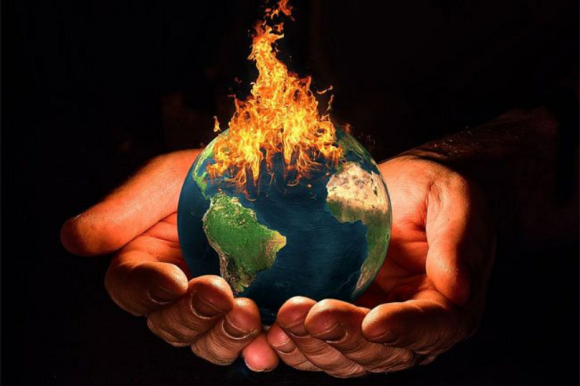
“I want you to act as if our house is on fire. Because it is.”
Jeff Peck is a former lecturer in film history at La Trobe University.
 This work is licensed under a Creative Commons Attribution-NonCommercial-NoDerivs 3.0 Australia License
Support independent journalism Subscribe to IA.


Related Articles
- Climate catastrophe risks pushing humanity towards collapse
- The climate crisis behind Australia's migration panic
- The carbon capture con keeping fossil fuels alive
- Arming for extinction: The climate cost of militarism
- Australia’s environmental crisis ignored as political parties drift Right