Australian people teams sign up to Rippling for the all-in-one promise: one login covering HR, IT, payroll and spend.
A few months in, two things tend to surface. The bill creeps up each time another module gets switched on and the platform's centre of gravity sits in IT and device management rather than the daily work of an HR team.
That pairing is why local HR leaders start pricing up Rippling alternatives. Most published lists, though, are written for a U.S. or global reader, so they skip what matters here, such as Single Touch Payroll Phase 2 (STP2) reporting and the Australian-built vendors that handle it. The shortlist below is scoped for Australian companies. It ranks eleven Rippling alternatives, sets the global platforms next to the local incumbents and flags where each one lands on Australian payroll and compliance.
Why Australian teams are outgrowing Rippling
Rippling earns its reputation on breadth. One system connects HR, payroll, IT provisioning, app access, device management and spend and for a company that wants to fold all of that into a single database, the appeal is real. The product also reviews well on usability, holding a G2 rating of 4.8 out of 5 based on more than 12,000 reviews.
The friction shows up in two places. First, the model is modular, so the headline figure is only a starting point. Australian directory listings put Rippling from around AUD $12 per employee per month and every extra workflow you switch on lifts that number. Second, the design leads with IT. Device inventory, identity and app provisioning sit at the front of the product, while the people-experience side, the onboarding, engagement and performance work an HR team lives in, feels secondary to the IT and HR crossover. Even satisfied reviewers flag the trade-offs: the most-cited G2 complaints are gaps in features, a steep learning curve and thin coverage in specific areas.
For an Australian HR leader, the deeper issue is fit. A local people team seldom needs to manage laptops. It needs core HR, a modern employee experience, engagement and performance tools and payroll that reports STP2 to the ATO, interprets modern awards and handles superannuation. Rippling does run Australian payroll with STP2 reporting, though Australian buying guides describe its award handling as shallower than the home-grown platforms. The deeper mismatch stays the same, so many buyers end up looking for a platform that treats HR, not IT, as the main event.
What Australian companies should look for in a Rippling alternative
The strongest shortlist blends two families of product. Global platforms like Deel, Remote and Oyster earn a place when a distributed Australian company hires staff or contractors overseas and wants employer-of-record cover without opening entities. Australian-built platforms like Employment Hero and ELMO earn a place because they were designed around local awards, superannuation and STP2 from the start.
Three questions separate a good fit from a poor one. Does the platform lead with the people experience or with IT? Does it cover Australian payroll and compliance in-country, through a native engine or a credible local partner? Does it scale past a Sydney head office to cover overseas teams without forcing a re-platform later? The entries below answer those questions for each vendor, with a pricing note and honest pros and cons for every option.
The best Rippling alternatives for Australian companies
1. HiBob
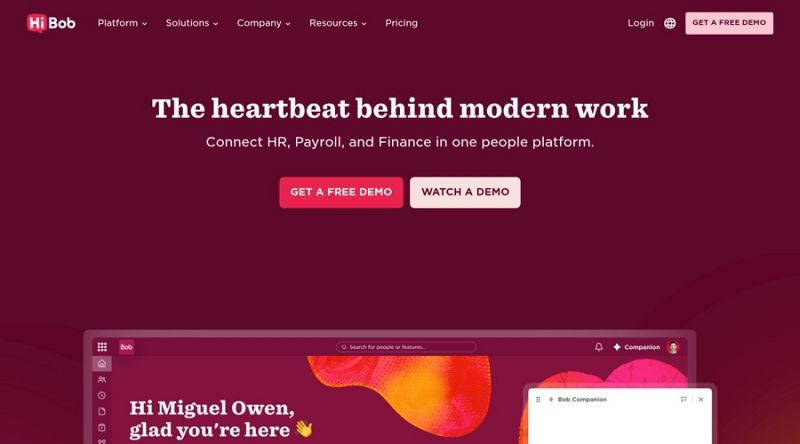
Bob, HiBob's platform, is the modern, HR-first alternative on this list, built for fast-growing small, mid-market and multinational companies rather than for IT departments. It carries a G2 rating of 4.5 out of 5 based on more than 1,800 reviews and a 4.6 on Capterra and its consumer-grade interface is the reason people open it daily. Bob runs on a Bob Core foundation of unified people data, self-service and automation, extended by its Talent, Payroll and HR Planning suites and customers such as Fiverr and VaynerMedia use it to run people operations across borders. For Australian teams, the draw is the people experience: onboarding, engagement, performance and analytics in one system that HR, managers and employees enjoy using, backed by a HiBob office in Sydney.
Pricing: HiBob doesn't publish rates in Australia, so a per-employee figure needs a sales conversation, not a public rate card.
Pros
- Bob puts the people experience first, giving HR teams, managers and employees a modern, mobile-first system for onboarding, engagement and performance instead of treating HR as a by-product of device and identity management.
- Australian mid-market and multinational companies get one source of people data with deep localisation, so a Sydney team and an overseas office work inside the same platform with regional workflows and multi-language support.
- Bob's payroll story is built for global teams, with its own U.S. and UK payroll engines, plus a Payroll Hub that plugs into local providers, which lets an Australian payroll admin keep an STP2-compliant local engine and the accounting tools they already run, such as Xero or MYOB, while reporting stays in one dashboard.
Cons
- HiBob keeps its pricing behind a demo, so you can't line up a per-employee figure without talking to sales and the required Bob Core foundation has to come first before you add the suites you want.
- Bob covers Australian payroll through the Payroll Hub and local partners rather than a native in-country payroll engine, so a team that wants fully local payroll running on day one often weighs an Australian-built incumbent such as Employment Hero alongside it.
2. Employment Hero

Employment Hero is the Australian-native incumbent, an all-in-one HR and payroll platform designed in Australia for local small and mid-sized businesses. It handles STP2 reporting, modern award interpretation and superannuation as core functions rather than add-ons, which is why it anchors most Australian shortlists. The product holds a G2 rating of 4.4 out of 5 based on more than 4,000 reviews, with users praising how much local compliance it takes off their plate.
Pricing: Australian directory listings put Employment Hero from around AUD $6 per employee per month with a free trial and higher tiers move to a custom quote.
Pros
- Employment Hero runs Australian payroll in-country, so STP2 submissions, award rates and superannuation calculations happen inside the same system that holds employee records and onboarding.
- Small Australian businesses get HR, payroll, benefits and rostering bundled into one local platform, which removes the need to stitch together separate tools for people data and pay.
- A large Australian customer base and local support presence mean the product is tuned to Fair Work obligations that global vendors treat as an afterthought.
Cons
- Reviewers report missing features and limited customisation as their structures get more complex, so the fit weakens for mid-market companies that need configurable workflows.
- Support responsiveness draws criticism in a share of reviews and the platform suits smaller, simpler organisations better than multinationals running several entities.
3. BambooHR

BambooHR is a popular HRIS for small and mid-sized companies that want clean employee records, onboarding and time-off tracking without a heavy IT layer. Its interface is the headline strength and it holds a G2 rating of 4.4 out of 5 based on more than 5,000 reviews. For an Australian buyer, it works as a tidy system of record, though payroll is where the story gets thinner.
Pricing: BambooHR doesn't list public rates in Australia; it quotes a per-employee price by plan, with add-ons for payroll and performance modules.
Pros
- The product is easy to adopt, with a clean interface that HR teams and employees pick up fast for records, onboarding and leave.
- Core HR workflows are well organised, so a growing company gets a reliable people database without the complexity of a full workforce operating system.
- A very large review base gives buyers plenty of independent feedback to check before committing.
Cons
- Reviewers keep flagging limited customisation and limited configuration options, which constrains teams that need workflows shaped to their own processes.
- BambooHR has no native Australian payroll engine, so local companies still need a separate STP2-compliant payroll tool and its scalability for multinational operations is a known gap.
4. Deel

Deel is a global hiring platform that suits Australian companies employing staff or contractors across borders. It brings employer-of-record cover, contractor management and global payroll into one vendor and it reviews well, with a G2 rating of 4.7 out of 5 based on more than 6,500 reviews. For local HR, it's most useful when the problem is international expansion rather than day-to-day Australian people management.
Pricing: Deel quotes by product and country, so employer-of-record, contractor management and payroll each carry their own rate rather than a single published figure.
Pros
- Australian companies hiring overseas can employ people in markets where they hold no entity, with localised contracts and compliance handled by Deel.
- Contractor management and global payroll sit alongside the employer-of-record product, so a distributed team runs several worker types through one vendor.
- The platform is straightforward to onboard onto, which is a frequent theme in its large review base.
Cons
- Reviewers cite payment issues and processing delays, along with a sense that the product gets expensive as headcount and worker types grow.
- Slow loading times appear in feedback and the platform carries far more global-employment machinery than an Australian team managing local staff needs.
5. Remote

Remote is a global employment platform with clear separation between its employer-of-record, contractor management and Contractor of Record products. That segmentation helps Australian companies that want a defined path into overseas hiring and the product holds a G2 rating of 4.5 out of 5 based on more than 4,800 reviews. Like Deel, it earns its keep on international teams rather than local HR.
Pricing: Remote publishes per-product rates for contractor management and lists employer-of-record on its own line, with the total shaped by country, billing term and worker type.
Pros
- The product line is easy to map to a need, so a company that wants contractor cover in one region and full employment in another can pick the right product for each.
- International hiring and onboarding run without a local entity, which suits an Australian firm testing a new overseas market.
- Public pricing on the core contractor products makes an initial comparison simpler than fully quote-only rivals.
Cons
- Poor customer support and processing delays are the most-cited complaints in its reviews, which matters when a payroll or employment issue needs a fast answer.
- Missing features and occasional payment issues show up in feedback and the platform reaches well beyond what a local Australian people team requires.
6. Oyster

Oyster is a global employment platform built for distributed teams, with hiring cover across 180-plus countries. It gives Australian companies both employee and contractor pathways in one place and reviews well on G2 at 4.7 out of 5. It fits a business whose main challenge is spreading a team across markets rather than running Australian payroll.
Pricing: Oyster lists contractor management from around USD $29 per month and quotes employer-of-record on its own in the USD $599 to $699 per month range, depending on plan and billing.
Pros
- Broad country coverage lets an Australian company hire and pay across many markets through a single provider.
- Employee and contractor options live in one platform, so a distributed team doesn't juggle separate vendors for each worker type.
- Onboarding and local documentation are handled for the buyer, which reduces the manual work of setting up in a new country.
Cons
- Pricing compounds as international headcount grows and running employer-of-record in several countries at once lifts the total fast.
- Reviewers point to support responsiveness and cases where employment workflows still need manual follow-up and Oyster offers no Australian-native HR or payroll layer.
7. ELMO

ELMO is an Australian and New Zealand mid-market platform that bundles HR, payroll and learning for the local market. It's built with ANZ compliance in mind, which makes it a genuine home-grown alternative for companies that want their learning and development in the same system as their people data. It holds a G2 rating of 4.4 out of 5, though from a slimmer review base of about 60.
Pricing: ELMO quotes custom pricing by module and headcount, with a free demo available before you commit.
Pros
- The suite is designed for the ANZ market, so payroll and compliance reflect local obligations rather than a retrofit of a US product.
- HR, payroll and learning sit in one modular platform, which suits mid-market teams that want development tracked alongside core people data.
- A single local vendor covers several functions, reducing the number of contracts an Australian HR team manages.
Cons
- Reviewers flag limited customisation and limited features, so teams with specific workflow needs can hit the edges of the product.
- Integration issues and a learning curve appear in feedback and the smaller review base gives buyers less independent evidence to weigh.
8. Deputy

Deputy is an Australian-founded workforce management platform built for rostered shift teams, with rostering, time and attendance, and Fair Work award compliance at its core. Retail, hospitality and healthcare businesses lean on it for scheduling and accurate wage calculation, and it carries a G2 rating of 4.6 out of 5. It works as a rostering and compliance layer rather than a full HRIS.
Pricing: Australian listings put Deputy from around AUD $4.50 per user per month, with a free trial, which makes it one of the more affordable options here for frontline workforces.
Pros
- Rostering and scheduling are the product's real strength, with shift templates and availability management that frontline managers use every day.
- Fair Work award interpretation is automated, so penalty rates and allowances flow through to the right wage figure without manual checking.
- The mobile-first design suits shift workers and real-time labour-cost visibility helps managers control spend on the floor.
Cons
- It suits shift-based teams better than salaried ones and its core HR capabilities are less developed than a full HRIS platform offers.
- Deputy leans toward workforce management over comprehensive HR, so performance management and broader people workflows are limited.
9. Gusto

Gusto is a payroll and HR platform built for small businesses and it's one of the highest-volume options here, with a G2 rating of 4.6 out of 5 based on more than 10,000 reviews. The catch for Australian buyers is geography: Gusto is a U.S. product, with U.S. payroll and tax filing at its heart, so its relevance here is limited to teams whose payroll runs stateside.
Pricing: Gusto sells U.S. plans, with the entry Simple tier from around USD $49 per month plus a per-person fee and there's no Australian-localised payroll rate.
Pros
- For a US-based operation, Gusto makes payroll and benefits easy to run, with automatic tax filing and a clean setup.
- The product is simple to learn, which is the dominant theme across its large review base.
- Contractor payments and basic HR sit alongside payroll, so a small US team runs pay and people admin in one place.
Cons
- Reviewers cite poor customer support, payroll issues and login problems, along with limited customisation for teams that outgrow the basics.
- Gusto is US-centric, with no native Australian payroll or STP2 support, so it can't serve as a local payroll system for an Australian company.
10. Paylocity

Paylocity is a U.S. payroll and HR platform aimed at the mid-market, with talent, benefits and workforce tools around a payroll core. It holds a G2 rating of 4.4 out of 5 from more than 5,000 reviews and has a strong following in the United States. For Australian teams, the same geography limit applies as with Gusto.
Pricing: Paylocity quotes custom pricing rather than publishing rates and its packaging is scoped for the U.S. market.
Pros
- The platform bundles payroll, HR and talent tools, which gives a US mid-market company a broad system from one vendor.
- Reviewers rate its ease of use and find the day-to-day payroll workflows manageable.
- A large customer base means mature payroll and reporting for U.S. employers.
Cons
- Poor customer support, feature gaps and a demanding learning curve are recurring complaints in its reviews.
- Paylocity is U.S.-centric and isn't built for Australian payroll, awards or STP2, so it doesn't fit as a local system of pay.
11. Workday

Workday is an enterprise HCM and finance platform for big, complex enterprises that want deep analytics and a unified system across HR and financials. It's the heaviest option on this list and reviews at a G2 rating of 4.1 out of 5 based on more than 1,600 reviews. For most Australian mid-market companies leaving Rippling, it's a step up in scale rather than a like-for-like swap.
Pricing: Workday quotes enterprise pricing through sales, with implementation and licensing shaped by headcount, modules and services.
Pros
- Workday offers deep HCM, financials and analytics in one platform, which suits very large organisations running global operations.
- Its planning and reporting tools are built for complex, multi-entity structures that lighter platforms can't model.
- The unified data model across HR and finance appeals to enterprises that want a single source of truth at scale.
Cons
Reviewers point to a dated interface, a demanding learning curve and awkward navigation and configuration draws complaints about limited customisation.
The implementation is long and costly, which makes Workday heavy for an Australian mid-market team whose main need is a modern HR system.
Choosing the right Rippling alternative for your Australian team
The best Rippling alternative for an Australian company depends on the problem you're fixing. If you hire across borders, a global platform like Deel, Remote or Oyster gives you employer-of-record cover without local entities. If you want home-grown payroll with STP2, award interpretation and superannuation running in-country, Employment Hero and ELMO are the local incumbents worth a demo. If your workforce is shift-based, Deputy handles rostering and Fair Work compliance at a low per-user cost.
For a growing Australian mid-market or multinational company that wants HR, not IT, at the centre, Bob earns the top spot. It pairs a modern, culture-led employee experience with unified people data, deep localisation and a Payroll Hub that connects to local providers, and the Xero or MYOB tools your finance team already runs. You give up published pricing and a native in-country payroll engine and Bob does start every deployment on Bob Core. In return, an Australian HR team gets a platform people enjoy using and one that grows with you as you add teams overseas, without a re-platform later.
Rippling alternatives in Australia: FAQ
Who are Rippling's main competitors in Australia?
Rippling's biggest competitors are the broad HR and workforce platforms it gets compared with most often, which around the world include Deel for hiring and Workday at the enterprise end. In Australia, Employment Hero is the closest home-grown rival, since it covers HR and local payroll in one platform.
What are the top Rippling alternatives for Australian businesses?
The main alternatives span global hiring platforms such as Deel, Remote and Oyster, dedicated HR systems such as BambooHR and Australian-built options such as Employment Hero, ELMO and the shift-focused Deputy. The right one depends on whether your priority is overseas hiring, local payroll or a modern people experience.
What is the best Australian alternative to Rippling?
For fully local payroll with STP2, award interpretation and superannuation running in-country, Employment Hero is the strongest Australian-native alternative. For a modern, HR-first platform that scales across a Sydney office and overseas teams, Bob is the standout, covering Australian payroll through its Payroll Hub and local partners.
Does Rippling do Australian payroll?
Yes. Rippling supports Australian payroll, STP2 reporting included and it markets payday super and award features to local teams. Australian buying guides still rate its award handling shallower than the home-grown options, so award-heavy employers often line it up against Employment Hero or ELMO before deciding.
How does Rippling compare with Workday for Australian teams?
Rippling is lighter, faster to implement and more usable than Workday, which is built for very large, complex enterprises and carries a long, costly rollout. Workday wins on depth of analytics and financials at enterprise scale, so the better choice comes down to company size rather than one being better outright.
What are the top HR systems for Australian companies?
Australian buyers most often shortlist Bob for a modern, HR-first people platform, Employment Hero and ELMO for local payroll and compliance and BambooHR for a clean core HRIS. Deputy rounds out the list for rostered shift workforces that need rostering and Fair Work compliance.
Is there a free Rippling alternative in Australia?
There's no fully free enterprise-grade alternative, but several vendors offer free trials so you can test before you commit, including Employment Hero and Deputy. Most full-featured platforms move to a paid per-employee or quoted plan once the trial ends.
How do Rippling alternatives handle STP2 in Australia?
Australian-built platforms such as Employment Hero and ELMO handle STP2 reporting to the ATO as a native function, alongside award interpretation and superannuation. Bob covers STP2 through its Payroll Hub and local payroll partners, which lets Australian teams keep a compliant local engine while people data and reporting stay in one place.
Which Rippling alternative suits a culture-led Australian company?
Bob is a strong fit for Australian companies that want a modern, culture-led HR platform rather than an IT-led one, with unified people data, engagement, and performance tools and deep localisation. It covers Australian payroll through local partners rather than a native engine and pricing sits behind a demo, so weigh it against Employment Hero if in-country payroll is your first priority.


Best custom CRM development companies building more accessible digital services
Explore how custom CRM builders make digital services accessible under Australian ...
Paint protection and the dealership upsell
Paint protection is one of the most upsold add-ons at new car delivery. What it ...