Australia's problem is the unequal distribution of economic resources much more than it is a shortage of them, writes Professor Carl Rhodes.
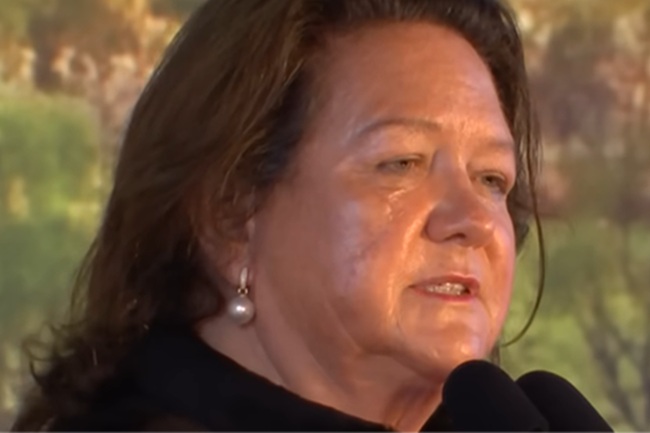
EACH YEAR, News Corp Australia hosts a series of bush summits in regional centres across the country. This year’s national summit was held in Dubbo on 26 and 27 August. For the fourth year in a row, the presenting partner was Hancock Prospecting, the mining giant controlled by Australia's richest person, multi-billionaire Gina Rinehart.
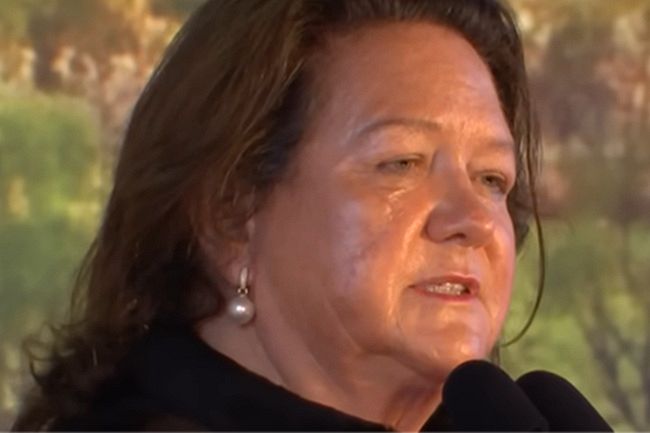
Prime Minister Anthony Albanese, Opposition leader Angus Taylor and One Nation leader Pauline Hanson all spoke, but possibly the most politically charged contribution came from Rinehart herself, whose keynote address was delivered on her behalf by Adam Giles, CEO of Hancock Agriculture and S. Kidman & Co.
As presenting partner, Hancock Prospecting provided Australia’s richest citizen a platform to portray herself as a defender of ordinary Australians, while directing public frustration towards governments, regulators and the so-called deep state.
When Australia’s richest person uses wealth to intervene in the national political conversation, perhaps the more important question concerns whether Australians are being pointed in the wrong direction when it comes to the source of their economic frustrations.
Doom and gloom in Dubbo
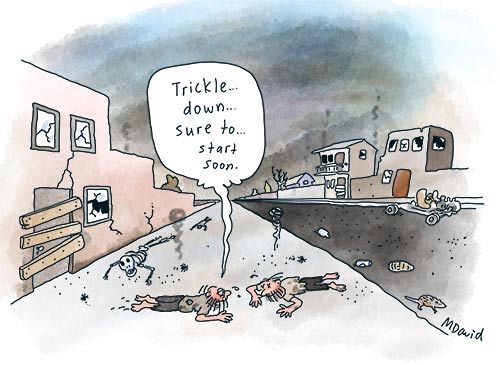
Framed as a warning about Australia's future, the keynote speech followed a familiar right-wing populist script of presenting the country as being driven into decline by out-of-touch political and cultural elites.
The speech painted a dismal picture of an Australia in crisis, claiming that the nation is beset by:
“... record debt and record business failures, to falling real investment and falling standards of living, plus rising crime and too high immigration.”
All the mainstream political parties were to blame, she argued, united by a shared appetite to tax, regulate and control. Universities, schools, public institutions and the media were portrayed as part of an entrenched establishment detached from the concerns of ordinary Australians.
With Cold War rhetorical flair, the address cast government regulation, higher taxes, bureaucracy and state intervention as components of a broader left-wing ideological project that sees business as a problem, arguing that:
“This is the oldest and most tried instrument in the manual of every socialist or communist who ever misled a people.”
Rinehart's solution? Unless Australians “fight the emergence of the deep state in our country”, she warned, political elites will continue their assault on prosperity, living standards and freedom.
The speech called on Australians to “stand up for our country, our freedoms and our future”. If we fail to do so, she warned, “we may have no country”.
A rich country with an inequality problem
But how do we reconcile Rinehart’s gloomy depiction of Australia’s overall economic condition, when this year’s Global Wealth Report, published a few months ago by Swiss financial services company UBS, paints a picture of Australia as one of the world’s wealthiest nations?
The report shows that the average wealth of all Australians is the fifth highest globally at USD$616,306 (AU$855,981). Median wealth, the amount held by the person at the midpoint of the population, ranks third globally at USD$210,783 (AU$292,754).
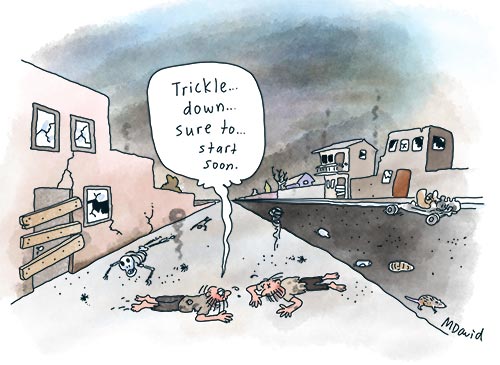
But while the average wealth has increased by 19 per cent since 2020, median wealth has contracted by almost seven per cent, suggesting that wealth gains have accrued disproportionately to those already better off.
Rinehart herself is a vivid illustration. Forbes estimated her wealth rose from around USD$13.1 billion (AU$18.19 billion) in 2020 to USD$30.2 billion (AU$41.9 billion) in 2022, largely due to the surge in iron ore prices during the commodity boom. Her fortune was valued at USD$25.5 billion (AU$35.4 billion) in early 2026.
By global standards, Australia is a rich but relatively unequal country, with recent gains concentrating at the top rather than spreading evenly across the population.
On the separate measure of income inequality, Australia has been relatively stable. But stability is not the same as fairness. The latest figures from the Australian Bureau of Statistics (ABS) place Australia around the middle of comparable OECD countries. That leaves significant room for improvement.
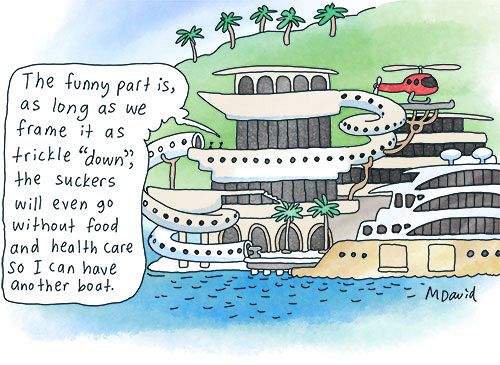
To make matters worse, it is much more difficult for lower-income households to absorb rising costs, even if income inequality is stable. For those with substantial assets and discretionary income, higher prices are largely manageable.
For people without such resources, the same increases place substantial pressure on living standards.
Right symptoms, wrong disease
Rinehart’s speech amounted to an emotionally charged call to arms railing against “every socialist or communist who ever misled a people”.
When it comes to Australia’s economic woes, she insisted that:
“... every family in this country now knows the arithmetic of the grocery bill, the mortgage, the electricity account, the license costs”.
On this point, she is undeniably correct. More and more Australians are struggling with the cost of living.
But while Rinehart rightly identifies the symptoms, she misdiagnoses the disease.
Australia's problem is the unequal distribution of economic resources much more than it is a shortage of them. If Australia is to address the frustrations that Rinehart so effectively channels, it will need to look beyond simplistic, if not hackneyed, right-wing populist claims about socialism, bureaucracy and the so-called deep state.
Australia has already proven remarkably successful at generating wealth and prosperity. The challenge is to ensure that prosperity is shared fairly across social classes and generations.
Until that challenge is confronted, Australians will continue to live in one of the world's wealthiest countries while growing numbers struggle to afford the costs of everyday life.
Blaming bureaucrats and the mythical deep state does not solve Australia's economic frustrations. It just redirects public anger away from the inequalities actually driving them.
Carl Rhodes is Professor of Business and Society at the University of Technology, Sydney. He has written several books on the relationship between liberal democracy and contemporary capitalism. You can follow him on X/Twitter @ProfCarlRhodes.
 This work is licensed under a Creative Commons Attribution-NonCommercial-NoDerivs 3.0 Australia License
Support independent journalism Subscribe to IA.


Related Articles
- Gina is generous with other people's money
- AFR-king what!? Mad money mag grovels to Gina, bootlicks billionaires and promotes plutocracy
- EDITORIAL: AFR urges Aussies to submit to Gina the Great and our gilded digger-barons
- DISCLAIMER: Gina Rinehart’s Hancock Prospecting makes deal with IA
- Gina Rinehart and Peter Dutton prepare for Trumpian ‘Golden Shower’ down under