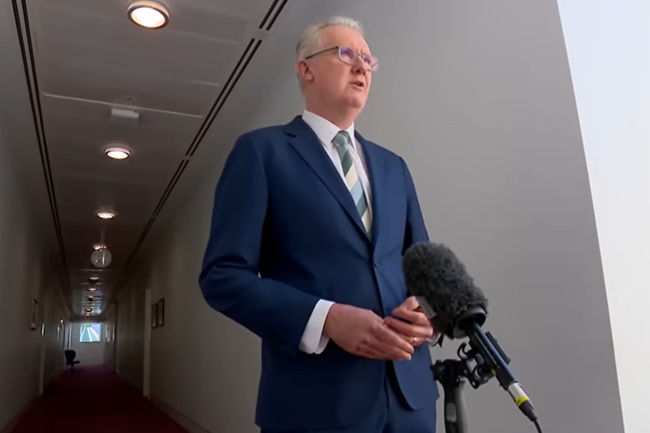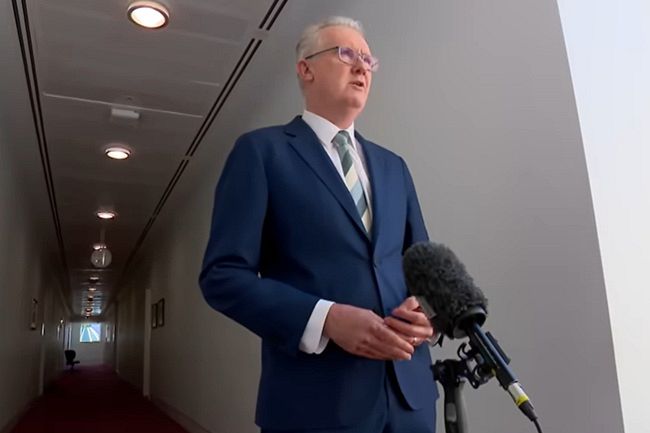
Burke will need to demonstrate that the measures he is taking will reduce net migration to the Treasury forecasts the Prime Minister has publicly committed the Government to, writes Dr Abul Rizvi.
THE MEDIA IS REPORTING Immigration Minister Tony Burke will soon announce his postponed package of measures to further tighten immigration policy.
That will lead to the usual frenzy of media commentary. Some of it will be well informed, some not so. Some will be totally uninformed and just political opinion.
So how should Australians judge the merits of the package?
In broad terms, Burke will need to demonstrate that the measures he is taking will reduce net migration to the Treasury forecasts the Prime Minister, Anthony Albanese, has publicly committed the Government to. That is 245,000 in 2026-27 and 225,000 in 2027-28.
He will also need to demonstrate that the package:
- Has no significant negative or unintended consequences;
- Any costs are manageable;
- Does not create any major legal problems;
- Starts to address some of the massive and unsustainable backlogs and temporary entry stocks in the system; and
- Can be implemented in a timely way, noting the very significant time lags between announcement, implementation, impact and publication of relevant data demonstrating that impact.
Inevitably, legitimate questions will be asked about why the Government had not acted earlier, especially against the background of Treasury repeatedly missing its net migration forecasts in recent years.
While the Government has acted to reverse unsustainable growth in the stock of student visa holders (see Chart 1), it has done relatively little to address the flow-on consequences of the net migration boom of 2022-23.
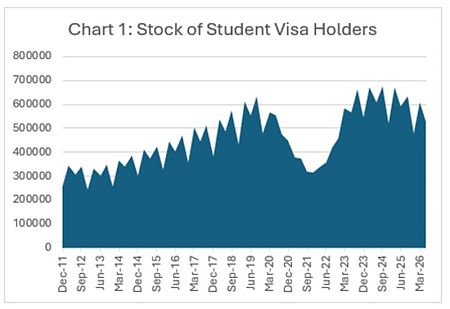
Note the stock does not include around 100,000 students on bridging visas. The small decline in the student visa holder stock in recent quarters has been the result of a massive (and unsustainable) increase in offshore refusal rates and increases in application fees.
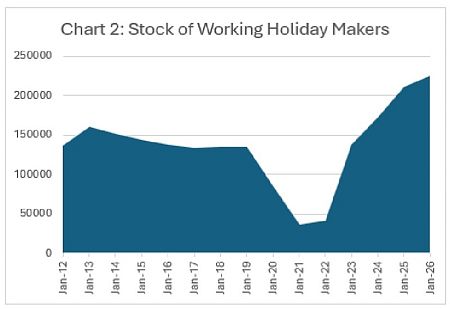
The rise in the stock of working holiday makers (WHMs) since COVID was a function of major changes to existing WHM agreements (particularly for the UK as well as temporary increases in nationality caps) as well as the impact of new agreements.
At this stage, there is little sign of the WHM stock falling (see Chart 2).
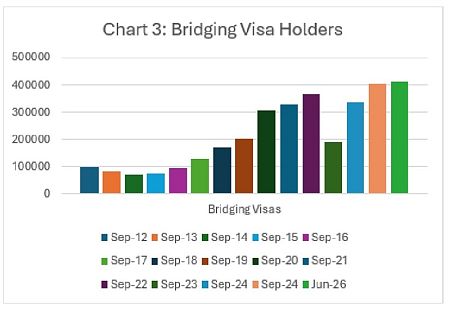
The large increase in the stock of students and WHMs (as well as partner and asylum seeker applicants) has contributed to a massive increase in the stock of bridging visa holders (Chart 3). That increase started around 2015 and reached just under 400,000 before COVID.
The size of the bridging visa backlog is indicative of a visa system in deep trouble and unable to cope with the caseload.
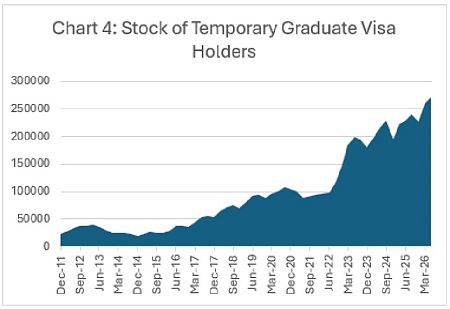
The big increase in student visa numbers has progressively flowed through to the stock of temporary graduates (see Chart 4). The size of the temporary graduate stock is unsustainable, as a large portion of these will be seeking a permanent residence place, which are limited.
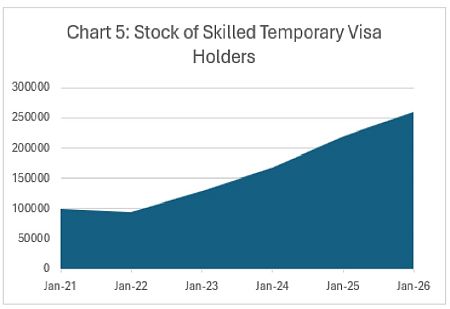
The large increase in students, WHM and temporary graduates is flowing through to the stock of skilled temporary visa holders (see Chart 5).
There is also a flow-through to partner visa applications where the backlog is now over 120,000. There is also the ongoing increase in refused asylum seekers who have not departed (over 110,000 refused at primary stage). Both of those took off under Peter Dutton and Mike Pezzullo.
All of this increases pressure on the permanent migration program. But as that is a fixed number and the temporary visas are uncapped (with an unsustainable visa design), the pressure on the permanent program will keep rising.
The Government is looking for ways to address the size of these unsustainable numbers, but with only a marginal impact to date.
That is why Tony Burke’s forthcoming announcement is so important. Even if he identifies measures to address just a small portion of the above, he will have made progress.
Dr Abul Rizvi is an Independent Australia columnist and former Deputy Secretary of the Department of Immigration. You can follow Abul on Twitter @RizviAbul or Bluesky @abulrizvi.bsky.social.
 This work is licensed under a Creative Commons Attribution-NonCommercial-NoDerivs 3.0 Australia License
Support independent journalism Subscribe to IA.


Related Articles
- Labor faces growing challenge on migration target
- Government twists student visa policy to chase migration targets
- Visa fee increases reflect lazy government
- Skilled visa invites reveal Australia's workforce priorities
- Why political diversity lags as ethnic diversity rises in Australia