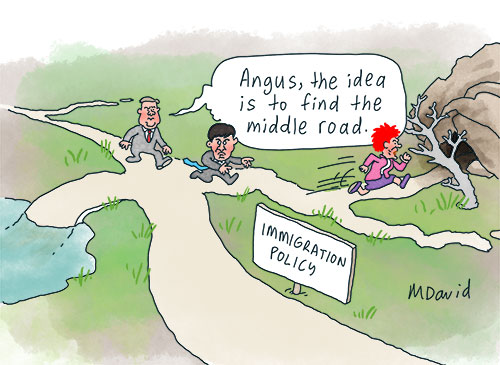
Australians demanding radical political change may defend the economic arrangements causing their insecurity and reject the redistribution needed to build universal public services, writes Rob Powell.
THERE ARE SEVERAL political realities on which many Australians might agree.
Politics is failing many people, the economy is leaving too many behind, and housing has become so expensive that younger Australians feel excluded from the security and wealth it delivered to earlier generations. The National Housing Supply and Affordability Council reports that homeownership among households aged 25 to 34 fell from 61% in 1981 to 43% in 2021, while the time required to save a deposit increased from nine years in 2015 to 11.2 years in 2025.
These conditions have strengthened demands for radical political change. Yet there is a contradiction within that demand.
In 2019, Bill Shorten took a comparatively substantial redistributive program to an election. It proposed restricting negative gearing, reducing the capital gains tax discount and limiting refundable franking credits. Labor lost.
That defeat cannot be reduced to one group of policies, nor does it prove that the people demanding reform were those who rejected Labor. It illustrates how difficult reform becomes once it creates identifiable losses. Political ideology shapes how people recognise their interests. Australians have been taught to defend private aspiration more strongly than collective security, even when collective provision might offer greater material security.
When we say that people vote “against their own interests”, we often assume that self-interest is obvious and purely economic. It is not. People also value cultural identity, social status, family loyalty, moral commitments, belonging, recognition, their children’s prospects and autonomy. A voter may knowingly accept an economic cost to defend something they regard as morally or culturally important.
It would therefore be paternalistic to assume that an external observer always knows a person’s “true” interests better than they do. However, it would be equally mistaken to assume that preferences form independently of ideology, misinformation and social power. People must interpret their circumstances before deciding what serves them.
Political power operates partly by shaping the categories through which that interpretation occurs. A renter may identify as a future property investor. A worker may identify with a billionaire as a fellow taxpayer. Both may be encouraged to see a welfare recipient as belonging to an opposing economic class and threatening their security.
The political question is therefore not only what people want. It is also how they came to understand their interests in that particular way.
The public may rationalise an unequal political and economic system because believing that it is legitimate provides psychological reassurance. John Jost and Mahzarin Banaji’s system justification theory helps explain why advantaged and disadvantaged groups may defend social arrangements that reproduce inequality, sometimes at the expense of individual or collective interests.
This does not mean that every disadvantaged person supports the system or that resistance is impossible. It suggests that people can have psychological reasons to regard established institutions as normal, fair or unavoidable.
Inequality must be interpreted as well as experienced. A person can be struggling while believing the cause is their own choices or unfair assistance given to somebody else. If insecurity is instead understood as a product of wages, housing, taxation and ownership, the appropriate response changes from individual perseverance to collective reform.
Believing that hard work will be reliably rewarded allows people to think their sacrifices will eventually matter. Recognising that wealth also reflects inheritance, property ownership, bargaining power and luck threatens that reassuring story. It may be psychologically easier to believe “I can succeed within this system” than “this system is structured against people like me”.
Defending aspects of the system can preserve hope, identity and a sense of control, even when those arrangements weaken a person’s material security.
Grievance politics exploits this paradox by blaming outsiders rather than challenging the economic order causing much of the pain. The system survives not only because powerful people defend it, but because its values become embedded in the hopes of those who receive fewer of its benefits.
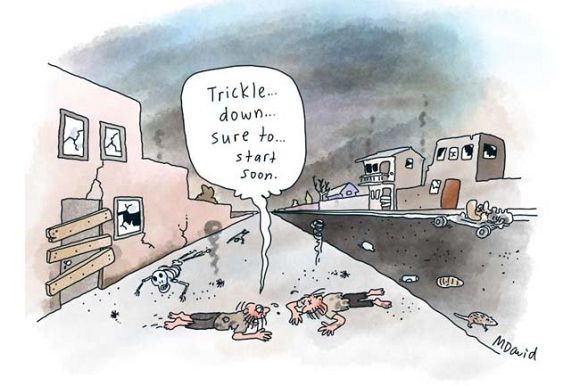
Personal aspiration is not inherently dishonest. The lie begins when exceptional upward mobility is presented as proof that structural inequality is broadly escapable. Some people do rise from poverty into wealth and power. Anthony Albanese’s journey from council housing to the prime ministership demonstrates that such movement is possible.
But individual success does not establish that opportunity is distributed fairly. When exceptional cases become the moral justification for the entire system, those who remain poor can be blamed for lacking effort, discipline or ambition.
The success story reassures those at the bottom that escape remains possible and those at the top that their position reflects merit. Poverty becomes evidence of bad choices and wealth evidence of virtue, while the circumstances shaping both disappear.
John Rawls’ principle of fair equality of opportunity requires more than formally allowing everybody to compete for the same positions. People with comparable talent and motivation should have genuinely comparable prospects, regardless of the class into which they were born. Permission to succeed is not the same as possessing the material capacity to succeed.
Aspiration can nevertheless encourage people to identify with an imagined future position rather than their present circumstances. Someone without a home, let alone an investment property, may defend negative gearing because they hope to become an investor. Someone with little capital may defend concessions benefiting wealth because they imagine those concessions waiting at the end of their own success.
Aspiration can therefore weaken class solidarity. People with similar material interests divide themselves according to the status they possess, hope to acquire or fear losing. The worker is encouraged to ask whether reform might disadvantage the investor they hope to become.
This should not be overstated. Research does not establish that anticipated mobility always reduces support for redistribution. A 2025 study of the ‘prospect of upward mobility’ hypothesis, for example, found political ideology more influential than verified personal financial circumstances.
Other research indicates that beliefs about mobility can affect whether inequality appears fair and whether redistribution seems necessary. Aspiration becomes ideological when the possibility of private escape is used to obstruct collective improvement.
Redistributive reform also faces a problem of framing. Kahneman and Tversky’s prospect theory shows that people evaluate decisions in relation to perceived gains and losses, and often respond more strongly to losses than to equivalent gains. Losing a tax concession is concrete. Gradually constructing better universal services is abstract. Opponents can describe the loss as a tax on retirement, investment or ordinary families, while the promised public benefit must survive elections, implementation delays and distrust of government.

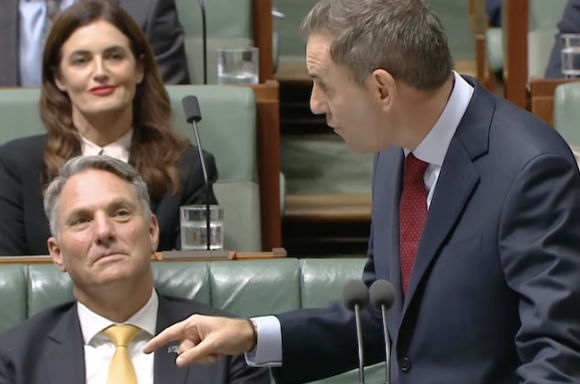
This framing remains visible today. Shadow Treasurer Tim Wilson described the 2026 tax reforms as an “economic earthquake” that would “kill aspiration”. People who do not currently receive a concession may still fear losing a future opportunity. They may also doubt that governments will deliver the promised housing, dental care or aged care.
Resistance to reform does not necessarily prove that people prefer inequality. It may demonstrate that private losses have been made visible while public gains remain uncertain.
This is the proper significance of the 2019 Election. Labor’s proposals were real, but the Election was not a referendum on each of them.
Grattan Institute analysis found that electorates receiving substantial benefits from negative gearing and franking credits did not uniformly swing towards the Coalition. The defensible conclusion is not that Australians simply voted against their financial interests. It is that the reforms were successfully framed as threats to aspiration, retirement and independence.
Similar reforms have now been adopted, although their effects should not be exaggerated. The 2026 changes restrict negative gearing on established residential properties purchased after the Budget announcement and replace the capital gains tax discount with indexation and a minimum tax rate.
Most provisions begin in July 2027. It is too early to claim that these reforms have caused investors to leave or house prices to fall. The Commonwealth Bank forecasts that prices may be about 3% lower than otherwise, but that remains a forecast, and housing prices respond to many forces.
The deeper issue is how Australia distinguishes between earned and unearned assistance. JobSeeker, disability payments and public housing appear as visible expenditure and are treated as welfare. Negative gearing and the capital gains tax discount operate through revenue the Government chooses not to collect. These mechanisms are not identical, but both are political choices that distribute public resources.
This difference in visibility matters. A welfare payment appears as a transfer from taxpayers, while a tax concession appears as money that always belonged to its beneficiary. Removing one can be called budget discipline and removing the other confiscation. Yet both require the state to decide whose needs, activities and risks deserve support.
The welfare recipient is represented as dependent, while the property investor is represented as independent. The public-housing tenant receives a subsidy; the negatively geared investor receives a legitimate deduction. One must continually prove need and deservingness. The other is presumed productive and aspirational. Yet Parliamentary Budget Office analysis shows that the benefits of negative gearing and the capital gains tax discount are concentrated towards the upper end of the income distribution.
Australia has accepted a substantial system of public support for asset ownership while stigmatising assistance directed towards vulnerability.

This becomes the central barrier to universal basic services. Real public housing, dental care through Medicare, affordable early childhood education, dignified disability support and properly funded aged care cannot be built solely through moral declarations. They require durable revenue, capable public institutions and a population willing to understand taxation as a contribution to common security rather than money confiscated for somebody else’s benefit.
Nor can every universal service be funded by promising that only billionaires will pay. Concentrated wealth and corporate profits should carry a greater burden, but a comprehensive social settlement would also require reconsidering concessions enjoyed by affluent and upper-middle-income households. That is politically difficult because people experience an existing concession as something they own, while experiencing a proposed public service as something government might fail to deliver.
The case for universal services must therefore rest on more than altruism. Disability, illness, unemployment, housing insecurity and dependency in old age are not peculiar failures affecting a separate class of people. They are ordinary human vulnerabilities that can enter almost any family. Universal provision turns individual exposure to those risks into collective protection. It asks people to surrender some private advantage, but offers something neoliberal aspiration cannot guarantee: security that does not depend on becoming wealthy.
Genuine structural reform requires some people to surrender advantages. Hansonism instead offers disaffected voters a revolution in which somebody else bears the cost and concentrations of economic power remain largely undisturbed. Neoliberal aspiration offers the hope of private escape while protecting many of the conditions that produce insecurity. Both can prevent people from recognising shared material interests.
The political task is to replace the fantasy that everyone can individually climb into security with the promise that nobody should have to become wealthy to live with dignity. Everyone says they want to burn down the system. The real test is what they are willing to contribute to building something better in its place.
Rob Powell is a retired mature-aged student currently studying politics and philosophy, focusing on how ethical frameworks shape public policy and political behaviour.
 This work is licensed under a Creative Commons Attribution-NonCommercial-NoDerivs 3.0 Australia License
Support independent journalism Subscribe to IA.


Related Articles
- Market mysticism and the misinformation that dudded Australia
- Make Australia fair dinkum again
- The great decoupling: How we became the Eloi
- Mateship for sale: The economic betrayal of working Australia
- Hastie’s break with neoliberalism puts business on notice