Since 1 October, Australian businesses have not been allowed to pass card costs to the customer. That quietly turned the choice of payment gateway from an IT decision into a margin decision.
For 23 years, surcharging let Australian merchants pass the cost of a card payment to the customer. Only 16% of them actually did. On 31 March 2026, the Reserve Bank's Payments System Board closed that door, and from 1 October surcharging on eftpos, Mastercard and Visa is no longer permitted. American Express dropped its surcharges on the same day.
The cost did not leave with the surcharge. The RBA puts total card surcharges at roughly $1.8 billion a year, $1.6 billion of it paid by consumers. From October that money sits on the merchant's side of the ledger, on top of the $7 billion a year Australian businesses already pay in merchant service fees.
Here is the number that should shape how you read any "best payment gateways" list. RBA data shows a small merchant on a single-rate plan pays an average of 1.4% of transaction value to accept card payments. A small merchant on an unblended plan pays 0.9%. Same shop, same cards, same customers: half a percentage point of gross margin, decided by the pricing sheet rather than the brand printed on it. Only 19% of small merchants are on unblended plans.
What follows is a ranking of payment providers written for the first quarter in which nobody else is covering the bill.
What changed on 1 October 2026
- Surcharging on eftpos, Mastercard and Visa ended, in-store and online.
- Interchange caps on domestic-issued cards fell and a cap on foreign-issued cards was introduced, worth around $910 million a year in lower wholesale card payment costs.
- Acquirers processing more than $10 billion in card transactions a year must now publish their merchant service fees quarterly, and the RBA republishes them. Merchant statements must separate domestic from foreign-issued cards, and in-person payments from online.
The third change is the sleeper. For the first time, an Australian business can compare what a payment provider actually charges without first asking for a quote.
How payment gateways work in Australia
A payment gateway is the component that captures payment details at checkout, encrypts them, and carries an authorisation request to the customer's bank. It is not the thing that holds your money, and it does not set most of your transaction fees.
Four parties touch every card transaction:
- the customer's bank (the issuer), which approves or declines and charges interchange;
- the card network (eftpos, Mastercard, Visa, American Express), which routes the message and charges scheme fees;
- the acquirer or payment processor, which holds the merchant relationship and settles funds; and
- the gateway, which connects your website, app or terminal to the other three.
Most providers in the Australian market now sell all four as one product. Stripe, Square and PayPal are payment facilitators: gateway, payment processing and merchant account under a single contract. Older gateway providers such as eWAY sell the connection and leave the acquiring to your bank.
Authorisation, settlement, refunds and chargebacks
Authorisation happens in roughly a second and only reserves the funds. Settlement is the separate, slower movement of money into your bank account, usually one to three business days depending on the provider and the day of the week. A refund reverses a completed transaction and, with most payment processors, does not return the original transaction fee. A chargeback is the customer's bank clawing the money back on the cardholder's behalf, and it usually carries a fee of its own whether or not you win.
That distinction matters for cash flow. A gateway that authorises instantly but settles on day three is holding three days of your revenue, every day, permanently.
Hosted, API and in-person: the three shapes a gateway takes
Australia runs two broad categories of payment gateway, physical and virtual. Physical gateways process in-person card payments through a terminal at the counter. Virtual gateways, which is what most online payment gateways are, process payments through a website or mobile app. Plenty of businesses now need both, and the providers that handle both under one contract save you a reconciliation headache at tax time.
Hosted payment gateways
A hosted checkout redirects the customer to the provider's own secure payment page, or drops in an iframe that the provider controls. Card details never touch your server, which collapses your PCI DSS compliance obligation to the lightest self-assessment tier. Setup can be an afternoon.
The trade-off is control. You inherit the provider's checkout design, its error messages and its conversion rate, and a visible redirect still costs some customers at the final step.
API and self-hosted payment gateways
Self-hosted gateways collect payment details on your own page and pass them to the provider through payment APIs. You keep the design, the data and the flexibility to build subscriptions, split payments or marketplace flows exactly as you want them.
You also inherit the compliance. Collecting raw card data on your own infrastructure pushes you up the PCI DSS ladder, and the engineering is not finished at launch: sandbox testing, webhook handling, failed-payment retries and scheme mandate updates are permanent line items. Most providers now offer a middle path, where their JavaScript tokenises the card in the browser so the fields look like yours but the data never lands on your server.
What Australian businesses actually need from a payment gateway
Local payment preferences here are unusually concentrated, and that simplifies the shortlist. Australians pay by card, and increasingly by phone.
By the end of 2025, Apple Pay, Google Pay and Samsung Pay together carried around 45% of all card payments in Australia by number. In the RBA's 2025 Consumer Payments Survey, mobile apps accounted for 46% of online payments, up from 37% in 2022. A payment gateway that handles Apple Pay and Google Pay badly is not handling half your checkout.
The payment methods that actually matter here
Visa and Mastercard credit and debit cards are the floor. Beyond that, the Australian market has a specific set: eftpos for domestic debit, which is usually the cheapest card to accept and which least-cost routing can select automatically; PayID and PayTo for account-to-account transfers; BPAY for bills and invoices; and buy now pay later, which the RBA measures at around 2.5% of the size of Australian card purchases but which has doubled in value since 2020.
BNPL sits outside the surcharge ban, and its merchant fees of several per cent are now among the most expensive ways to take money. The RBA has said it will examine BNPL, mobile wallets and three-party networks in the review it opened in mid-2026.
Different businesses, different problems
A cafe needs cheap in-person payments and least-cost routing switched on. An online store needs wallets, good decline recovery and a checkout that does not redirect. A marketplace needs split settlement and onboarding of third-party sellers. An exporter needs multi-currency support and settlement that does not quietly take 3% on the exchange rate. These are four different products, and no single provider wins all four.
How this list of payment gateways was built
This is not ordered by brand recognition. It is ordered by which cost the October reforms left you holding.
The reforms capped interchange and killed the surcharge, but they did nothing about the gap between a 0.9% unblended plan and a 1.4% single-rate one, and they do not help the exporter paying foreign-card rates on half their revenue. So the list starts with the most expensive uncapped exposure (cross-border and foreign-issued cards), then works down through the domestic providers most Australian businesses will actually shortlist.
Four tests were applied to every payment provider:
- Published pricing. If the rate is not on the website, it is not in the comparison as a number. Negotiated rates are real but unverifiable.
- Who holds the merchant relationship. A payment facilitator and a traditional acquirer behave very differently when something goes wrong.
- What it costs when the transaction is not normal. Foreign card, refund, chargeback, currency conversion, failed direct debit.
- Whether it is honest about what it does badly. Every entry below includes the thing the provider's own marketing leaves out.
All fees quoted are the providers' standard advertised rates for Australia, checked in late October 2026. GST treatment differs between providers, some publishing rates inclusive and some exclusive, which on its own is enough to make two headline numbers non-comparable. Rates change. Check the provider's pricing page before you sign anything.
1. Unlimit: For Australian businesses selling into hard markets
Start with the number almost nobody in this debate quoted. Foreign-issued cards are about 3% of card transactions in Australia but around 20% of all the interchange Australian acquirers pay, which reaches you through your rate. The weighted-average interchange on those cards was running at roughly 1.75% of transaction value. From 1 October, the RBA capped it at 1.0%.
That cap is real relief, and it stops at the water's edge. It applies to transactions acquired in Australia. If you are an Australian business charging a customer in São Paulo, Mumbai or Jakarta, your card is the foreign one, and no Australian regulator caps what you pay there. You are also paying it without a surcharge to hide behind.
Unlimit exists for that specific problem. It is a cross-border payments company, founded in 2009 as Cardpay, that acquires locally in markets where being a foreign merchant is expensive. It holds an online payment aggregator authorisation from the Reserve Bank of India, a payment institution licence from Banco Central do Brasil, a money service operator licence in Hong Kong and a Visa principal licence in Mexico that extends to card issuing. It added Brazil's Pix to its acquiring in 2022 and connected Alipay+ the same year. Clients it names publicly include Xiaomi, Telegram and inDrive.
Two things make it worth the first slot for exporters. It acquires as a local entity rather than routing your transaction cross-border, which is the only structural way to stop paying foreign-card rates. And it quotes on interchange-plus as well as blended pricing, which, on the RBA's own numbers, is where the 0.5 percentage point gap lives.
What it is not. Unlimit is not a domestic Australian acquirer and is not sold as one, so it will not replace your local merchant facility, your eftpos terminal or your Tyro box. Pricing is quoted, not published, so you cannot compare it against this list without a sales call. And the onboarding is built for businesses processing serious volume, not for a Shopify store doing $20,000 a month. If your customers are all in Australia, skip to number two.
2. Stripe: The default for online stores — and it just got cheaper
Stripe cut its Australian domestic card rate on the day the reforms landed, from 1.7% to 1.65% plus A$0.30 online, and to 1.65% plus A$0.10 in person through Stripe Terminal. Its international card rate is scheduled to fall from 3.5% to 2.8% on 1 April 2027.
A five basis point cut, delivered in the same week the consumer credit interchange cap fell from 0.8% to 0.3% and a new 1.0% cap landed on foreign cards, is not generosity, and it is worth naming. This is precisely what the RBA was worried about when it ordered acquirers to publish their interchange pass-through from January 2027.
Stripe remains the best-documented payment gateway in the Australian market. Its API is the one your developer already knows, it handles subscriptions, marketplaces and payment links without bolt-ons, it supports PayTo and Apple Pay and Google Pay natively, and onboarding takes minutes rather than weeks.
The honest problems. Chargeback handling is largely automated, and the A$25 dispute fee has not been refunded on successfully contested disputes since Stripe changed that policy in October 2023, so you pay it whether you win or lose. Account freezes on new or unusual merchants are a recurring complaint and support is ticket-based. And standard pricing is blended, which is the expensive side of the RBA's 0.9% versus 1.4% split. If you are processing over about $50,000 a month, ask Stripe for interchange-plus and compare it against your blended rate before renewing.
3. Square: Simplest for counter-first businesses, expensive online
Square publishes 1.6% for in-person card payments and 2.2% for online and manually keyed transactions, with no monthly fee and a reader from around $65. The in-person rate applies to accounts opened from 30 May 2024.
One detail worth more than it looks: Square is one of a small group of providers in the Australian market, with Zeller and SumUp, that charges nothing extra for international cards. Every other flat-rate provider adds a margin of up to roughly two percentage points. For a tourist-facing cafe, gallery or regional accommodation business, that single policy can beat a lower headline rate.
Square is a payment facilitator, so you get a shared merchant account, same-day approval, POS software, invoicing, rosters and eftpos in one place.
The honest problems. That 2.2% online rate is the second-highest here and makes Square a poor primary gateway for an online store. Shared merchant accounts mean Square decides your risk profile, and funds can be held with limited explanation. Complex routing, multi-entity structures and enterprise reconciliation are outside what it does well.
4. Airwallex: The Melbourne-born option for multi-currency sellers
Airwallex started in a Melbourne cafe in 2015 and is now a global payments and treasury platform, which makes it the most credible Australian-origin answer to the cross-border problem.
Its published Australian domestic card rate sits close to Stripe's, with a lower international card rate and foreign exchange priced at a small margin over the interbank rate rather than the 3% to 4% conversion markups common elsewhere. Check its pricing page for the current figures, which move more often than the flat-rate providers.
What makes it genuinely different is the account underneath the gateway. You can hold and settle in multiple currencies, open local receiving accounts in markets such as the US, UK and EU, pay overseas suppliers out of the same balance, and issue multi-currency corporate cards. For an exporter, avoiding one conversion is often worth more than shaving ten basis points off the card rate.
The honest problems. It is not an in-person payments business, so a retailer still needs a terminal from somewhere else. Onboarding is heavier than Stripe or Square, and the product surface is wide enough that smaller teams end up using a fraction of what they are set up on.
5. PayPal: The most expensive button your customers insist on
PayPal carries the highest published domestic rate of any mainstream provider here: 2.9% plus A$0.30 for standard domestic commercial transactions, 3.9% plus A$0.30 when the buyer is overseas, and a currency conversion margin of roughly 3% to 4% on top. Its Australian merchant fee schedule was last updated in February 2026. Eligible merchants on Advanced Credit and Debit Card Payments pay 1.5% plus the fixed fee, which is worth asking about, because it is rarely offered unprompted. Check the current figure on PayPal's Australian merchant fees page before budgeting from it.
It earns its place on reputation rather than price. Decades of buyer-protection marketing mean a meaningful share of Australian shoppers will abandon a checkout that does not offer it, particularly for first purchases from unfamiliar stores. That is why PayPal belongs as a secondary payment method beside a cheaper primary gateway, not as your main payment processor.
One live detail worth knowing. The RBA's removal of surcharging applies to the designated card networks: eftpos, Mastercard and Visa. PayPal wallet payments are not a designated network, so a surcharge within your cost of acceptance may still be available there, subject to PayPal's own merchant terms and to Australian Consumer Law on how prices are displayed. Check both before you rely on it.
The honest problems. Refunds do not return the original transaction fee. Dispute outcomes are opaque and account holds are common enough to plan around.
6. eWAY: The cheapest published online rate and the route to unblended pricing
eWAY has operated from Australia since 1998 and publishes 1.5% plus A$0.25 for most major domestic cards with no setup or monthly fee, the lowest headline online rate among the flat-rate providers. International credit cards add roughly 1.99% on top.
Its real advantage is structural, and it is the one almost every "best payment gateway" list misses. eWAY will sell you the gateway alone and let you keep your own merchant account with your bank. That matters because the RBA's 0.9% figure belongs to merchants on unblended plans, and unblended pricing is something you negotiate with an acquirer, not something a payment facilitator hands out. If you have the volume to get a real interchange-plus quote from a bank, a gateway-only provider is how you use it.
Around 250 platform and accounting integrations, including Xero, and local phone support that answers in Australian business hours.
The honest problems. Setting up a separate merchant facility is slower and involves underwriting. Multi-currency settlement needs a merchant account per currency, which rules eWAY out for genuine global sellers. The developer experience is a generation behind Stripe.
7. GoCardless: For recurring payments, the cheapest money you can collect
If your revenue is subscriptions, memberships, retainers or progress invoices, this is the entry that will save you the most, and most Australian businesses still do not use it.
GoCardless collects by direct debit through BECS, straight from the customer's bank account. No card network sits in the middle, which means no interchange, no scheme fees and no surcharge question to answer. It prices as a percentage with a per-transaction cap rather than an uncapped percentage, so the saving grows with invoice size: on a $2,000 monthly retainer, a capped direct debit fee against 1.65% on a card is the difference between a few dollars and $33. Check the current Australian rates and caps on GoCardless's own pricing page.
It also handles the unglamorous part well: mandate collection, automatic retries on failed payments, and retry scheduling that avoids hammering an account on the same day it bounced.
The honest problems. Direct debit is not a checkout. It suits agreed, repeating amounts, not impulse purchases, and settlement takes days rather than seconds. Customers must authorise a mandate, which adds a step and costs you some signups.
8. Adyen: The only big name whose standard pricing already passes the cuts through
Adyen holds its own acquiring licence in Australia and prices on interchange++: the actual interchange, the actual scheme fees, and a fixed processing fee per transaction, all itemised.
That structure is the whole argument. The RBA has told acquirers to publish how much of the October interchange reduction they passed to merchants, because merchants on single-rate and blended plans do not get it automatically. Merchants on unblended pricing do. With Adyen, the 0.3% consumer credit cap and the 1.0% foreign card cap reached your invoice on 1 October without anyone deciding to be generous about it.
It also does unified commerce properly: the same platform for online, in-app and terminal payments, with one reconciliation, multi-currency settlement and risk tooling built for volume.
The honest problems. There is a monthly minimum and the commercial conversation starts at a level that rules out most small businesses. Implementation is an engineering project, not a plugin. And an itemised invoice is only an advantage if someone in your business reads it.
9. Zeller: The cheapest published in-person rate in the country
Zeller launched in Melbourne in 2021, built by people who had run Square's Australian business, and it has spent the years since undercutting them. It publishes 1.4% for tap and insert payments, dropping to 1.2% when you use its own terminal with its own point of sale, 1.7% online, no monthly fee and no terminal rental.
It also absorbs the international card margin rather than charging extra, and settles to an external bank account the next business day, or faster into its own transaction account. For a hospitality or retail business that was surcharging until last month and now has to wear the cost, moving from a 1.6% to 1.7% plan onto 1.2% to 1.4% is a larger saving than the entire interchange reform delivered.
The honest problems. The ecosystem is smaller than Square's, with fewer third-party integrations and a less developed online offering. Hardware is an upfront purchase. And a young provider has a shorter track record on outages and dispute handling than a bank-licensed competitor such as Tyro, which publishes 1.3% with least-cost routing and a monthly fee, and is worth a second quote.
Transaction fees and the hidden fees nobody quotes you
Published Australian rates as advertised in late October 2026. Providers state GST differently and promotional hardware pricing moves, so treat this as a starting point and confirm on each provider's own pricing page before you switch.
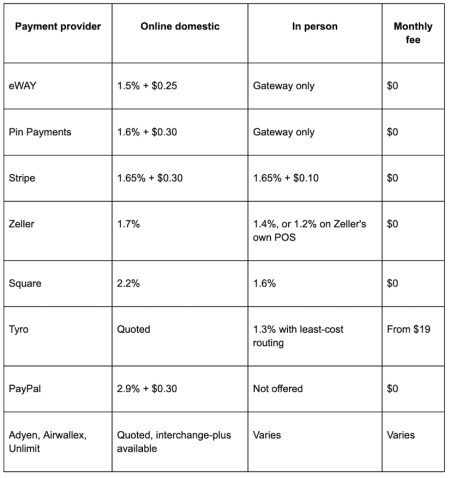
Flat-rate pricing versus interchange-plus
Flat-rate pricing is one number for every card, which is why small businesses like it and why it costs them 1.4% against 0.9%. The provider absorbs the variation and prices in a margin for the risk. Interchange-plus itemises the wholesale cost and adds a fixed markup, so when the regulator cuts interchange, your invoice falls that week.
The rough threshold is around $30,000 to $50,000 a month in card volume. Below it, flat rates usually win on simplicity and often on price. Above it, ask for an unblended quote, and ask every provider you shortlist how much of the October interchange reduction they passed through. Large acquirers now have to publish that figure, with the first numbers due from this week, although that opening batch covers July to September and so predates the reform, and pass-through data from 30 January 2027.
The fees that are not in the headline rate
- International transactions. Most flat-rate providers add up to about 2 percentage points for a foreign-issued card. Square, Zeller and SumUp do not.
- Currency conversion. Markups of 2% to 4% are common and sit on top of the card rate. This is where cross-border margin actually disappears.
- Refunds. Most payment processors keep the original transaction fee.
- Chargebacks. Expect $15 to $25 per dispute, charged whether you win or lose.
- Payout timing. Next business day to three days. Three days of held revenue is a permanent working capital loan you are making to your payment provider.
- Setup and monthly fees. Rare among flat-rate providers, standard with bank merchant facilities and terminal rental.
Do you need a merchant account, or just a bank account?
The answer decides your pricing model, which decides your rate, which is the whole argument of this article.
A payment facilitator such as Stripe, Square, Zeller or PayPal puts you on its own merchant account alongside thousands of others. You sign up in a day, give it a bank account for settlement, and take the flat rate it offers. Nothing is negotiable, and when risk rules trip, the facilitator can hold your funds while it decides.
A dedicated merchant account is issued to your business by an acquirer, usually a bank. It takes underwriting, financial statements and a week or three. In exchange you get a real counterparty, a negotiable rate and access to unblended pricing. Pair it with a gateway such as eWAY, and you are buying the two pieces separately on purpose.
Settlement and higher-risk industries
Funds settle into a nominated Australian business bank account on the provider's schedule, which you should check against your payroll cycle rather than assume.
If you operate in an industry acquirers class as higher risk, including travel, ticketing, subscriptions with long fulfilment, gaming, adult and some health services, expect longer approval, a rolling reserve held against chargebacks, or both. Ask about the reserve percentage before you sign, not after the first dispute.
Security standards and fraud prevention tools worth paying for
PCI DSS compliance is not optional for any business accepting card payments, and the practical question is only how much of it lands on you. A hosted or tokenised checkout keeps raw card data off your servers and reduces you to the lightest self-assessment questionnaire. Collect card numbers yourself and you own an audit.
Every secure payment gateway in this list encrypts payment data in transit with TLS and replaces the card number with a token for storage, so a breach of your database yields nothing reusable. Treat that as the floor, not a feature.
Where Australian fraud actually sits
The RBA's fraud figures for 2024/25 are specific enough to plan around. Fraud cost 0.01% of transaction value on in-person payments with Australian-issued cards. Online, on foreign-issued cards, it cost 0.36%, more than thirty times higher. Australia's overall card fraud rate remains low by international standards.
That shape tells you where to spend. A cafe does not need an elaborate risk stack. An online store taking international orders does.
What to ask a payment provider for
- 3D Secure 2, applied by rule rather than to every transaction, since blanket challenges cost more in abandoned checkouts than they save in fraud;
- risk scoring you can tune, with the ability to review rather than only block;
- chargeback alerts early enough to refund before a dispute is raised; and
- dispute management that submits evidence for you, and a clear statement of what the fee is when you lose
Payment methods an Australian online store should actually accept
Cash has fallen from about 70% of consumer payments by number in 2007 to 15% in 2025. The question is no longer whether to accept cards but which of the alternatives earn their integration.
Apple Pay and Google Pay are not optional
With the three major phone wallets carrying roughly 45% of Australian card payments, and mobile apps now making up 46% of online payments, wallet support is a conversion requirement rather than a nice extra. Every provider in this list supports Apple Pay and Google Pay. What differs is whether the wallet button appears before the customer has typed anything, which is the only version that helps.
Least-cost routing is free money you have to ask for
Most Australian debit cards carry both eftpos and an international network. Least-cost routing sends the transaction down whichever is cheaper, usually eftpos. It is not always switched on by default. Ring your payment provider and ask. For a business taking mostly contactless debit, this is often worth more than changing providers.
The rest of the shortlist
PayID and PayTo handle account-to-account transfers without card fees and suit invoices and higher-value payments. BPAY still matters for bills. Afterpay and Zip raise average order values in some categories, but their merchant fees of several per cent are the most expensive money in this article; they sit outside the surcharge ban, and the RBA has them under review. Add them because your customers demand them, not because they are cheap.
Integrations with your existing payment systems
The cheapest payment gateway is expensive if your bookkeeper spends six hours a month reconciling it.
Check the platform first: Shopify, WooCommerce, Magento or BigCommerce plugins that the provider itself maintains, not a third party's abandoned fork. Then check the accounting side, because this is where the real hours go. Xero and MYOB feeds that match payouts to invoices automatically are worth more to a small business than ten basis points.
For custom builds, four questions separate a good set of payment APIs from a bad one. Is there a sandbox you can test against without talking to sales? Are webhooks documented, retried on failure and signed? Does the payout report reconcile to the cent against your bank statement, including fees and refunds? And does the provider version its API, or break yours on a Tuesday?
One practical note on Shopify stores: using a third-party payment gateway instead of Shopify Payments attracts an additional platform fee. Include that in the comparison before you decide eWAY's 1.5% beats the alternative.
Which payment gateway fits your business?
Match the provider to where your money actually comes from, not to the brand you have heard of.
- Cafe, salon, retail counter: Zeller at 1.4%, or Tyro at 1.3% with least-cost routing if the monthly fee pays for itself at your volume.
- Online store, Australian customers: eWAY on 1.5% + $0.25 if you want the cheapest published rate, Stripe on 1.65% + $0.30 if you want the better developer experience and faster setup.
- Both counter and website: Square, accepting that 2.2% online is the price of one system.
- Subscriptions, memberships, retainers: GoCardless for the recurring billing, a card gateway only for signup.
- Selling into Asia, Latin America or Africa: Unlimit for local acquiring, or Airwallex if multi-currency treasury matters more than local acceptance.
- Enterprise, over roughly $1 million a month: Adyen on interchange++.
Small business priorities
Speed of setup, predictable pricing, and a dashboard someone non-technical can read. Below about $30,000 a month, the difference between providers is usually smaller than the cost of getting it wrong, so optimise for support and settlement speed.
Enterprise priorities
Unblended pricing with itemised interchange and scheme fees, routing control across acquirers, reporting your finance team can reconcile, and a named contact. At volume, half a percentage point is a hire.
Whatever the size, read the merchant statement that arrives in January. It will tell you whether your provider passed the interchange cuts through.
Frequently asked questions about payment gateways in Australia
How do payment gateways work?
The gateway encrypts the customer's payment details at checkout and sends an authorisation request through the card network to the customer's bank. The bank approves or declines in about a second, which reserves the funds rather than moving them. Settlement follows separately, transferring the money, less fees, into the merchant's nominated bank account, typically within one to three business days.
Do all Australian businesses need a merchant account?
No. Payment facilitators such as Stripe, Square, Zeller and PayPal combine processing with their own merchant account, so you only need a business bank account to receive settlements. A dedicated merchant account from a bank takes longer to obtain but gives you a negotiable, unblended rate, which matters above roughly $30,000 to $50,000 a month in card volume.
How much do payment gateways cost in Australia?
Published flat rates in late October 2026 run from about 1.2% in person to 2.9% online. The RBA found small merchants on single-rate plans pay an average 1.4% of transaction value, against 0.9% on unblended plans and 0.6% for large merchants. Rates change, so confirm current pricing with the provider before deciding.
Are payment gateways safe?
PCI DSS compliance is mandatory for any business processing card payments, and every provider here encrypts payment data in transit and tokenises stored card numbers. Australian card fraud is low internationally: the RBA measured it at 0.01% of transaction value for in-person domestic cards in 2024/25.
Can payment gateways accept Apple Pay?
Yes. Every provider covered here supports Apple Pay and Google Pay online and, where they sell terminals, in person. The customer needs a compatible device with the card loaded into the wallet. Around 45% of Australian card payments now run through a phone wallet.
Can I still surcharge card payments?
Not on eftpos, Mastercard or Visa. Surcharging on those networks ended on 1 October 2026 and American Express stopped on the same day. Methods outside the designated card networks follow their own scheme rules and merchant agreements, so check your provider's terms rather than assuming.
The final recommendation — and the part that is not settled
For a typical Australian online store selling to Australian customers, eWAY on 1.5% plus A$0.25 is the cheapest published route and Stripe on 1.65% plus A$0.30 is the better-built one. For a counter, Zeller at 1.4%. Those are defensible answers, and they are also the small part of this.
The larger point is that business model beats brand. A subscription business on GoCardless and a retailer on Zeller are both paying less than half what an exporter pays on a blended card rate, and none of that is visible in a list of logos.
And the reform is not finished. The RBA cut interchange by roughly $910 million a year and then, in the same paper, published what happened elsewhere: in the European Union only 45% of comparable savings reached merchants, with 45% absorbed by acquirer margins and 10% by scheme fees. In the United Kingdom, small merchants on blended plans received close to nothing. The RBA knows this, which is why it ordered acquirers above $10 billion to publish their merchant service fees quarterly from this month and their interchange pass-through from January.
That data is the first real tool Australian businesses have been given for comparing payment providers. Whether anyone uses it will decide if the surcharge ban was a saving or a transfer.