Despite economic growth and rising profits, many Australians have experienced a decade of stagnant living standards, writes Dr James Schuurmans-Stekhoven.
FOR DECADES, Australians were told that the “lucky country” was built on an inexorable upward march of productivity and wealth. We were promised that if the national pie grew, everyone’s slice would, too.
But since 2011, Australia’s Real Net National Disposable Income per capita has stagnated, recording a compound annual growth rate effectively at zero, all while per capita GDP and Gross Operating Surplus – a measure of corporate profitability – have outstripped inflation by 6.5 per cent and 22 per cent respectively.
It’s the workers who are experiencing the sustained “per capita recession” that has hollowed out the foundations of the Australian middle class. To understand why, we must stop viewing this as an unavoidable side effect of global markets and start recognising it for what it really is: a series of deliberate policy choices.
The great divergence: 2012 as a turning point
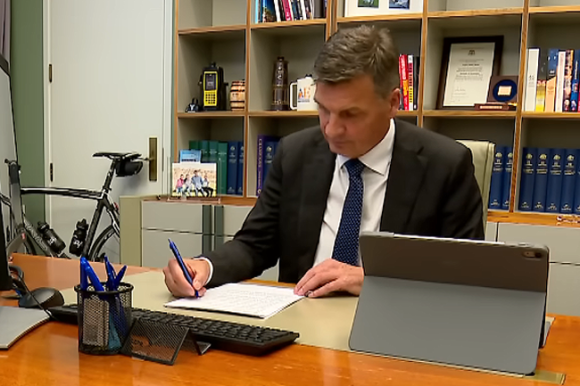
The seeds of our current stagnation were arguably sown in the wake of the 2008 Global Financial Crisis (GFC). By 2012, as the dust settled, the global policy response, mirrored faithfully in Canberra, was to prioritise the protection of the financial and corporate sectors.
While the GFC was a crisis created by reckless private sector speculation, the burden of stabilisation was socialised. Quantitative easing and massive capital injections effectively bailed out corporate balance sheets, preventing a necessary market correction.
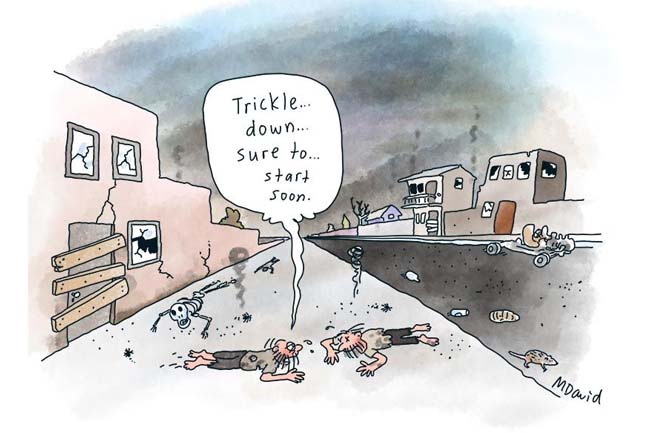
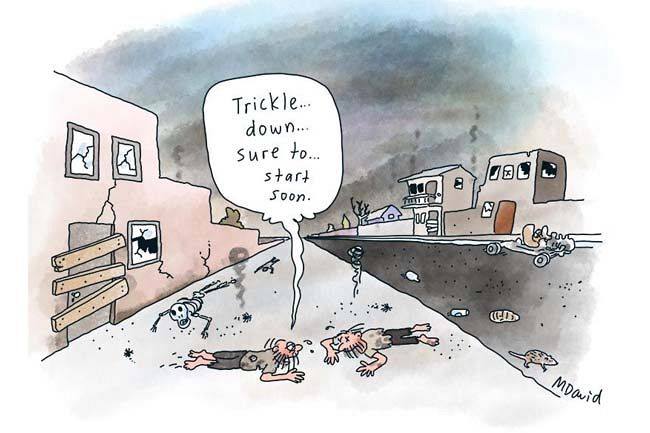
This didn’t “trickle down”. Instead, it fuelled asset price inflation, sending housing and share markets into the stratosphere while wage growth flatlined. For the average household, this meant that the cost of entry into the economy skyrocketed while the returns on their own effort remained trapped in a pre-2012 time warp, as they were sold the myth of meritocracy.
The anatomy of inequality: Casualised work and insecurity
The post-2012 era brought us the “gig economy” and an aggressive push toward the casualisation of the workforce. When labour is treated as a disposable, just-in-time commodity, the collective bargaining power of workers evaporates.
We have seen a steady shift where the risk of business cycles has been transferred from shareholders to employees. If the economy slows, the casual worker is the first to be cut, with no redundancy pay or stability to fall back on.
This job insecurity is not a feature of “innovation”, it is a policy outcome designed to suppress wages and maximise corporate margins. When workers live in a perpetual state of financial intimidation, their ability to spend, invest, or plan for the future vanishes, further dragging down the real per-capita growth of our nation.

The user-pays gut-punch
Compounding this precariousness is the relentless march of the neoliberal “user-pays” model. Across the country, the social contract is being rewritten.
From skyrocketing university fees that saddle young Australians with life-long debt to the increasing privatisation of public services and the erosion of education and health services, we are witnessing the systematic withdrawal of the state from its role as an enabler of opportunity.
These are not “efficiencies”. They are transfers of cost from the public purse, which is funded by progressive taxation, to workers, who are already struggling with stagnant wages. By forcing households to pay retail prices for what were once foundational public goods, policymakers are deliberately imposing a regressive tax on the working and middle classes by stealth.
The policy choice
It is time to reject the narrative that we are merely victims of global headwinds. Australia has some of the world’s most abundant resources and a highly skilled population. The stagnation of our real per-capita income is the direct result of a policy architecture that prizes asset-owner returns over productive investment and public welfare.
The politicians chose to prioritise the corporate sector in 2012; they chose to allow the casualisation of our workforce and they are currently choosing to dismantle the public services that underpin social mobility and civility.
A different path exists. It requires moving away from the failed trickle-down myth of the last decade, taxing resources and the ultra-wealthy and reinvesting in the people who actually drive the nation’s productivity.
Prosperity should not be an index measured in corporate dividends; it should be measured in the security, health and dignity of the average Australian household. Until our policy settings reflect that reality, most of us will be stuck in the quagmire of the “lucky-for-some country”.
Dr James Schuurmans-Stekhoven has a career defined by high-level academic rigour, a polymathic approach to research and a commitment to strategic optimisation across multiple disciplines.
 This work is licensed under a Creative Commons Attribution-NonCommercial-NoDerivs 3.0 Australia License
Support independent journalism Subscribe to IA.


Related Articles
- The richer Australians get, the sadder they become, data shows
- Farmers are anxious, but still in a pretty good paddock
- Global agencies give Australia’s economy thumbs up
- Boycott newsroom liars and restore Australia’s absent self-assurance
- Specialists refuse to correctly diagnose best economy ever