The Liberal Party's gender divide exposes a deeper crisis in Australian democracy, writes Carl Rhodes.
THE QUESTION OVER whether the Liberal Party of Australia should adopt gender quotas to address the radical under-representation of women in its ranks is a telling tale of the stubborn pervasiveness of Australian patriarchy.
The latest chapter of this long-running saga started on 25 June, when the newly appointed Liberal Opposition leader – and self-described feminist – Sussan Ley, addressed the National Press Club.
Reflecting on how her party might rebuild after its harrowing loss in May’s federal election, Ley said she was a “zealot” for increasing the representation of women in the party. She added that she would be more than happy if gender quotas were used to do that.
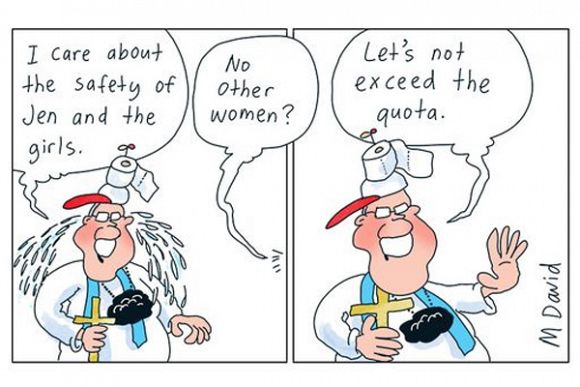
Ley’s male colleagues did not all share her zeal. Far from it, they quickly stepped in to block any possibility of change. Men from across the party, including former prime ministers, got hot under the collar, vehemently opposing any hint that female representation should be guaranteed.

Democracy or deflection?
Just two days after Ley’s Press Club address, Liberal minister Angus Taylor – runner-up to Ley for party leadership – directly challenged his leader.
Taylor did demand that his party embark on a ‘crusade’ to attract more women at all levels, from the branches to the executive.
Despite calling for a metaphorical religious war for women, he insisted that using quotas to ensure gender-balanced outcomes was strictly off the table.
He asserted:
“I don’t believe in subverting democratic processes."
Implying that Ley, the first female leader of the party, was willing to subvert democracy was a disheartening start to the Liberal Party’s so-called war for women.
Other male conservative politicians, most notably former Prime Ministers John Howard and Tony Abbott, quickly joined the man-choir against quotas.
Howard argued that political appointments should be based solely on individual merit.
He said:
“I don't think I believe in quotas for anything. I just think you have to make judgements about individuals."
Judgements, it seems, that overwhelmingly favour men. In Howard’s final cabinet as Prime Minister in 2007, only four of its 23 members were women.
Abbott echoed the sentiment, claiming that quotas were “fundamentally illiberal”. He preferred "the merit principle that should be at the heart of our party". This was the same principle that, as Prime Minister in 2013, led to a twenty-member cabinet with just one woman — Julie Bishop. And even her inclusion wasn’t Abbott’s decision.
Bishop said last year:
“I wasn’t appointed by Tony, I was there in my own right as the elected deputy leader, so they had no choice but to have me in cabinet.”
Nothing new to see here
Despite all this high-minded talk of meritocracy, democracy and liberalism, the Liberal Party’s record in gender suggests that equality has never been taken seriously. If it has, then the party has failed miserably — its supposed meritocratic and democratic processes have yielded woefully unequal results.
Ten years ago, the Liberals commissioned a confidential report on their sad record on female representation. While never officially released, the report – Room for Movement: Women and Leadership in the Liberal Party – documented a deeply regressive male chauvinist culture in the party.
According to the report, the party operated as a boys' club that actively silenced, intimidated and bullied its women members. It lacked any commitment to equality of opportunity or outcomes. Worse still, it worked actively to prevent women from succeeding. That is not liberalism — it is institutionalised exclusion.
Ominously, the report warned that if the party did not address its “problem with women” by achieving a 50-50 split of men and women in parliament, then it would face an “existential challenge”. Back then, the House of Representatives had seventeen Liberal women members. After this year's election, there were just six.
Just like today, the report argued that quotas were not the answer. The predominantly male leadership of the Liberal Party has had ample time to implement its cherished meritocratic ideals — but has clearly chosen not to.
A legacy of misogyny
The Room for Movement report came just three years after then Prime Minister Julia Gillard’s now famous misogyny speech in Parliament on 9 October 2012. An international sensation, Gillard’s speech directly confronted Opposition Leader Tony Abbott’s shameless record of sexism.
This was the same Abbott who, in 2011, was photographed addressing the crowd at Parliament House in front of placards stating “ditch the witch” and referring to Gillard as “JuLIAR … Bob Brown’s bitch”. It was also Abbott who is on record describing abortion as an “easy way out” for women.
He also once argued that:
“...by physiology or temperament [men are] more adapted to exercise authority or to issue command."
Taken at face value, that statement implies we live in a meritocracy, just one where men are inherently more meritorious. Is that why men dominate political leadership in the Liberal Party?
This is nonsense. It is male supremacism writ large as a moral justification for patriarchy.
Liberalism without pluralism
Abbott’s first outing as an anti-quota advocate was not in 2025. In 2017, when the Human Rights Commission suggested the government needed to achieve greater gender balance, he responded that such a proposal was “anti-men” and concurred that it was “politically correct rubbish”.
If liberalism values freedom, equality and pluralism, then this is not it.
The masculinist views Abbott embodies appear to have been dutifully passed on to a new generation of Liberal party men. On 4 July, leaked messages from a Liberal party WhatsApp group reinforce how attestations to political liberalism and democratic process serve as a smokescreen for a less savoury reality.
In those messages, former President of the Young Liberals Alex Dore claimed that implementing quotas for women would be akin to putting a Labor trade unionist on the Liberal Party’s board of directors.
It would appear that, according to such men, women are simply unwelcome in the corridors of Liberal power. That is neither democratic nor liberal. Its name is patriarchy, and the past few weeks have shown that it is alive and well in Australia.
A national problem
The conservative male response to the call for quotas reveals the regressive patriarchy hiding behind a thin veil of liberal rhetoric. But this is not just a matter for the Liberal party, it is a problem for the whole of Australia.
It is telling that even when the Liberals consider gender quotas, they focus on whether having more women in office will help them win elections. Reducing the value of gender equality to an electioneering tactic rather than recognising it as a fundamental aspect of equal rights and justice speaks volumes.
Even if the Liberals adopt quotas, it will still be the case that patriarchalism that Australia should have long left behind is being nurtured at the highest levels of politics.
Insofar as democracy is rooted in ideals of freedom, equality, solidarity and respect for difference, patriarchy has no legitimate place in it.
We can do better, Australia. Much better.
Carl Rhodes is Professor of Business and Society at the University of Technology, Sydney. He has written five books on the relationship between liberal democracy and contemporary capitalism. You can follow him on Twitter @ProfCarlRhodes.
 This work is licensed under a Creative Commons Attribution-NonCommercial-NoDerivs 3.0 Australia License
Support independent journalism Subscribe to IA.