Australia's Royal Commission on Antisemitism and Social Cohesion risks undermining its own purpose by excluding evidence of Islamophobia and anti-Palestinian racism, writes Wayne Hawkins.
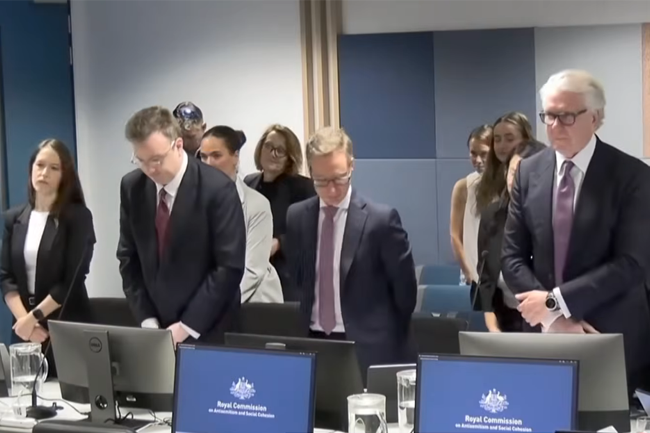
AUSTRALIA’S Royal Commission on Antisemitism and Social Cohesion is now in its third Sydney hearing block, running until 10 July.
It was established in January, in the aftermath of the Bondi Beach attack that killed 15 people on a night meant for celebration. Nobody disputes that the Commission has real work to do. The rise in antisemitic incidents recorded since October 2023 is documented, severe and deserving of the most rigorous scrutiny our institutions can offer.
But an inquiry into hatred reveals something about itself in who it decides not to hear from. And on that count, this Commission has already answered the question.
In May, the Loud Jewish Collective applied for leave to appear before the first hearing block, wanting to give evidence about their own members’ experiences of antisemitism. They were refused — the Commissioner was, in the words used to reject them, “not satisfied” that they had a direct and substantial interest in the matter.
The Australian Palestine Advocacy Network met the same fate. Two organisations, both with members who have lived antisemitism or anti-Palestinian racism directly, both judged to be outside the scope of an inquiry into hatred and social cohesion in Australia.
I find it hard to read that as anything other than a decision about which Australians get to define what cohesion means.
I wrote a parliamentary submission earlier this year arguing that Islamophobia is racism — not by analogy, not as a lesser cousin of antisemitism, but structurally, mechanistically, the same thing happening to a different group. Collective blame. The demand that an entire community continuously prove its loyalty to the actions of people who share only its faith. The recasting of legitimate political grievance – in this case, mass civilian death in Gaza – as evidence of an inherent, civilisational danger.
These are not two separate phenomena needing two separate inquiries that never speak to each other. They are the same mechanism, pointed in two directions at once, often by the same actors in the same news cycle.
The Commission’s own proceedings have illustrated the problem it was never asked to examine. Commissioner Virginia Bell described the 7 October attack, in passing, as a “Hamas invasion”, a characterisation that quietly recasts a population under decades of occupation as the invading force on their own land.
Witnesses in an SBS News report on the second hearing block have testified to being “tired” of seeing Palestinian flags at cultural events, of overhearing artists call for a free Palestine, of having to scroll past footage of starvation in Gaza on their phones.
These are real discomforts and I don’t dismiss them. But an Inquiry that treats a 45-second elevator ride past distressing news as a harm worth recording, while refusing entry to the people living the underlying catastrophe, has told us where its sympathies sit before a single recommendation is written.
This is not a call to relitigate the Commission’s right to exist, or to diminish what Jewish Australians have endured since the Bondi attack and well before it. It is a call to notice the asymmetry, because the asymmetry is the story.
No one has asked Christian Australians to account for Christian nationalist violence as the price of being heard on social cohesion. No one demands that Buddhist or Hindu Australians distance themselves from documented nationalist violence against Muslim minorities in Myanmar and India before their testimony is taken seriously. Only one direction of scrutiny in this country currently requires an entire community to prove, in advance and as a condition of entry, that it is not secretly the threat.
I don’t say this to score a point against the Commission. I say it because the same evening news that reports rising antisemitism in Australia – correctly, and without my objection – routinely fails to report the parallel rise in anti-Muslim and anti-Palestinian abuse, the vandalised mosques, the women afraid to wear hijab in public, the children told by implication that their faith makes them suspect.
A Royal Commission with “social cohesion” in its title, that structurally cannot hear from the second-largest group experiencing religious and racial hostility in this country, is not examining social cohesion. It is examining one half of a single problem and calling the result whole.
The fix here isn’t complicated and it doesn’t require abandoning the Commission’s core purpose. It requires the Commissioner to recognise that anti-Palestinian racism and Islamophobia sit inside the same terms of reference as antisemitism, not outside them — because they are produced by the same mechanism of collective blame, and because a finding on “social cohesion” that only canvasses the cohesion of part of the country isn’t a finding at all.
Bell still has time, before her final report in December, to widen the door rather than defend its current width.
Naming a mechanism early is not alarmism — it’s the only thing that has ever interrupted one before it finishes running its course. Every Australian who has had a synagogue vandalised, a mosque firebombed, or a hijab grabbed in the street deserves the same seriousness from the institutions meant to protect them.
An Inquiry that only extends that seriousness in one direction isn’t building cohesion. It’s choosing sides while insisting it isn’t.
Wayne Hawkins is an independent commentator based in Tasmania and an independent candidate for the federal seat of Clark.
 This work is licensed under a Creative Commons Attribution-NonCommercial-NoDerivs 3.0 Australia License
Support independent journalism Subscribe to IA.


Related Articles
- Antisemitism and Israel: A challenge to the Australian narrative
- Beneath the anti-Zionist Big Banana
- Here we Joh again! Queensland’s new speech bans and police powers
- How to speak Zionist: A beginners' guide to 'antisemitism'
- The poisoned word: How Palestine solidarity is branded as antisemitism