America's dwindling missile stockpiles are forcing Australia to confront the strategic risks of ever-deeper alliance integration, writes Wayne Hawkins.
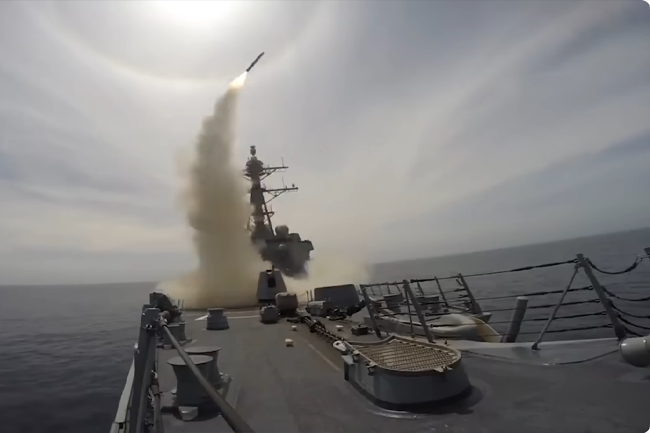
IN THE 39 DAYS between 28 February and the April ceasefire, the United States fired more than 850 Tomahawk cruise missiles into Iran – more than Operation Desert Fox and Desert Storm combined – and burned through roughly 80 per cent of its JASSM-ER inventory.
Now that the ceasefire has cracked and Operation Epic Fury has resumed, the Centre for Strategic and International Studies (CSIS) puts the true Tomahawk count above 1,000. Half the Patriot interceptor stockpile is gone. Half the THAAD interceptor stockpile is gone, along with one of only nine THAAD radars in the entire U.S. inventory, destroyed in a strike on a base in Jordan.
The Pentagon's own comptroller-level officials say replacing what's been fired will take two to five years, and as of writing, Congress hasn't appropriated the funding to do it.
That's the bill for a war against a country with no navy to speak of and a fraction of the U.S. defence budget. The number that should worry Canberra isn't the Iran total. It's the comparison. Pentagon wargames of a three-week Taiwan conflict average around 4,000 JASSMs, 450 long-range anti-ship missiles and 400 Tomahawks per iteration.
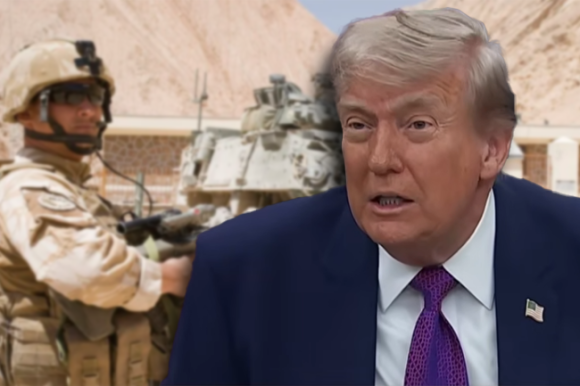
The Iran war has already burned through more than double the Tomahawks those simulations assume a China war would need — against an adversary with no serious air force, no carrier fleet and no capacity to contest the sea lanes the U.S. fired from. CSIS's own analysts call the depletion “a window of vulnerability for a potential Western Pacific conflict”.
Now play the ideological-war scenario forward, because that's the one Taiwan actually is. A war fought over resources or territory has a rational stopping point — you quit when the cost outweighs the prize. A war where surrender is existential for one side and politically fatal for the other doesn't have that off-ramp.
For Beijing, Taiwan is framed as the completion of national unification and the legitimacy of Communist Party rule; a defeat there is not a policy setback, it's regime-threatening. For Washington, backing down after committing forces would end American primacy in the Pacific in a single afternoon.
Neither leadership can afford the loss, which means neither can afford to stop early — the same dynamic that turned the Iran-Iraq War into eight years of attrition once both sides had burned through the weapons meant to finish it quickly.
Layer today's drone and precision-strike density on top of that and the outcome isn't a short, decisive war. It's mutual denial.
Ukraine already shows what that looks like: both sides can see and strike almost anything that moves near the front, so vehicles can't approach the line and infantry end up fighting at close range in airspace saturated with drones the whole time. A U.S.-China war fought by two peer-capable militaries, neither able to accept defeat, would compress the same way — expensive stand-off missiles first, drone and electronic-warfare saturation next, then a long grinding phase neither government can politically afford to end.
That is what a forever war actually means in practice: not endless intensity, but an absence of any point at which either side can stop without losing.
Australia doesn't get to opt into this later. It's already wired in. RAAF Base Tindal, near Katherine, is being upgraded at Australian taxpayer expense to host up to six U.S. B-52 bombers, each able to reach China without refuelling. Marine Rotational Force - Darwin has grown from a few hundred personnel in 2012 to more than 2,000 a year, training explicitly for Indo-Pacific contingencies.

Pine Gap operates under a policy called “full knowledge and concurrence” — Australia is told everything the base does and formally approves it. When Defence Minister Richard Marles was asked in June 2025 whether Australia supported U.S. operations against Iran, he didn't deny it. He returned to the same two words: ‘knowledge and concurrence’. A policy that's supposed to express sovereignty functions, in practice, as a formula for not answering who actually decides.
That's the structural problem and it isn't about any one minister or one alliance decision. It's that the infrastructure – the base upgrades, the rotations, the targeting data-sharing – gets built years before any government has to front the public and justify committing to a shooting war.
By the time a prime minister stands at a podium, Tindal's hardstands are already poured and Pine Gap's data is already flowing. The vote, if there ever is one, comes after the facts on the ground have already answered the question.
If policymakers in Canberra are serious about sovereignty rather than its rhetoric, the fix isn't rhetorical, either. It's structural: a binding parliamentary vote before Australian territory or Australian-hosted intelligence can be used in offensive operations, not after; a public, non-classified accounting of what “concurrence” has actually authorised since Pine Gap's last declassified review; and an independent assessment – not a Defence Department briefing – of what a Western Pacific contingency would actually cost Australia, the way CSIS has now done for the United States.
None of that requires Australia to leave the alliance. It requires Australia to stop outsourcing the decision of whether it's at war to the pouring of concrete in Katherine and the wiring of a satellite dish outside Alice Springs.
The U.S. just found out the hard way that a war it thought it could afford turned out to consume, in weeks, weapons stocks it needs years to replace, against an opponent nowhere near its equal. The next one won't come with that kind of margin. Australia should decide, in daylight and before the fact, whether it's willing to be part of that war — because right now, the infrastructure has already decided for it.
Wayne Hawkins is a small business owner in Hobart, Tasmania, and an independent candidate for the federal seat of Clark at the 2028 Election.
 This work is licensed under a Creative Commons Attribution-NonCommercial-NoDerivs 3.0 Australia License
Support independent journalism Subscribe to IA.


Related Articles
- Epic Fury, strategic failure: America’s Iran debacle
- The Iran nuclear lie and the warning signs Australia must not ignore
- America’s Iran war for oil signals environmental disaster
- Late 2026 — far from now
- Oil, war and ecocide: The destruction of the Middle East