

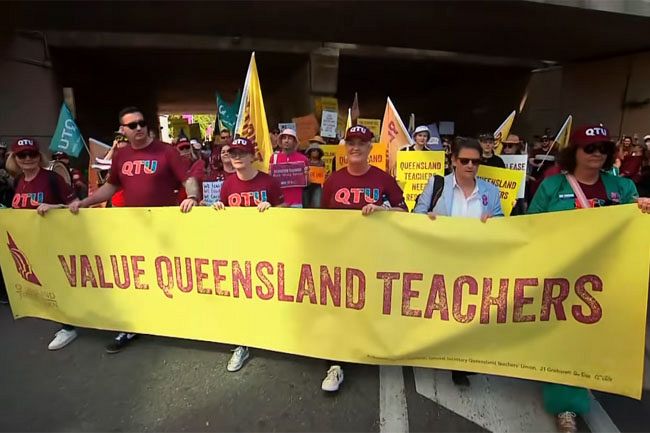
Queensland teachers recently walked off the job in unprecedented numbers, demanding fair pay, safe classrooms and respect for the profession, writes Anny Chau.
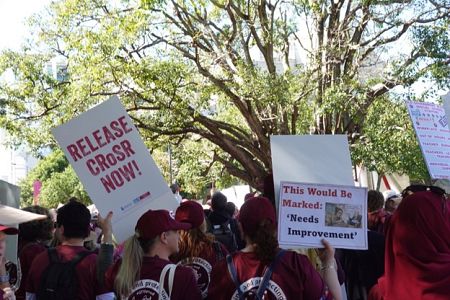
QUEENSLAND TEACHERS went on a 24-hour strike on 6 August 2025, demanding better pay and working conditions. Teachers marched from the Brisbane Convention Centre to Parliament House, delivering their demands to the Queensland Government.
Why were the teachers striking?
The Queensland Teachers’ Union (QTU) voted to go on a strike after the failure of pay negotiations with the Government a few months prior. The Government offered an 8% wage increase in three years, but has been criticised for leaving Queensland teachers among the lowest paid in the country.
“Alice”, a state school primary teacher who preferred to remain anonymous, said:
“That’s the Government’s way of saying thank you by paying us in that lowest bracket.”
What was the impact of the strike?
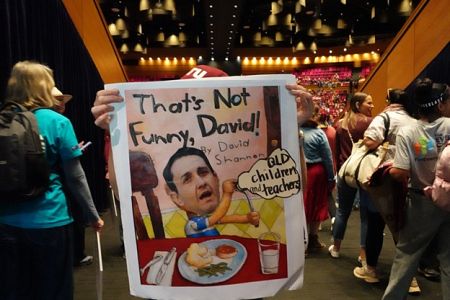
Over 38,000 union members voted for this industrial action. The union believed it was the largest strike ever, with around 50,000 teachers having gone on strike on Wednesday 6 August.
The QTU estimated there were over 560,000 students affected statewide and encouraged parents to keep their children home for safety.
According to the figure from ABC, there were only 20% of state school teachers and 13% students present in schools on Wednesday.
Kate Ruttiman, the General Secretary of QTU, described the action as “historic”.
What happened in the strike?
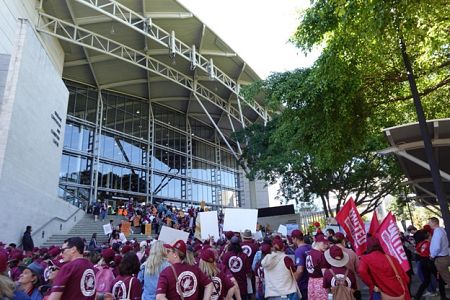
The march began at 11:45 A.M. after the union meeting. Teachers gathered at the Brisbane Convention and Exhibition Centre, holding placards and chanting slogans.
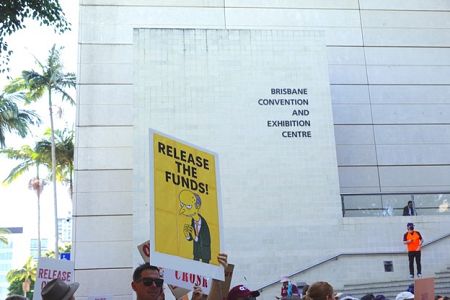
QTU president Cresta Richardson mentioned that the strike was not only about pay, but a broader issue affecting the future of education. This action was a direct response to the Government’s failure to tackle teacher shortages, unsafe working conditions and insufficient funds.
Alice said:
“Being a teacher for 30 years, the conditions over the last ten years have gone down in the funding and the support from the government.”
The Department of Education's Comprehensive Review of Infrastructure Renewal report in 2022 stated that more than 33% of school assets were rated in poor or very poor condition, with approximately $441 million needed for repairs.
Said Alice:
“Teachers have to buy their own work desk or their own chair and [use] their own resources. This is unreasonable.”
Besides the inadequate funding, Alice mentioned that state school teachers face heavy workloads outside of teaching:
“We work extremely long hours — weekends, nights and holidays.”
The strike also sparked demonstrations in Toowoomba and Rockhampton, and was scheduled for the Sunshine Coast, Gold Coast, Townsville and Cairns. Teachers in regional areas are also facing the same dilemmas.
Kelly Lineburg, a QTU union member, drove all the way to Brisbane to participate in the march on Wednesday.
Lineburg said her main reason for joining the strike was to advocate for future teachers:
“My own daughter wants to become a teacher and I’ve got a practice unit right now. So I’m thinking about the future and attracting more people to the profession that I love.”
However, the treatment of Queensland teachers is unsatisfactory.
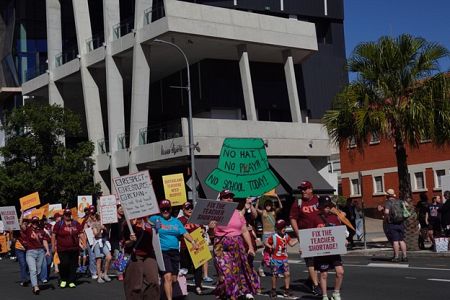
Lineburg said:
“The cost of living is challenging for our teachers entering this profession. We've been at university for four years and studying, so I think we deserve to be respected as professionals.”
Lineburg also hoped the Government could give schools sufficient funding to provide quality education, adding:
“These children are our future.”
What happened after the strike?
Following the 24-hour strike, teachers returned to the negotiation table. The Crisafulli Government decided to move a conciliation meeting five days forward on 7 August 2025, the day after the strike.
Minister for Education John-Paul Langbroek acknowledged the teachers’ concerns in a media conference on the morning of Thursday 7 August.
Langbroek claimed that the Crisafulli Government had negotiated the agreement in good faith through the Industrial Relations Commission.
The Crisafulli Government was offering $134,000 per year for an experienced senior teacher, which included additional incentives, such as regional bonuses and relocation allowances that could increase teacher salaries by over $10,000 in certain regions.
Langbroek also mentioned a second offer for new teachers, such as a starting bonus and an extra pupil-free day. Overnight camp allowance would also be considered.
While the union rejected the offers, stating that they did not meet members’ interests.
Cresta Richardson said:
“[The offer will need to cover] attraction and retention. Reducing occupational violence, resourcing in our schools, respect for the profession and salaries.”
Langbroek has acknowledged concerns regarding occupational violence:
“Occupational violence will be an important part of that. I read testimonials yesterday, no one deserves to be treated like that in their workplace.”
The Government plans to launch a workforce strategy in the coming weeks to address teachers’ concerns.

Legal considerations
The Fair Work Act provides entitled teachers to negotiate wages and working conditions. It also prohibits harassment, including physical abuse and any form of inappropriate conduct in the workplace.
Under this legislation, teachers have the right to engage in industrial action through unions and professional associations.
The QTU's strike was a demonstration of these rights, advocating the need for fair pay and safe working conditions.
Anny Chau is a student journalist originally from Hong Kong, currently pursuing a journalism degree in Australia.
 This work is licensed under a Creative Commons Attribution-NonCommercial-NoDerivs 3.0 Australia License
Support independent journalism Subscribe to IA.







