Economic inequality is reshaping Australian politics. The May Budget will decide whether Labor tackles it—or leaves the door open to populism, writes Carl Rhodes.
THE MAY BUDGET will reveal whether the Albanese Government intends to confront the conditions driving populism or continue governing in ways that allow it to grow. Debate has focused on tax reform, cost‑of‑living pressures, and housing affordability. These matter, but this budget is about more than economics.
It is about the future of Australian democracy.
The Prime Minister has long been explicit in his ambition for Labor to become the "natural party of government". But the centrism, moderation and conflict avoidance used to advance that ambition are ill-suited to today’s volatile economic and political conditions. This is not a time to focus on holding power. It is a time to exercise it.
With the budget approaching Albanese faces a defining choice. One path is to continue governing cautiously, allowing widening economic inequality to deepen disenfranchisement and giving One Nation the conditions it needs to build a mainstream populist movement.
The other is to act decisively and begin reshaping an increasingly unequal Australia by implementing policies capable of sustaining democracy and shared prosperity.
Populism fills the vacuum
Since last year’s Economic Reform Roundtable, the brutal reality of housing‑driven wealth inequality has forced its way back onto the national political agenda. Still, mainstream parties have been slow to respond.
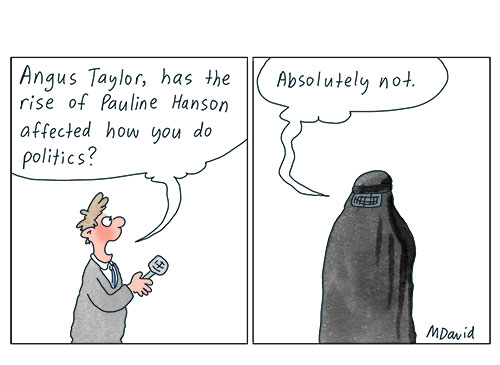
One Nation has moved quickly to fill that gap, speaking directly to the economic struggles of everyday Australians and, predictably, offering an easy scapegoat. It understands the emotional reality, naming frustrations, identifying culprits and promising simplicity in a world that feels rigged and complex.
Labor has responded with caution rather than clarity. It has clung to an increasingly anachronistic centrism, preferring incrementalism that avoids risk over confronting structural problems head‑on.
But the political centre Labor seeks to defend is no longer solid ground. The collapse of the Liberal Party’s coherence and the rising popularity of One Nation both signal that the centre is shifting, and it is a shift driven less by ideology than by economic stress.
The May budget cannot be a single fix, but it is a chance to change course, countering right‑wing populism with reforms that are economically productive rather than socially divisive.
Only a year ago, reform of capital gains tax and negative gearing would have seemed politically impossible. Now the government has signalled that such measures are no longer off limits. These settings have long driven structural inequality, and they sit at the heart of whether Australia continues down a path of entrenched division or begins to claw its way toward fairness.
When inequality goes mainstream
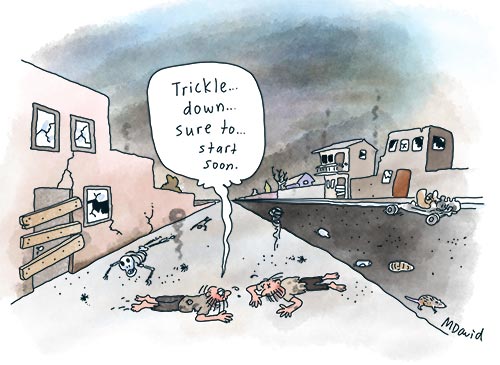
There was a time when inequality conjured only images of poverty and destitution. Poverty is worsening, but inequality has gone mainstream. One Nation’s growth is coming largely from economically insecure voters, especially former Coalition supporters and lower‑ and middle‑income Australians.
These are the people who quite rightly feel cheated by being locked out of housing, squeezed by rising costs, and ignored by cautious major parties. For these voters, One Nation doesn’t offer coherent solutions, instead turning material insecurity and frustration into reactionary political protest that is socially and racially divisive but emotionally resonant.
The question is no longer whether inequality matters. It is whether Australia has the ambition to build a fairer nation before right-wing populism hardens into something more durable.
Labor’s caution, shaped by memories of past elections lost on tax policy, is understandable but misplaced. A fair Australia demands ambition for major change, and Labor’s parliamentary majority gives it the opportunity to realise that ambition.
The tools to make change are there, and as Independent MP Allegra Spender outlined this week, Australia could cut income taxes by about $29 billion while still being budget neutral. It would mean rebalancing the system away from taxing work and toward taxing assets, including capital gains and trusts.
This is not about punishing wealth. It is about modernising a system that no longer reflects the interests of ordinary Australians. Ignoring inequality by clinging to a centrist past will not protect Labor. It will accelerate voter realignment toward parties that promise disruption, however reckless.

A time to act
The Prime Minister still has time to lead decisively. A May budget built around economic fairness would reset the government’s purpose, restore faith that politics can deliver for the many, and blunt the pull of right-wing populism.
Power that is not exercised is meaningless. Australia needs an ambition for fairness, and Labor has a rare opportunity to make that real. Albanese can choose to lead that future, or he can leave the field open to those who will reshape it far more divisively.
Carl Rhodes is Professor of Business and Society at the University of Technology, Sydney. He has written several books on the relationship between liberal democracy and contemporary capitalism. You can follow him on X/Twitter @ProfCarlRhodes.
 This work is licensed under a Creative Commons Attribution-NonCommercial-NoDerivs 3.0 Australia License
Support independent journalism Subscribe to IA.


Related Articles