Our new series, WARFARE TO WEALTH, is a progressive critique of the Federal Government's defence and foreign policy trajectory. It provides in-depth analysis of Australia's $368 billion AUKUS commitment and the broader militarisation of our economy.
It is timed to precede the ALP national conference (23-25 July) – which will shape the Government's policy platform and strategic direction for at least the next two years – in the hope that, along with growing pressure from the broader community, the arguments against this militarisation may be compelling enough to make their mark.
This article is part four of the series, Warfare to Wealth: Redirecting Australia's Future. You can read the other chapters in this series HERE. The next chapter will be published soon.The next chapter will be published soon.
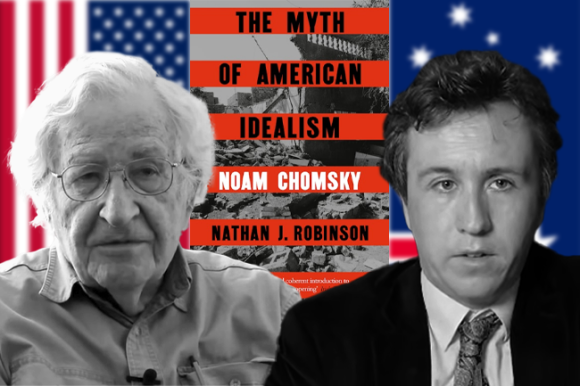
This piece follows our review of Chomsky and Robinson’s The Myth of American Idealism and asks what that myth means for Australia’s own claim to sovereignty.
Part 4: The AUKUS illusion and the death of statecraft
The AUKUS pact has prioritised military spending over diplomacy and statecraft, writes Kym Davey.
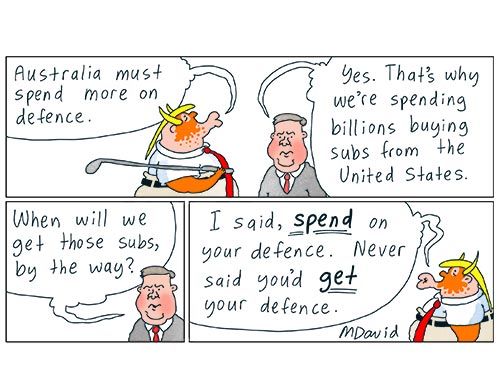
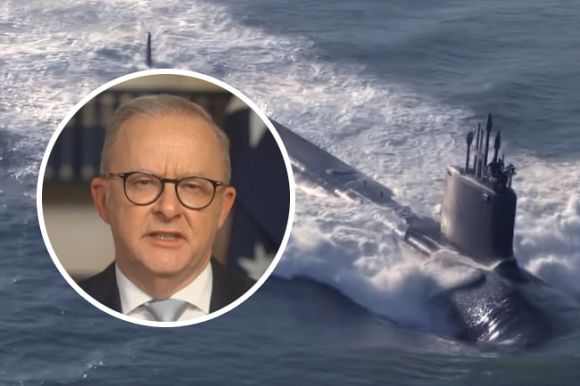
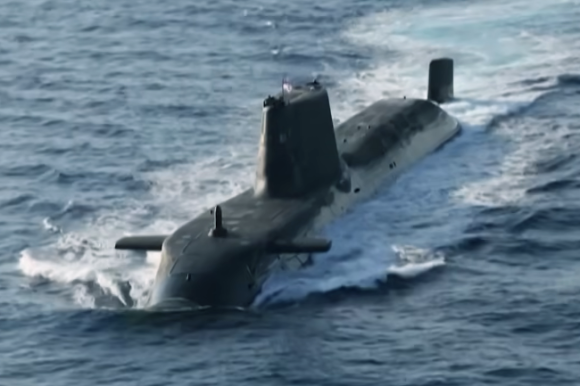
REAMS OF WORDS have been written and said about AUKUS, most of them critical about the staggering $368 billion cost of the project, the uncertainty around delivery of both U.S. and UK versions of the nuclear-powered submarines, and the risks to Australia’s sovereign agency.
By contrast, very few words have been said in explanation and defence of the project from its sponsors.
There is no evidence that AUKUS has social licence to proceed in Australia. By that, I mean AUKUS has no original community acceptance and has not earned support from the Australian people by building trust and demonstrating progress on delivery of the promised weapons systems.
I believe the absence of a social licence is a direct result of the AUKUS pact being conceived in the politics of raw power. It did not come from the development of a policy rationale or coherent defence strategy. It has yet to demonstrate either.
The threat narrative
Central to the case for AUKUS, such as it is made by successive Australian governments, is the covert and overt assertion that nuclear-powered submarines are needed to protect Australia from Chinese military aggression.
There is no doubt China has developed its People’s Liberation Army (PLA) capabilities to now claim military ascendency in the South China Sea and beyond. However, there is a clear distinction to be made between China’s growing military capability and the level of threat that it presents to Australia.
While the analysis of the growing military capabilities of the PRC is relevant to our understanding of our legitimate defence needs, it should be clearly understood that China already has the capacity to interdict Australia’s trade routes and undersea communications technology, as well as to wage effective cyber operations against our critical communications and energy infrastructure.
None of this requires a weapon to reach the Australian landmass.
It is not surprising that China feels threatened by the U.S. and, in response, has built up its defence forces significantly.
Add to this the fact that China is by far Australia’s largest trading partner, taking one third of all our exports, providing 570,000 direct jobs in Australia and driving two-way trade worth $200 billion per annum and the conclusion is surely that China already has the ability to subdue Australia economically without firing a shot.
Whereas China’s rise is presented in Australia as a threat requiring a military response, the reality is far more complex than the perception. The threat narrative omits facts that China’s critics find inconvenient.
A clear example is the balance of forces in the Asia-Pacific. The U.S. maintains 120 military bases in Japan, including the U.S. Navy base Yokosuka and the Kadena Air Base. South Korea hosts another 73 U.S. bases anchored by the massive Camp Humphreys and Osan Air Bases. The Philippines provides the U.S. with access to a further nine military sites.
Add U.S. military access to bases in Singapore, Diego Garcia and, of course, Australia, and the picture is clear: China is in fact surrounded by a massive array of U.S. and allied land, sea and air power. It is not surprising that China feels threatened by the U.S. and, in response, has built up its defence forces significantly.
Progressive patriotism
At his recent National Press Club speech, Minister for Defence Industry Pat Conroy revived the hazy notion of “progressive patriotism”. Wrapping “our investment in defence” in the traditional Labor values of fairness, equality, social justice, democracy and multiculturalism, Conroy evoked Labor’s wartime and security history.
I think Conroy's speech was a stalking horse intended to reposition AUKUS within Labor as essential to the nation's defence.
Conroy meant to tap the zeitgeist of today — a sense of patriotism. He did that boldly by criticising the track record of the very Department of Defence he has co-led for the last four years. The speech takeaway for media consumption was the revelation that $29 billion had been wasted across (a sample of) Defence procurement projects over the past decade.
For many people, expressions of “progressive patriotism” and “investing in defence to deter aggression” are uncontroversial, indeed desirable. No one in the debate around AUKUS is seriously arguing that Australia should not be able to defend itself.
However, if one looks closely at the recent contests around defence and security policy in Australia, most of the political energy has been focused on the levels of defence expenditure and the percentage of GDP Australia should invest to satisfy the demands of Washington. The problem here for Conroy and the Government is that clever rhetoric does not translate into a policy rationale for AUKUS.
Conroy’s address let the cat out of the bag when he conceded the massive cost overruns that have beset Defence procurement for over a decade. This is a central issue that all AUKUS critics agree on — the gigantic cost of $368 billion likely to blow out further still.
The deeper problem for Australia’s foreign policy is the inability of our leaders to understand the fading hegemonic power of the United States.
The death of statecraft
The likely slow collapse of the AUKUS Pillar 1 project is not a cause for celebration. Given the huge amounts of public money already spent and the gap in Australian defence capability it will likely expose, the impact of the project’s failure will be profound for Australia.
That probable reality begs the question about what can be done to promote alternatives that might work to fill the capability shortfall, and how we can better take into account our relationship with China and our Asia-Pacific neighbours.
Throughout this submission, I have made mention of the need for Australia to return to a foreign policy that prioritises statecraft and engagement with China and ASEAN nations over an offensive military posture that characterises AUKUS.
The misguided importance attached to AUKUS by successive Australian governments has corrupted both defence and foreign policy priorities. Its failure risks Australian prestige and whatever soft power we retain in our region. Allowing AUKUS to dominate Australian defence and foreign policy is a huge mistake. But the mistake is bigger than the likely failure of AUKUS. It matters that Australia’s international standing and national security have been attached so profoundly to a flawed defence project.
The deeper problem for Australia’s foreign policy is the inability of our leaders to understand the fading hegemonic power of the United States. Our national security posture is still anchored in our conviction that the U.S. will remain the dominant power in the Asia-Pacific. That is simply no longer the case.
It is becoming obvious to many in Labor that prioritising defence over statecraft does not play to Australia’s historical strengths. No matter how much we spend on building up our armed forces to meet the expectations of the Pentagon hawks, we cannot expect to counter the military power of China. Nor should we try. But it is realistic to rebuild our diplomatic stocks and to reclaim our aspiration as a creative and independent-minded middle power.
It remains to be recognised by policymakers that the armed forces of Australia should be an instrument of foreign policy, not its master. As former Foreign Affairs Minister Gareth Evans and others have long advised, it is time to articulate a foreign policy that balances traditional security and economic interests with moral decency and cooperation on global challenges.
Kym Davey is a human rights advocate and former Commonwealth and State public servant.
This article is the fourth in a multi-part series, FROM WARFARE TO WEALTH, examining the real costs of our current defence trajectory and exploring the alternatives proposed by the Make Peace a Priority (MPAP) campaign.
Read the other chapters in this series:

 This work is licensed under a Creative Commons Attribution-NonCommercial-NoDerivs 3.0 Australia License
Support independent journalism Subscribe to IA.


Related Articles
- FROM WARFARE TO WEALTH — The myth of American idealism
- FROM WARFARE TO WEALTH — Australia's struggle for strategic independence
- FROM WARFARE TO WEALTH — The $368 billion question: What AUKUS is really costing us