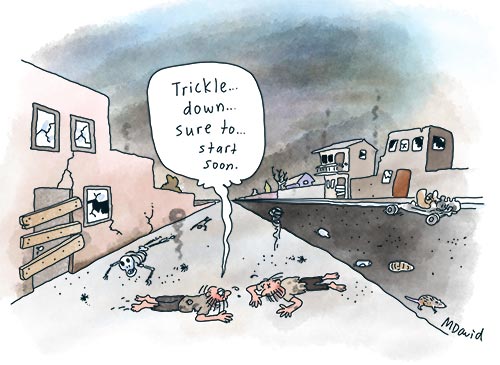
Corporate Goliaths are being challenged for putting profit before people, with ordinary Australians fighting back, writes Carl Rhodes.
FEBRUARY HAS BEEN a month of high‑profile corporate court cases in Australia, both shining a spotlight an economy where customer welfare is incidental to the pursuit of profit.
In what has been called the “case of the century”, Coles is defending a major ACCC action alleging a planned campaign to mislead customer about discounts on more than 200 everyday products.
Meanwhile, Westpac was in the NSW Supreme Court accused of acting without basic morality after using its corporate might against a customer over a trivial shortfall not of her making.

In both cases, the same pattern emerges of powerful institutions wielding legal teams, algorithms and market dominance in ways ordinary people cannot match.
These are modern David‑and‑Goliath battles, with David simply trying to buy groceries or secure a mortgage. The good news, at least this month, is that David is fighting back, and winning.
Defending the indefensible
What is particularly remarkable in both cases is the lengths to which the corporations will go to argue for moral justifications for behaviour that reeks of greed and wanton self-interest.
In Westpac’s case, Justice David Hammerschlag castigated the bank’s stance as “unconscionable”, and said it was attempting to “defend the indefensible”.
It all started when plaintiff Fiona Vinall inadvertently underpaid her mortgage after an ambiguous rate change communication from the bank led her think a reduction had taken effect earlier than it actually did.
The $44.11 shortfall was then reported to credit agencies as “adverse repayment history information”, leading to a sharp drop in her credit rating and refused loan for a new home.
Vinall repeatedly asked the bank to fix the error so she could move on with her life. The bank obdurately refused.
Even when Westpac’s lawyers appeared in court, they argued that the bank was “powerless” to fix the problem. They suddenly found the power when the Court directed Westpac’s CEO to attend. Only then did they finally reverse course and removed the black mark from her file.
As Justice Hammerschlag put it, the refusal to fix the issue was “legally unjustifiable and short on commercial morality.”
Down, down for Coles
The case against Coles is ongoing, but the evidence outlined so far is serious. Take the example of Strepsils, a lozenge people across the country rely on the ease an unwanted sore throat.
For at least 649 days Coles sold 16-pack Strepsils honey and lemon throat lozenges for $5.50. The court was told by the ACCC that the price was increased to $7 for just 28 days before being reduced to $6.
That "reduced" price was promoted as part of the supermarket’s "down, down" campaign that has been running since 2010.
Coles defended itself claiming there was no deception, that the $7 “was a genuine, undiscounted shelf price”, and that “the subsequent down down program price was […] a genuine discount”. The retailer’s position was that claimed discount was in no way misleading and represented good value.
As with Westpac, it is a ‘nothing-to-see-here’ defence.
Coles' lawyer told the court dismissively:
“All prices are temporary. Nothing lasts forever."
Cash strapped customer fighting the cost of living crisis have a different view.
One shopper said:
“It’s one of the biggest scams that ever hit the markets."
Strepsils may be striking, but it is far from the only example. The court is examining pricing behaviour of 245 household items. Arnott’s Shapes, dog food, baby formula, yoghurt and deodorant all show the same pattern of a brief price spike followed by a so‑called discount that leaves customers paying more than before.

Goliath in the system
The problem is not simply whether Coles or Westpac behaved badly. It is that the economic system we have built rewards them for doing so. When commercial gain outranks fairness, when profiteering is treated as professionalism, and when customers become data points rather than people, greed and neglect stop being aberrations, they are a business model.
But these cases show that corporate Goliaths are not untouchable. Regulators, courts and ordinary people are pushing back. Each ruling, each challenge, each customer who refuses to be steamrolled chips away at the idea that power is beyond accountability.
If we want a fairer economy, we need to confront the structures that enable and reward exploitation and disregard. That means stronger oversight, greater transparency, and a cultural shift that recognises that markets serve society, not the other way around.
David may be winning this month, but lasting change will require more than a slingshot. It will require rewriting the rules so that fairness and decency are not exceptions, they are the standard.
Carl Rhodes is Professor of Business and Society at the University of Technology, Sydney. He has written several books on the relationship between liberal democracy and contemporary capitalism. You can follow him on X/Twitter @ProfCarlRhodes.
 This work is licensed under a Creative Commons Attribution-NonCommercial-NoDerivs 3.0 Australia License
Support independent journalism Subscribe to IA.


Related Articles
- EDITORIAL: Food, energy and news: It’s a neoliberal inequality thing
- Shop Small! The duopoly of Woolworths and Coles is killing small business