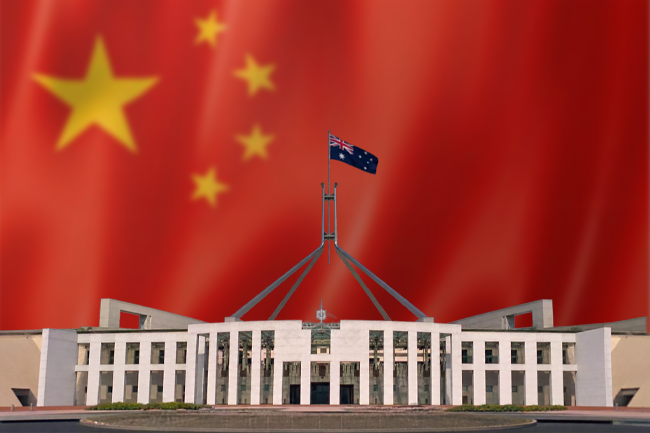
Australia is arming against China while remaining economically dependent on the very power it is preparing to contain, writes Professor Vince Hooper.
ON 6 JULY 2026, two things happened in the Pacific within hours of each other.
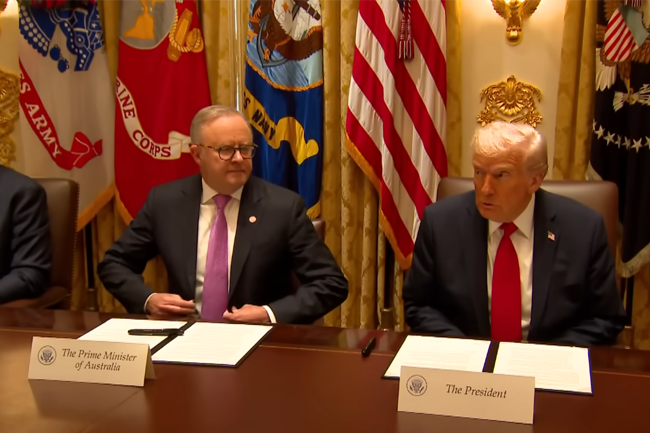
In Suva, Prime Minister Anthony Albanese signed the Ocean of Peace Alliance with Fiji's PM, Sitiveni Rabuka, making Fiji Australia's fourth formal defence ally.
In the South China Sea, a People's Liberation Army Navy submarine launched a ballistic missile carrying a dummy warhead into the same ocean, the first Chinese submarine-launched ballistic missile ever fired into international waters.
The juxtaposition was exquisite: one country signing pacts to keep the Pacific safe, another demonstrating it could render the Pacific incandescent.
A few weeks earlier, Singaporean diplomat Kishore Mahbubani had restated his familiar thesis: Asia is merely reclaiming the economic weight it held for 18 of the last 20 centuries and the West's refusal to accommodate that rebalancing is fuelling conflict rather than forestalling it.
The question for Australia is whether Canberra belongs in Mahbubani's frame at all. Australia is not the West in any structural sense: it is a middle power whose largest trading partner is China, whose security guarantor is America and whose geography makes it a Pacific country whether it likes it or not. It is a nation trying to hold a position that the underlying geometry of the world economy is quietly dissolving.
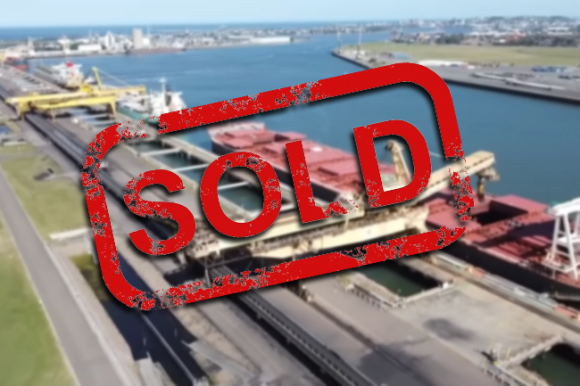
Start with where the money is. Australia exported $196 billion to China in 2025, roughly 29% of all exports. Iron ore is the single commodity that keeps the bilateral calculation tilted in Canberra's favour. Australia accounts for more than half of the world's seaborne iron ore supply and China consumes the majority of it.
Apply a Herfindahl-Hirschman Index (HHI) to Australia's export book and the concentration risk is immediately visible: a single buyer dominates a single commodity class to a degree that would trigger an antitrust review in any other market.
That asymmetry has, until now, worked as mutual deterrence. Beijing cannot punish Canberra on iron ore without cratering its own steel industry; Canberra cannot pivot away from Chinese demand without blowing a hole in the federal budget. Treasury modelling suggests a $14 per tonne fall in iron ore prices would strip up to $2.1 billion from Commonwealth revenues by 2028-29.
But mutual deterrence only holds as long as neither side can find the exit.
In November 2025, Guinea's Simandou mine began production and by January 2026, its first commercial cargo had reached Zhejiang province. With it, Beijing began building the door. The project holds 2.4 billion tonnes of ore grading 65% iron, comparable to the best of Brazil's Carajás and cost $23 billion to bring to production.
SimFer expects five to ten million tonnes in 2026, ramping toward 60 million per year within 30 months. The Winning Consortium Simandou, dominated by Chinese state-linked firms including Baowu Steel, controls the other half of the range. China is not abandoning Australian iron ore; it is building an alternative that lowers the HHI of its own supply chain. Each tonne from West Africa chips away at the structural leverage Canberra once assumed was permanent.
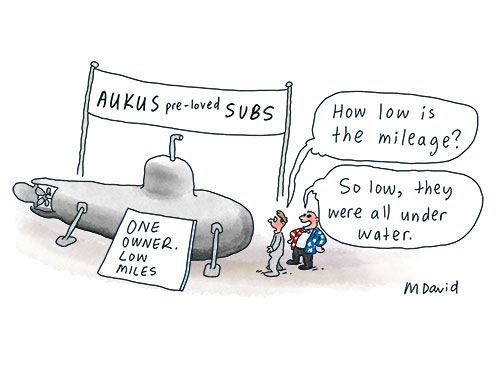
The defence ledger is moving in the opposite direction, toward maximum concentration. In July, Canberra committed a further $4.6 billion to the Osborne shipyard in South Australia, bringing total AUKUS submarine infrastructure spending to $8.5 billion.
At the Shangri-La Dialogue in May, the three partners revised the pathway: Australia will now acquire three in-service Block IV Virginia-class submarines from the U.S. Navy rather than the original plan, which included one newly built boat. The decision eases pressure on America's backlogged shipyards but means the Royal Australian Navy's first nuclear-powered submarines will arrive with a substantial portion of their reactor life already consumed.
Under the revised timeline, the third transferred boat could reach the end of its service life around 2061, a decade earlier than a new-build would have managed.
Think of AUKUS as a call option: it gives Canberra the right, but not the obligation, to project undersea power across the Indo-Pacific at some future date, in exchange for an upfront premium measured in the tens of billions. But the premium is being paid now and the underlying asset, a functioning nuclear submarine fleet, does not settle until the early 2030s at the earliest.
In options language, the time value is enormous. And every dollar of premium is visible to Beijing, because defence spending is not a private hedge; it is a public signal about which future Australia considers worth insuring against. The more Canberra pays for the option, the harder it becomes to pretend the relationship it is pricing against is purely commercial.
Nowhere is this tension more visible than at Darwin Port. In 2015, the Northern Territory Government leased the port to Landbridge, a Shandong-based company, for 99 years. Both major parties now want the lease unwound. In January 2026, Ambassador Xiao Qian warned that Beijing would “take measures” if Canberra tried to claw back the concession.
By May, Landbridge's owner had filed a claim at the International Centre for Settlement of Investment Disputes, arguing the revocation would breach the China-Australia Free Trade Agreement. The port sits at Australia's northern edge, close to key Indo-Pacific shipping lanes and the staging area for U.S. Marine rotations. It is simultaneously a commercial asset, a security liability and a diplomatic tripwire: the physical embodiment of a country trying to separate its economic and strategic selves.
Albanese's Pacific diplomacy is the attempt to square this circle through geography rather than ideology. Since 2023, Australia has signed security agreements with Tuvalu, Nauru and Vanuatu, a full defence treaty with Papua New Guinea and now a mutual defence pact with Fiji. Each agreement contains a consultation clause giving Canberra a say whenever a partner considers granting a third party access to sensitive domains.
The target, obviously, is China. But as Fiji's Rabuka pointedly noted, these are exercises of sovereign right, not acts of hostility. The Pacific island states are playing their own options, keeping multiple suitors in the game to extract the best terms for themselves.
The fat-tail risk in all of this is that the managed equilibrium fails suddenly rather than gradually. Expected shortfall analysis asks not “what is the most likely outcome?” but “given that we are already in the worst 5% of scenarios, how bad does it get?”
For Australia, the tail scenario is not a war over Taiwan, although that features in every think-tank simulation. It is something quieter and more corrosive: a sustained Chinese economic reorientation, Simandou at full capacity, iron ore below $85 a tonne, an American security guarantee rendered unreliable by domestic dysfunction, and a Pacific neighbourhood that decides Beijing's infrastructure dollars matter more than Canberra's consultation clauses.
Will Canberra try to thwart the rise of China? The honest answer is that it already is, in every way short of saying so. The trajectory is legible in a single arc that runs from the Huawei 5G ban in 2018 through the foreign interference laws, the Darwin Port revocation and the Pacific alliance web, all the way to the welding bays at Osborne.
No country that was seeking accommodation would be building nuclear submarines with its security guarantor while simultaneously trying to unwind a port lease with its largest trading partner. But no country with unlimited room to manoeuvre would still be sending 29% of its exports to the power it is arming against. Australia is not constrained by ambivalence; it is constrained by arithmetic.
Mahbubani would call this the last spasm of a Western-aligned order that cannot accept its own relative decline. He may be right. But the diplomats in Suva drafting consultation clauses and the submariners training on Virginia-class boats at Pearl Harbour are betting that the transition need not be managed on Beijing's terms alone.
Whether they can sustain that bet, with the premium rising and the underlying shifting, is the defining question of Australian strategy for the next quarter century.
Stuck between a rock and a hard place — except the rock is iron ore, the hard place is a submarine hull and somehow Australia's paying for both.
Professor Vince Hooper is a proud Australian-British citizen and professor of finance and discipline head at SP Jain School of Global Management with campuses in London, Dubai, Mumbai, Singapore and Sydney.
 This work is licensed under a Creative Commons Attribution-NonCommercial-NoDerivs 3.0 Australia License
Support independent journalism Subscribe to IA.


Related Articles
- Silk Silver Opium: The trade with China that changed history
- Galloping through cultures: How horses connect humanity
- Albanese visit signals stability in China relations
- Postcard from the People’s Republic: Albo woos Uncle Xi
- Albanese courts China as allies watch warily