Australia is enjoying a rare era of sustained economic calm and stability, which the mainstream media actively denies, as Alan Austin reports.
GROSS DEBT was $971.4 billion last Friday, according to the Office of Financial Management. That’s not much more than the $946.4 billion borrowed in October 2024.
For the last 20 months, gross debt has fluctuated between $910 and $995 billion, and shows no sign of exiting this band.
Australia’s net debt in May, also reported Friday, was $537.4 billion, less than the $541.0 billion level in April 2022, just before Labor took office. Over Labor’s entire four years, net debt has remained between $484 billion and $567 billion, with no indication this will blow out either. That is remarkable stability.
Unprecedented calm and predictability
Australia’s inflation rate for the year to May posted last Wednesday was 3.96%, extending the streak of CPI rises below 4.2% to 32 months.
Gone are the days of inflation at 7% when Josh Frydenberg was trying to be Treasurer in 2022, or 11% when John Howard was failing at the same job in the 1980s.
Interest rates have now been in the optimum band 3% to 5% for an impressive 43 months. See chart below.
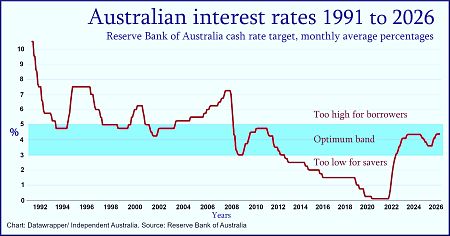
No longer do the elderly suffer a miserable 0.25% return on their life savings, or less, which Frydenberg imposed for two years. Nor must home buyers pay 8.5% interest on their loans, as when Peter Costello was trying to manage the economy.
The unemployment rate, announced last Thursday, fell from 4.48% in April to 4.36% in May, stretching the extraordinary run of numbers below 4.5% to 54 months.
Job vacancies fell again in May to 329,500, well below the peak of 473,100 in the 2022 election month. For Labor’s entire term, this variable has steadily declined towards the sweet spot, currently about 320,000, with no significant blips.
For 55 months now, job participation has remained constant at the optimum 66.5%, plus or minus 0.7%.
Business investment has strengthened over the last five years. See chart below.
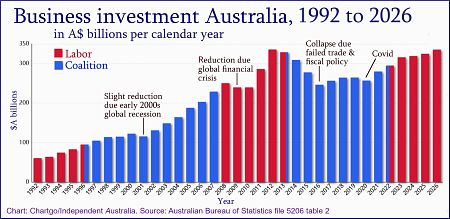
Gross operating profits for all corporations (excluding the volatile mining sector) hit an all-time high $84.6 billion in the March quarter. That’s up from $68.7 billion in March 2022, just before Labor took office, an average annual growth rate of 6.2%.
Employees have shared the nation’s affluence. Since Treasurer Jim Chalmers' first Budget in October 2022, the CPI has risen 13.9%. The minimum wage, average wages, the age pension, jobless benefits and Commonwealth rent assistance have all increased much more than that.
Other outcomes which have improved steadily include household wealth, consumer spending, social housing, engineering construction, exports and national income.
Clearly, Australians are enjoying an unprecedented period of restored economic strength, prosperity and predictability.
Media falsification of the record
Instead of celebrating this, the newsrooms are constructing an entirely false narrative.
Recent negative headlines framed to deceive audiences include:
- ‘Grim Jim Chalmers spinning up a whirlpool in sea of red’ (The Australian, 21 April);
- ‘Australia weeks away from worst economic crisis in decades’ (Sunrise, 20 April);
- ‘Desperate Treasurer is facing a credibility gap’ (The Nightly, 6 May);
- ‘Treasurer facing backlash over Federal Budget’ (Nine News, 13 May);
- ‘Lazy treasurer: Jim Chalmers takes huge reputational hit after federal budget lies’ (The Australian, 20 May);
- ‘Australia's economic slowdown is just beginning, economists warn, as recession risks rise’ (ABC News, 4 June); and
- ‘A third of Australian businesses find meeting financial costs difficult, shock new data shows’ (Sky News, 26 June).
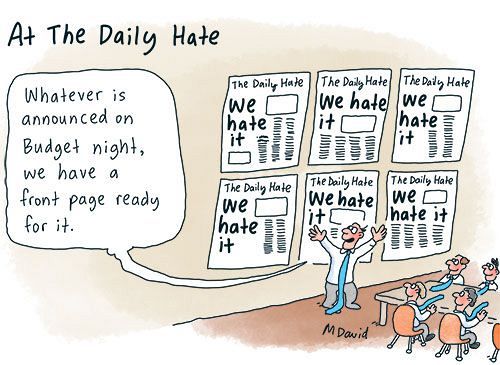
Shock! Worst crisis in decades! Desperate Treasurer! These are ridiculously mendacious. So are the writers simply ignorant of the data proving the economy is now the best-performed ever? Or do they know but are paid to tell porkies?
Refusal to report the 2025 roundtable
Arguably, the most heinous current evil of Australia’s corrupt commentariat is pretending the Treasurer’s economic summit convened last August never happened.
This was where the Government was urged – by unions, economists, the media, welfare lobbyists and others – to abandon the timid housing and taxation policies it took to the 2022 and 2025 elections and to implement bold reform.
Powerful voices demanded that all earlier commitments be set aside and “everything placed on the table”.
CEO of the Grattan Institute, Aruna Sathanapally, warned that ‘the longer we wait, the more ill-fitting our tax system is going to be and the harder this task gets’.
That task, she said, was ‘to wind back income tax concessions for housing and superannuation that are distorting our tax system and our economy’.
Sathanpally urged Prime Minister Albanese and Chalmers to deliver this in the May 2026 Budget:
‘The Government cannot let this momentum lapse... Next year’s budget is a golden opportunity for this government to take some measured steps towards rebalancing our income tax system, with two years before the next election.’
Similar calls came from economists Kristen Sobeck, Chris Murphy, Saul Eslake and Matt Grudnoff, and from the welfare peak body, the Australian Council of Social Service (ACOSS).
The media joined the clamour.
Peter Hartcher wrote in the Sydney Morning Herald:
‘The common refrain from frustrated commentators and would-be reformers is that, with his swag of 94 seats in the House, Albanese has enormous political capital and he now must spend some to achieve reform.’
The Government acceded to these demands and all the so-called “broken promises” the media are now bewailing were renegotiated.
It is certainly fair to note that the Government did abandon its promises and to caution that this ought not be undertaken lightly. But the destructive pile-on today is reprehensible.
Those malevolent actors in the media and politics now depicting the Government as “liars” and who refuse to acknowledge its substantial achievements deserve condemnation. They are the malicious liars.
Alan Austin is an Independent Australia columnist and freelance journalist. You can follow him on Twitter @alanaustin001 and Bluesky @alanaustin.bsky.social.
 This work is licensed under a Creative Commons Attribution-NonCommercial-NoDerivs 3.0 Australia License
Support independent journalism Subscribe to IA.


Related Articles
- Flailing newsrooms flog fears of a fictional recession
- Lucky for some: Australia’s per capita recession
- The richer Australians get, the sadder they become, data shows
- Farmers are anxious, but still in a pretty good paddock
- Global agencies give Australia’s economy thumbs up