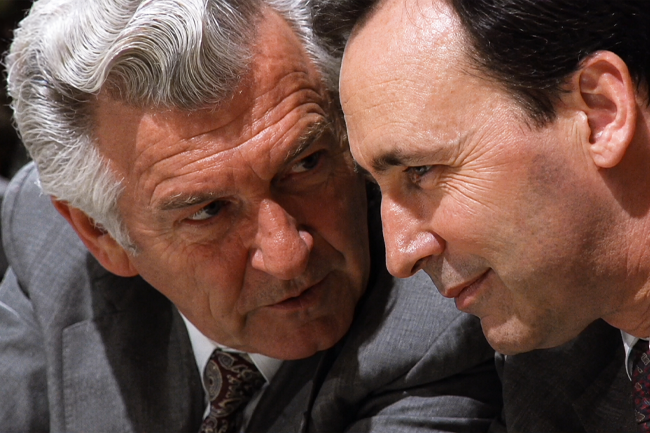
More than four decades after the Hawke-Keating Accord reshaped Australia's economy, it's time for a comprehensive review of what it delivered and what it cost, writes Kaijin Solo.
IN BEGINNING this discussion, I want to acknowledge the land I’m on and its people, be they Indigenous or, as we now say, First Nations.
Be they corn stalk, currency people, Federation people or post-World War immigration people or post-1967 Referendum immigration people, I also want to acknowledge the gains made by those people, our people, usually by a grassroots movement, and/or their guilds, societies, trade unions or non-government organisations.
Having said that, I want the 1983 Hawke-Keating Accord reviewed with bookends at 1983 and 2026. I say that because a short time ago, the Cambridge School of Economics in London announced it did not think the economics of the northern hemisphere could be practised in the southern hemisphere successfully.
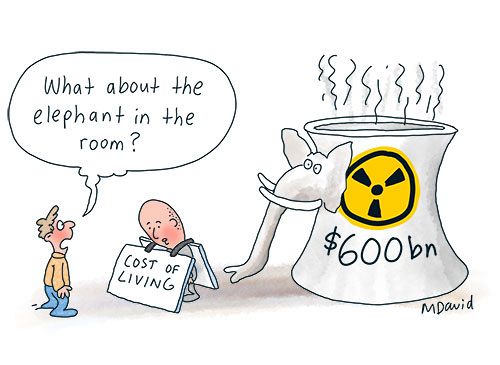
Australia is geographically located at the epicentre of the southern hemisphere and, looking forward, we need to be proactive in our economic policy. An overview of the national discussion at present is anything but – fair enough – the "Australian Dream" is now the Australian nightmare and the cost of living is a major political debate as we speak.
Let me make a point here that I am definitely not proposing “Ausexit”. I am definitely not a racist, nor is this just a whinge for clickbait.
This is actually a call for an intelligent discussion about the way we deal with the world. As it stands, the Federation is vulnerable to a global marketplace that is a beast of its own choosing. Before that gets railroaded, I am not quoting the Bible; I am appropriating that quote from the Hippocratic Corpus and putting it in much better context than its original use.
I suppose a cartoonist might say I’m sending the lifesavers out for the babies who got thrown out with the bath water.
Number one on the list, in my opinion, was the cancellation of the arbitration court. The legal home of not just the eight-hour day but, more importantly, “the anti-sweating” policy of the Federation and the minimum wage. The legacy of, in my opinion, the best and fairest judge in Australian history, the Most Honourable Justice Henry Bournes Higgins.
Robert Menzies himself wouldn’t have dreamed of touching the arbitration court or the system that Higgins pretty much set up single-handed, bearing in mind that law is a process and involves many people.
In 1987, former PM Bob Hawke said:
“By 1990, no Australian child will be living in poverty.”
Well, it's 2026 and if I ask the Australian Council of Social Service (ACOSS), The Smith Family, The Salvation Army, St Vincent de Paul for the cold facts on poverty in Australia, what do you think the report card really looks like?
What I’m leading up to is simply this: the current form of economics has failed its mission statement and therefore is not fit for purpose. The fact that the current treasurer has managed to make some sense out of the backyard straight he was handed for a Federal Budget says nothing good about the economics that caused it, though it does, I admit, say something positive about the ability of the current treasurer.
In calling for this review, I want to respectfully remind Prime Minister Albanese that the NSW Nurses and Midwives Association stood in formal democratic opposition to Hawke-Accord Version 1 in 1983, and as you are a lifetime member of the Labor Party, I expect you to know the foundation of that democratic principle which I am citing in calling for a complete review of the Hawke-Keating Accord.
- What has it delivered?
- What hasn’t it delivered?
- What gains have the people made?
- What sacrifices have the people had to make?
- What was the cost of living in 1983?
- What is the cost of living in 2026?
- What was the state of the national economy in 1983?
- What was the state of the international economy in Australia in 1983?
- What is the state of the national economy in 2026?
- What is the state of the international economy in Australia in 2026?
- What was the cost of a three-bedroom cottage in 1983?
- What is the cost of a three-bedroom cottage in 2026?
- How many local bank branches were there in 1983?
- How many local bank branches are there in 2026?
- How many banks were there in 1983?
- How many banks are there in 2026?
The list is going to be much more exhaustive than the few I have rattled off there, admittedly, not just to get your attention but to get you to realise we need to get on top of these problems. All of the above are macroeconomic policy items.
Macroeconomics is not chartered practising accountancy, but the arena that all of CPAs operate in. So yes, we need to upgrade what was and still is the macroeconomic theory of Robert James Hawke. No one has really said anything since Hawke and Keating; we have just suffered the failings of the media item called the two-party system.

And as the L-NP struggles to save itself, and the ALP struggles to maintain some sense of order, we need to see through the façade and start to deal with Gulliver Le Monde in a more sovereign fashion, bearing in mind that actual sovereignty is the suffrage of the people.
As for giving Gulliver his surname, it amuses me that political scientists wrestle with who was Lilliput and who was Blefuscu. When the obvious question is, who was Gulliver? There is nothing new about the world; the global economy is just its latest nickname.
As for the other two, they lived between Van Diemen’s Land and Jakarta, now called Tasmania and Jakarta; ironically, there are 8,000 metres between Black Mountain and Mount Ainslie, the two hills Canberra is named after, and it would only take a flood to turn them into islands. Just in case someone needed a further point of reference.
We need to first review the Hawke-Keating Accord, then make the necessary adjustments to redeem the babies we threw out with the bathwater. As for Gulliver Le Monde, the global economy, as it calls itself, is more than able to adjust and it is certainly in its own interest to do so.
This will not happen overnight, but it will happen. The question I’m asking the phalanx in Plato’s cave, previously called the National Tertiary Education Union, to put it bluntly, can you now see what the challenge actually is?
I have finished my background study on what would have been my doctorate called Commonwealth of the Sovereign Territorial Australian Republic, but rather than write a book, I want to implement my findings via a national et al that includes local meetings in local government areas on local country so the people are involved in the process.

I have left talking about macroeconomics until now because I deemed the structure of the virtual building and the structure of the written constitution more important. However, if becoming a republic does not improve the financial lot of the Australian people at large, then what is the point of the exercise?
The Australian people are interested in family and friends, community and culture. In asking them to subscribe to Commonwealth, citizenship and liberty, we need to alleviate the enormous financial strain they are under; whether trying to survive on wages or run their own business, the situation is not good as we speak and merely wringing our hands in token empathy is just dangling garlands over the chains.
We are located well academically with regard to the world. We are not an irresponsible nation and have many allies in both the Commonwealth league and the United Nations. Just as surely as the rate of change is the most important thing about change, the way we say this to the global economy needs to be cognisant of other nations.
Don’t you think other nations might support us? Don’t you think when they look at Australia, they don’t get concerned? We were once hailed as the champion of the small nations. Of course they are concerned; of course they will cheer if we do it temperately — that is to say, bravely and wisely.
In closing, can we outgrow looking for just one person and realise I may have defined the problem, but what is it going to take to have a team that will book in for the long haul? In an age of dead poets, cognitive dissonance, quick fads and fizz with no substance, is there anyone out there with enough on board to step up to the crease?
Or are we going to live in a permanent state of after the gold rush, telling young people about an Australia that was and doing nothing about what Australia is becoming?
Are we Australia or what?
Kaijin Solo is a general engineer by trade who holds a BA in Ancient Cultures and Creative Arts and Certificate IV in Training and Assessment. He was also a candidate in the 2001 Federal Election. You can follow Kaijin on Twitter/X @KaijinSolo.
 This work is licensed under a Creative Commons Attribution-NonCommercial-NoDerivs 3.0 Australia License
Support independent journalism Subscribe to IA.


Related Articles
- Truths about price rises they don’t want you to know
- The business investment boom will spark a surge in productivity
- Investors applaud resilient economy while newsrooms refuse to report it
- Australia's export slump quietly dragging down the economy
- Economists and newsrooms collaborate to lie about Australia’s economy