Australia’s approach to China reveals a strategic double standard that judges allies and adversaries by very different rules, writes David Higginbottom.
This article is part one in a two-part story. Part two will be published tomorrow, Tuesday 25 August.
AUSTRALIAN DEBATE about China often begins with a narrow question: is Beijing a threat?
It is a serious question and it deserves serious answers.
But it is not the only question:
Why do some states’ actions become proof of a fundamental threat while comparable conduct by allies is rationalised, minimised or ignored?
An earlier article proposed an answer in the form of an implicit four-tier framework.
Australia appears to sort countries, not always consciously, into four categories:
- Tier 1 contains unconditional allies, principally the United States and, to a lesser extent, Britain;
- Tier 2 contains democratic partners whose support is valued but not automatic;
- Tier 3 consists of states, including authoritarian states, with which Australia manages differences through practical engagement, but otherwise ignores; and
- Tier 4 contains designated adversaries whose conduct is presumed hostile and whose positive actions carry little weight.
The strength of this framework is not that it proves every Australian decision is cynical — its value is that it helps explain apparent inconsistencies.
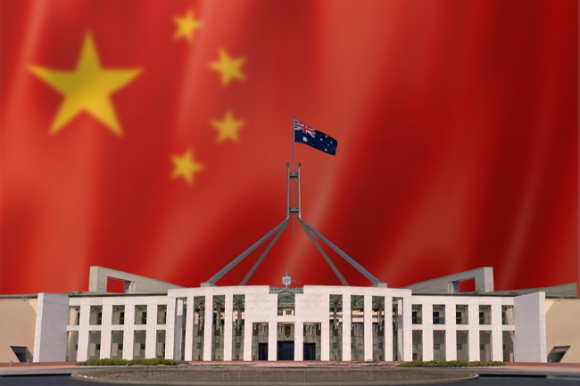
The central development in Australia-China relations, from 2016 to 2022, was China’s movement from a Tier 3 partner to a Tier 4 adversary. Once that shift occurred, the question was no longer merely what China did. It was what China’s actions were presumed to mean.
The same foreign policy that once treated China as Australia’s largest commercial opportunity began treating trade, investment, technology, research links and diplomatic contact as potential vectors of strategic danger.
The language of risk can sometimes be justified. But it can also be self-confirming: the same conduct, when undertaken by an ally, is characterised as competition, diplomacy or business, but becomes interference, coercion or infiltration when Chinese.
Xinjiang: security context is not an excuse — and human rights are not a weapon
Xinjiang illustrates the danger of forced choices. A fair account must begin with acknowledging history — China did face a serious security challenge. In 2014, the United States Military Academy’s Combating Terrorism Centre published a detailed study of Uyghur-linked militancy, including attacks in Beijing, Kunming and Urumqi, the Turkistan Islamic Party’s propaganda, and connections between a small militant network and conflicts beyond China.
A contemporaneous Australian analysis also described both Uyghur marginalisation and separatist violence as factors in an increasingly volatile Xinjiang.
These sources do not validate Beijing’s later policies. They do not establish that pervasive surveillance, mass detention, coercive labour allegations or religious restrictions were necessary, proportionate or lawful. Nor does the existence of militant groups license the collective treatment of a Turkic, overwhelmingly Muslim population as a security problem.

But the sources do mean that an account of Xinjiang which begins in 2017 or 2021, and ignores the violence and fear that preceded it, is incomplete.
That incompleteness matters because the international narrative changed as China moved from partner to strategic rival. Western governments increasingly framed Xinjiang principally through the language of genocide and crimes against humanity. Some of these allegations are grave and must be tested against the best available evidence.
But an Australian policy worthy of the name should be able to hold two positions at once: genuine abuses should be scrutinised and condemned; a real history of terrorism, separatism and ethnic tension should not be erased to make China appear uniquely irrational.
The four-tier framework raises a further question: would Australian moral urgency be as intense, public and punitive if comparable abuses were committed by a state in Tier 1 or Tier 2? The test of a human rights principle is not whether it can be applied to an adversary. It is whether it survives contact with an ally.
This is why source provenance matters. The ABC’s investigation of Falun Gong, together with the Snopes investigation of links between Epoch Times-associated personnel and The BL (The Beauty of Life), a pro-Trump media outlet, documents the political activism and media strategies of some anti-Beijing networks.
This does not mean that all reporting amplified by those networks is false, or that allegations of abuse in Xinjiang may simply be dismissed. It means that claims should be verified through transparent, diverse and independently corroborated evidence — precisely the standard demanded of all sides in a contested information environment.
Huawei: a case study in selective security
The Huawei controversy exposes the same underlying asymmetry. The company’s exclusion from Australia’s 5G rollout was justified on national security grounds. Australia is entitled to take network security seriously, especially where critical infrastructure is concerned. It does not follow, however, that allied intelligence assessments should be treated as self-validating or that comparable conduct by allies is beyond moral and political scrutiny.
The 2014 Snowden disclosures showed that the U.S. National Security Agency had infiltrated Huawei’s servers in Operation Shotgiant. Reporting by The New York Times, Der Spiegel and The Guardian described an effort to obtain technical information, read the communications of Huawei executives and understand how Huawei equipment might be exploited in networks around the world.
The United States was publicly warning that Huawei could create access for Chinese intelligence while its own agency was seeking access to any network using Huawei equipment.

This does not prove that Huawei created no security risk. The fact that a U.S. intelligence agency wanted to exploit a foreign company’s technology cannot decide whether Australia should use that company in critical networks. It does, however, reveal a double standard in the public narrative.
When potential access is attributed to China, it is presented as an exceptional threat to sovereignty. When demonstrated access is pursued by the United States, it is generally treated as ordinary intelligence practice.
That distinction is at the heart of the four-tier system. Tier 1 conduct is presumed protective. Tier 4 conduct is presumed predatory. The action may look similar; the moral and political vocabulary changes with the actor.
Institutions, incentives and the making of consensus
The shift in China policy was reinforced by an ecosystem of intelligence warnings, strategic commentary, media headlines and defence-industry incentives. Critical investigations have raised questions about the Australian Strategic Policy Institute (ASPI)’s funding from government, foreign-government and defence-industry sources, as well as the movement of senior personnel between government and major defence contractors.
Those concerns do not demonstrate that a particular report or procurement decision was dictated by a donor. ASPI maintains that it has editorial independence. They do show why transparency, disclosure and intellectual diversity are essential when institutions that shape threat perception are funded by parties with an interest in security spending or geopolitical alignment.
The media performs a similar role. Commentary by John Queripel and Fred Zhang argues that Australian reporting has often made China the default villain, elevating security theatrics over diplomacy and recasting ordinary commercial activity as an “assault” or “surrender”. Whether one agrees with every example, the broader caution is sound: a public sphere saturated with threat language cannot easily sustain calm, evidence-based debate.
The purpose of this argument is not to romanticise China. China is a powerful state with its own interests, coercive capacities and deeply contested domestic policies. It is to ask Australia to practise the consistency it claims to defend.
If human rights are universal, they cannot be selectively invoked. If sovereignty matters, it cannot be breached in the name of an ally and held absolute with an adversary. If security assessments are necessary, their evidence and assumptions must be subjected to the same scrutiny regardless of which great power benefits.
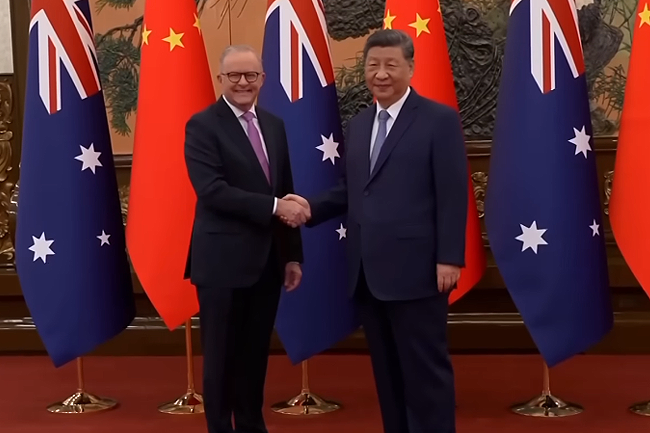
Australia has begun to stabilise its relationship with China through dialogue and pragmatic cooperation. The Government’s formula is sound: cooperate where possible, disagree where necessary and engage in the national interest. But that approach will remain fragile while the Tier 4 reflex survives beneath the rhetoric.
This is part one of a two-part story. Part two will be published tomorrow.
David Higginbottom is a member of the coordinating committee of the Independent and Peaceful Australia Network (IPAN) and coordinator of the Make Peace A Priority campaign (mpap.au).
 This work is licensed under a Creative Commons Attribution-NonCommercial-NoDerivs 3.0 Australia License
Support independent journalism Subscribe to IA.


Related Articles
- Canberra bets against China while banking on its trade
- Silk Silver Opium: The trade with China that changed history
- Galloping through cultures: How horses connect humanity
- Albanese visit signals stability in China relations
- Postcard from the People’s Republic: Albo woos Uncle Xi