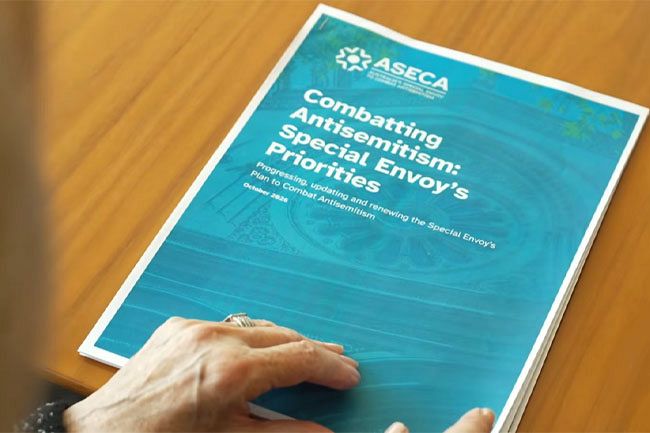
Jillian Segal’s latest antisemitism report raises concerns about political bias, freedom of expression and the conflation of criticism of Israel with antisemitism, writes Dr Michael Galvin.
‘Chutzpah is that quality of a man who, having killed his mother and father, throws himself on the mercy of the court because he is an orphan.’
This droll humour can be found in Leo Rosten’s 1968 book, The Joys of Yiddish. Chutzpah, derived from ancient Hebrew, can carry both positive and negative connotations depending on context. The term suggests supreme self-confidence, unbelievable gall, or audacity — a level of boldness that can either be admired as courageous or condemned as rude and shameless.
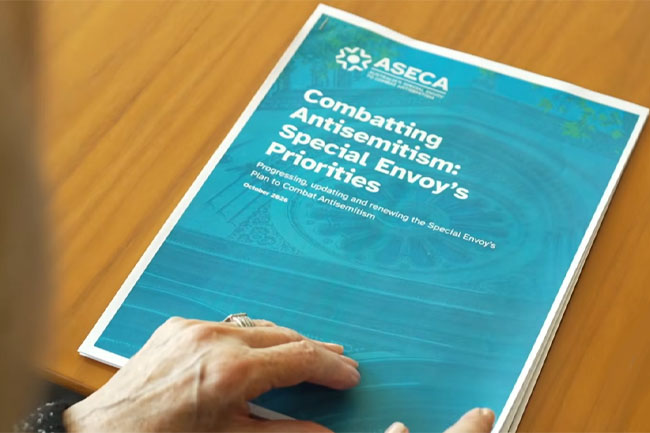
In her official role as Special Envoy to Combat Antisemitism, Jillian Segal’s latest report, subtitled Priorities, is nothing if not audacious, bold and quite shameless.
If there were a Chutzpah Olympics, Segal would likely win multiple gold medals.
Let me list some of the Priorities Report’s problematic features:
1. The report has appeared while the final report of the Royal Commission is being prepared. After extensive testimony from Zionist advocates during the Commission’s hearings, Segal’s report adds another prominent perspective that could influence how the Commission approaches antisemitism.
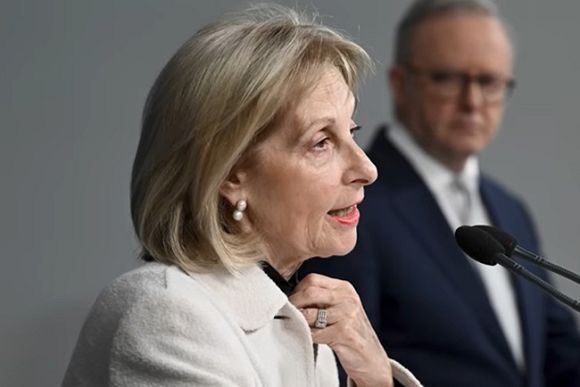
The effect of Segal’s approach is to blur the distinction between anti-Zionism and antisemitism, rather than recognising them as separate concepts and realities.
2. Segal’s agenda is not subtle. For example, it is to insist at every turn that the Royal Commission adopt the International Holocaust Remembrance Alliance (IHRA) definition of antisemitism and force (and police) this definition onto everyone else.
This might seem minor, but it isn’t. If ever forced on many Australian institutions, such as universities, public broadcasters and arts bodies, criticism of Israel would be even more minimised and censored than it is now.
The IHRA is referred to 27 times in this Report. Not mentioned is the ongoing controversy surrounding its adoption or use, including in Jewish circles.
Nor is its recent rebuff in the Australian courts mentioned.
Suffice to say, Segal takes every opportunity in this Report to insist that the IHRA definition must be the one everyone adheres to.
3. Another constant but highly questionable assertion in this Report is that the overwhelming majority of Australian Jews are either implicitly or explicitly Zionist, and support Israel regardless of what has happened since 2003.
This is not the case. Around a quarter of Australian Jews do not identify as Zionist, and do not support the Israel status quo. Reading Segal’s Report, significant Jewish opposition to the Special Envoy’s position is treated as if it simply doesn’t really exist in Australia.
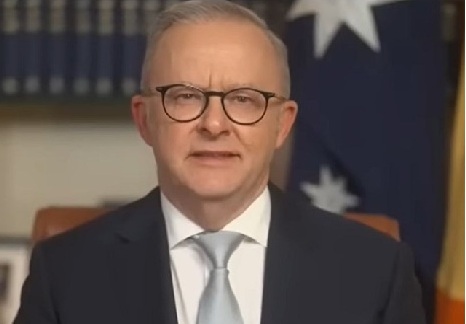
4. Segal is also shameless in her use of the Prime Minister. Whereas Albanese appeared only once in her original report, he is more of the star attraction in this latest Priorities Report. On page two, we see Segal and Albanese enjoying a cosy cup of tea in what looks like the PM’s Parliament House office. On page five, there is a full-page close-up of the Prime Minister’s face, looking positively charismatic and visionary.
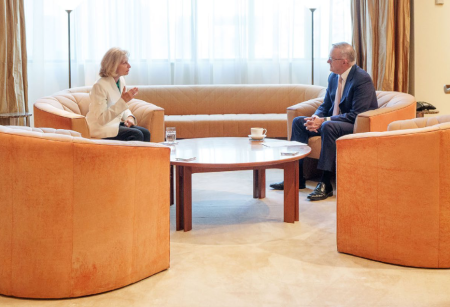
Why, one might ask? The prominence given to Albanese creates the impression that the Prime Minister fully endorses the report’s approach, including its implications for Zionism in Australia.
Given that the boldest intervention in this Report is the flimsy attempt to give “progressives” a bad name, this is first-class chutzpah. Despite everything, it appears the Prime Minister has forgotten his own lifelong identity as a progressive.
Presenting the Prime Minister in this way seems a risky choice rather than a thoughtful strategy. It is a huge risk, even if events since 7 October 2023 show that Albanese has not handled this crisis well, either domestically or internationally. And has acted as if the Zionist lobby has him totally spooked.
The full-page image on page eight is also a chutzpah contender. It is not at first clear what it is a photograph of. The only explanatory text is a quote which might be summarised roughly as “those who forget the history (of antisemitism, in this case) are condemned to repeat it”. And then a note under the image, saying simply: ‘Sydney Opera House, October 9 2023.’
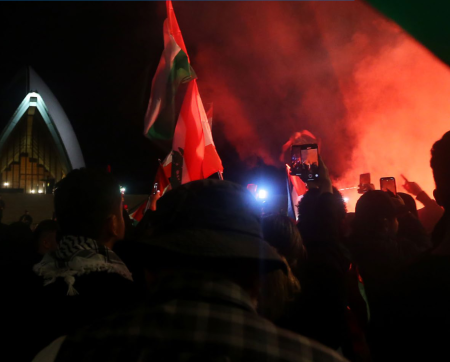
The visual impact of this image is startling. The small bit of the Opera House actually visible looks more like a white Ku Klux Klan hood than the roof of a concert hall; the colours red and black dominate the rest of the picture. The red flares make you think that the building was going up in flames, attacked by this wild mob in black silhouette. Only two items are clearly visible in the red and black gloom: a Palestinian flag and a Palestinian keffiyeh.
The not-so-subliminal message is clear. We are being warned that we are risking another Nazi Germany right here in Australia unless we fight this latest strain of antisemitism with all the tools at our disposal. Yet more chutzpah.
5. Media nonsense. Readers be warned. Segal’s 40-page report is a solid, turgid affair. A mix of bland truisms and nostrums about current affairs, interspersed with outlandish, highly provocative suggestions for the changes she is using her position to promote. It is largely fact-free and source-free.
But there are moments of unintended comedy. While she is happy to accuse the SBS and ABC of antisemitic bias, Segal has nothing to say about the rest of the mainstream media, which she labels “private media” for some reason and actually defends their freedom to say what they like.
The relentless pro-Israel campaign against all things Muslim, Arab and Palestinian in the mainstream media led by the Murdoch papers – The Australian, in particular – goes unremarked; the thought does not seem to occur to her that this level of sustained and often hysterical Islamophobia, in a country with nearly a million Muslims, might actually play a role in provoking a reactive antisemitism.
(The effects on social cohesion of a media that is by and large Islamophobic find no place in this Report; such is its myopic single-mindedness.)
Segal’s position – that the ABC and SBS should be overseen by an external scrutineer whose main job is to police anything that could be construed as antisemitic – is well known. She defends this position with reference to similar external oversight already in place in the banking and telecommunications industries.
Now here’s the touch of comedy. What regulatory scrutiny does she recommend for private media? Answer: None.
Segal's form of words for this tacit acknowledgement that the privately owned Australian media is doing just fine in promoting a one-sided pro-Israel agenda is captured in words so pallid they further damage the loss of credibility for the Report as a whole:
‘These outlets… should take it upon themselves to understand how their coverage can contribute to an environment of growing and normalised antisemitism… [page 28].’
‘…take it upon themselves…’ What a delightfully ineffectual, complaisant phrase, after wanting everyone else independently scrutinised and punished if need be.
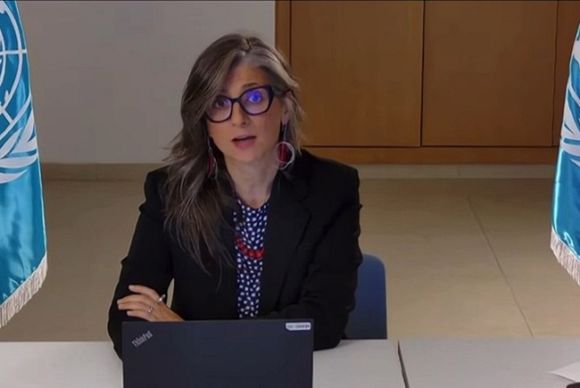
(How the world’s media, including Australia, has reported on the Gaza conflagration has been the subject of a recent highly critical United Nations Report, excellently discussed in a recent Independent Australia article by David Higginbottom.)
Conclusion
This is a deeply flawed document on a couple of levels.
First, zero sympathy is shown to the suffering and death of tens of thousands of Palestinian people and the destruction of their homelands. It seems common sense to assert that the rise in antisemitism in Australia and elsewhere has some correlation with what the Israeli Government, in the name of Jews everywhere insofar as they identify as Zionists, has done in Gaza since October 2023.
You do not have to be antisemitic to hate the Israeli Government and also question the viability of the Zionist project as it has evolved since 1948, 2023 or many other decision points in between.
Of course, this revulsion is also certain to bring out latent antisemitism in some people predisposed that way, just as most wars encourage generic vilification of the people on the other side if evil things are done in their name. (Past generations of German, Japanese and Italian people living in Australia at the time would know this feeling well.)
Unfortunately, this Report prolongs the self-defeating delusion that what is happening in Gaza and the West Bank has nothing to do with the rise of antisemitism in Australia. Insofar as Australian Zionists maintain or defend this non-connection, they will be aiding and abetting antisemitism, not remedying it.
Second, and equally as upsetting, this Report will exacerbate discord and conflict between Jews, including Australian Jews. Surely Dr Segal is aware that most Jews in Australia, as in America, support the progressive side of their countries’ politics. To choose the word “progressive” to name a new form of antisemitism is an outrageous use/abuse of the term.
On the Left side of politics, this characterisation alienates Jews and non-Jews alike. This Report reads as an intentional intervention in Australian politics. It’s likely to have minimal value as a constructive contribution to social cohesion.
In Segal’s taxonomy of the four “antisemitisms” (the other three being Islamic extremism, far-left antisemitism, and far-right antisemitism), ‘modern, progressive antisemitism is the most pervasive manifestation of antisemitism facing Australia today’ (page 17). How and why, one might ask.
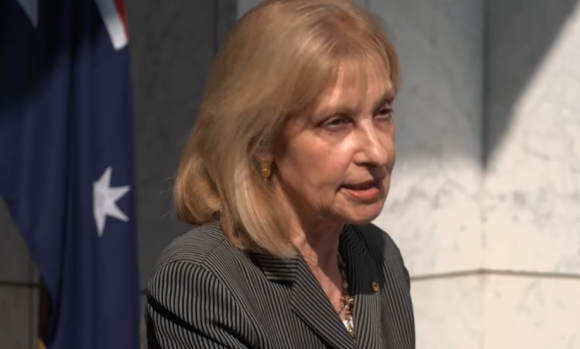
Segal’s scant argument explains that progressive antisemitism achieves this dubious status:
‘...by effectively laundering far-left antisemitism and Islamic extremism through a progressive lens, such as social justice and human rights, together with traditional antisemitic tropes, giving fundamentally extremist ideologies an apparently acceptable face.’
Dr Segal and her office must know that this is the most provocative sentence in her whole report. It is also the most intellectually incoherent, as the succession of mixed metaphors (laundry, lens, face and so on) instead of logical propositions and evidence suggests. She also must know that many Jewish Australians are prominent in social justice and human rights.
And some also question Zionism based on social justice and human rights. It is almost unbelievable that these words can appear in a document underwritten by a Labor government.
Although Dr Segal insists that the last thing she wants to do is become involved in Australian politics, the political implications of her report make that position difficult to reconcile with its contents.
It is well known that her husband is one of the largest financial supporters of the online movement known as Advance, best known for its role in defeating the Voice to Parliament and supporting sundry other alt-right causes. In the Advance lexicon, few people are more despised than “progressives”.
In the Advance universe, you would think that this Labor Government is the Australian people’s greatest enemy, to be mocked at every turn. Five minutes on their website will be enough to ruin your day if you think the Voice defeat was a dark, racist moment in our history.
Questioned about whether her husband’s politics played any role in her own, Segal’s response was firm but telling:
“No one would tolerate or accept my husband dictating my politics and I certainly won’t dictate his.”
Yes, based on these words of hers, it is possible that Dr Segal could be a member of the Greens or some other left-of-centre party and could be donating equally large amounts of money as her husband to worthy left-wing causes. But her husband’s views cannot establish her own. The report’s treatment of “progressive” antisemitism should instead be judged on its arguments and evidence.
In the broader conflict between Left and Right in Australian politics, Segal’s new category of progressive antisemitism makes her chutzpah gold.
If it wasn’t clear already, this Report suggests that Albanese made a grievous error in ever appointing this woman to such a complex and fraught role.
Dr Michael Galvin is an adjunct fellow at Victoria University and a former media and communications academic at the University of South Australia.
 This work is licensed under a Creative Commons Attribution-NonCommercial-NoDerivs 3.0 Australia License
Support independent journalism Subscribe to IA.


Related Articles
- Australia's institutions yet to follow court rulings on antisemitism
- Government’s anti-racism response exposes a glaring double standard
- NSW court draws a line between criticism of Israel and antisemitism
- Jillian Segal's 'Understanding Antisemitism in Australia': A lesson in propaganda
- Royal Commission on cohesion hears only half the story