Anthony Albanese’s recent trip to Beijing marked a return to calm diplomacy, signalling Australia’s readiness to engage with China — on its own terms. Imran Khalid writes.
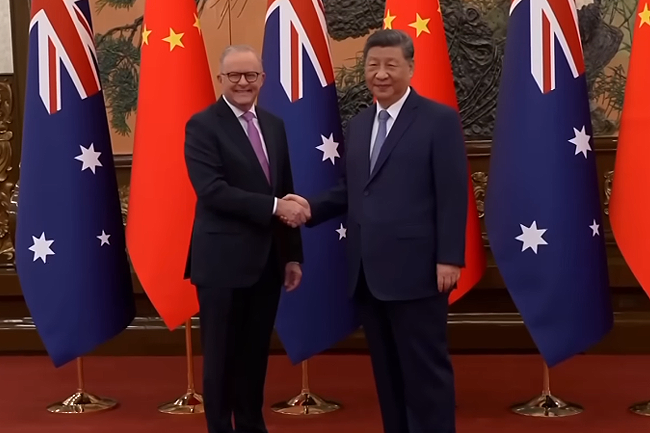
WHEN AUSTRALIAN Prime Minister Anthony Albanese arrived in Beijing for his recent six-day official visit – his second since taking office – he wasn’t seeking a breakthrough. He was offering predictability. After years of diplomatic friction, punitive tariffs and frozen ministerial contact, the signal from Canberra was clear: Australia is open to engagement, but not at the expense of its strategic backbone.
This measured tone marks a departure from both confrontation and capitulation. While no new doctrines were unveiled and no red lines erased, the visit itself restored what had been lost in recent years: a sense of stability in one of the Indo-Pacific’s most consequential bilateral relationships. It also underscored a broader shift in how middle powers like Australia are navigating an increasingly bipolar world.
The economic context of the visit is difficult to ignore. Since Albanese assumed office in 2022, Beijing has gradually dismantled over $20 billion worth of informal trade restrictions that once crippled key Australian exports such as wine, barley and lobster.
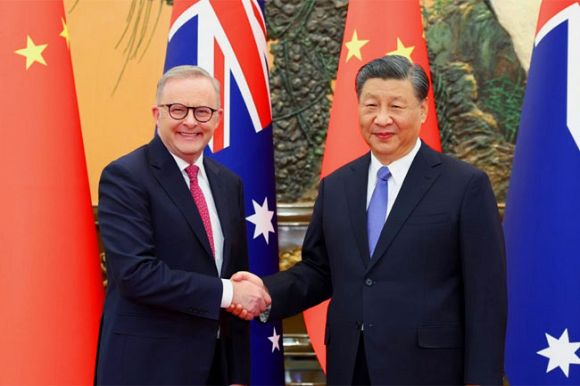
The payoff has been swift. In the second quarter of 2024, wine exports to China surged by more than 8,000% year-on-year. Lobster shipments are projected to generate over $700 million by year-end. Bilateral trade in goods and services hit $325 billion in 2023–24, with China accounting for roughly one-third of Australia’s total trade volume. These are not symbolic gestures — they are economic oxygen for sectors still recovering from the pandemic and the diplomatic freeze.
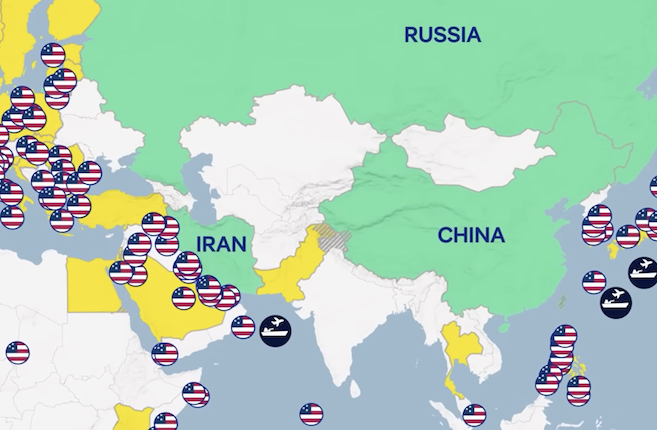
Yet the recalibration is not confined to the ledger books. Australia remains firmly committed to its security alliance with the United States. Joint exercises such as the 2024 Talisman Sabre drills, which involved 19 countries and more than 35,000 military personnel, reflect Canberra’s continuing role in regional deterrence.
Australia’s participation in AUKUS and its ongoing alignment with the Quad grouping further affirm that no strategic pivot is underway. Albanese’s China visit unfolded in parallel with U.S.–Australia naval operations in the South China Sea — a choreography that speaks volumes.
What distinguishes this approach is not its neutrality but its dual engagement. Australia is refusing to choose between economic lifelines and strategic loyalties. It is instead constructing a flexible foreign policy scaffold, one that allows it to embrace China where interests align, while ring-fencing sectors and values it deems non-negotiable.
This explains why, even amid revived trade talks and green cooperation agreements, Canberra declined Beijing’s overture for artificial intelligence collaboration, citing national sovereignty and technology security concerns.
For Southeast Asia, particularly countries like Singapore and Vietnam that have long balanced economic integration with China against security partnerships with the West, Australia’s posture resonates. It validates a pragmatic style of diplomacy that avoids binary choices. In fact, Albanese’s framing – “cooperate where we can, disagree where we must” – is strikingly similar to Singapore’s foreign policy ethos, which prizes stability, openness and agency.
The regional implications extend beyond symbolism. A more diplomatically agile Australia could bolster the Association of Southeast Asian Nations (ASEAN)’s own strategic autonomy, providing space for small and middle powers to engage both Washington and Beijing without being pulled irreversibly toward one. This is especially significant as ASEAN itself wrestles with unity in response to contested maritime claims, competing infrastructure offers and escalating tech decoupling.

Equally important was what Albanese’s delegation chose not to do. There was no public confrontation over Taiwan, no lecturing on the South China Sea and no headline-grabbing statements about ideological divides. Sensitive issues were raised, but discreetly, behind closed doors. This quiet diplomacy reflects a growing recognition that performative posturing may win domestic headlines but seldom yields sustainable outcomes in Asia.
Instead, the visit focused on future-facing cooperation. Agreements were signed on dryland farming, steel decarbonisation and climate-smart agriculture, areas where Australia’s resource capacity and China’s manufacturing prowess are genuinely complementary. These efforts, while lacking the drama of geopolitical flashpoints, serve as stabilisers in a volatile region. They also provide a model for constructive engagement that doesn’t require abandoning strategic vigilance.
Still, managing this balance will not be easy. The United States is already pressuring allies to increase defence spending, with Washington calling on Australia to raise its military budget to 3.5% of GDP — a request Albanese has politely rebuffed. Meanwhile, new U.S. tariffs under the Trump Administration, including a 50% levy on Australian aluminium and a baseline 10% duty on exports, have introduced new friction into the alliance. These developments could complicate Canberra’s balancing act if U.S.–China competition intensifies.
Yet the durability of Australia’s approach may lie in its transparency. By communicating clearly with both Beijing and Washington, and by staying consistent in its actions, Canberra can avoid the perception of drift that often undermines middle-power diplomacy. This is not about hedging for its own sake; it is about asserting agency in a world where small missteps can have outsize consequences.
For Asia, the real lesson may be that managing complexity is more realistic than eliminating it. Albanese’s visit to China did not break new ground, but it mapped a path that other states may choose to follow. At a time when ideological rigidity and strategic rivalry are resurgent, Australia’s calibrated pragmatism may prove not just sustainable, but quietly influential.
In a region where strategic ambiguity often fuels instability, Australia’s calibrated clarity offers a compelling alternative. By refusing false dichotomies and embracing practical engagement, Canberra is showing that middle powers can assert agency without forsaking principles. For others navigating the Indo-Pacific’s shifting fault lines, the lesson is clear: influence doesn’t hinge on choosing sides; it lies in shaping the space between them.
Imran Khalid is a geostrategic analyst and columnist on international affairs. His work has been widely published by prestigious international news organisations.
 This work is licensed under a Creative Commons Attribution-NonCommercial-NoDerivs 3.0 Australia License
Support independent journalism Subscribe to IA.


Related Articles
- Postcard from the People’s Republic: Albo woos Uncle Xi
- Albanese courts China as allies watch warily
- Pacific Rim countries say no to U.S.-China war
- Seeking cooperation with China does not make one a useful idiot
- Fool's gold: China beguiles the South Pacific