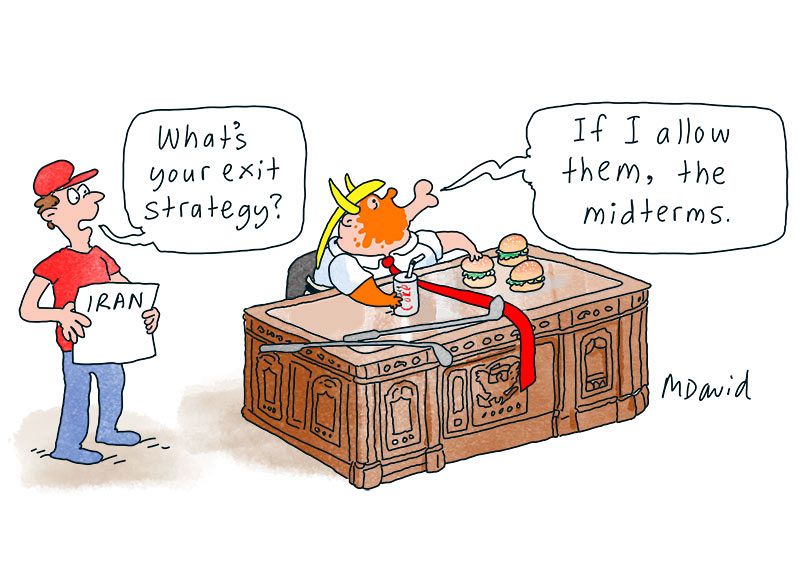
Donald Trump boasted of victory on Day One of the new Iran War. Jeff McMullen warns that the risks of escalation and fallout are yet to come.
AFTER THE first two weeks of the joint U.S.-Israeli attacks, President Trump declared that most of Iran’s military capabilities had been “literally obliterated”.
Trump bragged to the White House Press Corps that the U.S. had struck more than 7,000 military and commercial targets, including some 100 Iranian naval vessels and all 30 Iranian mine-laying vessels. He derided U.S. allies that were reluctant to help him open the Strait of Hormuz for oil tankers and then mocked his enemy:
"This is a paper tiger that we’re dealing with now.”
When asked whether Iran’s new leader, the Supreme Leader’s son, Mojtaba Khamenei, was alive or dead, Trump delivered one of his rambling monologues that so often include a Freudian allusion to King Donald on a throne:
A lot of people are saying that he [Mojtaba Khamenei] is badly disfigured. They say that he lost his leg, one leg and that he’s been hurt very badly. Other people are saying he’s dead. Nobody’s saying he’s 100 per cent healthy. He hasn’t spoken.
The [previous] Ayatollah would sit and he would spew hate from a throne. Not as nice as a throne. I like the English throne much better. But it was a fancy chair. He would spew hate from his fancy chair. But you would see him a lot, right?
This one, we haven’t seen him at all. That could be for a lot of reasons. We don’t know whether he’s dead or not.
It is characteristic of this American President to boast of unbridled power, demand unconditional surrender and seek to humiliate his foes, dead or alive.
But it is rash to boast of victory when several of the Trump Administration’s expressed goals – ending any nuclear threat, destroying Iran’s missile capability, sinking the Iranian Navy and bringing about a popular uprising after regime change – clearly have not been achieved.
There is almost certainly more fighting and many more deaths to come. Escalation usually involves more civilian losses.

The movement of 2,500 U.S. Marines in a rapid deployment force to join an estimated 50,000 U.S troops at regional bases or on U.S. vessels near the warzone is one indication of possible escalation ahead.
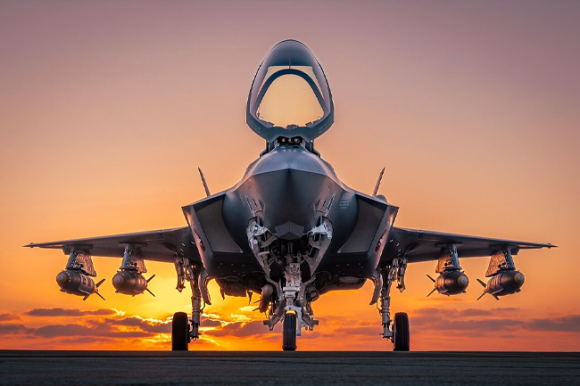
With two aircraft carriers, USS Abraham Lincoln and USS Ford, each accompanied by three destroyers and a variety of aircraft including F-35s, F-22s, F-15s and F-16s, we see a task force capable of continuing to pound Iranian military positions around the Strait of Hormuz.
Having struck military targets on Kharg Island, Iran’s critical oil processing and storage hub, there has been further speculation about a U.S. attempt to seize control of this strategic position.
Another possibility widely discussed among defence analysts in Washington DC, is that the U.S. and/or Israeli special forces might dare to go after Iran’s hidden cache of enriched uranium — the makings of future nuclear weapons.
Either of these escalatory actions carries tremendous risk.
The International Atomic Energy Agency (IAEA) estimated before the raids on three of Iran’s nuclear facilities last year that these stores held 440.9 kilograms of 60% highly enriched uranium and almost 200 kilograms of 20% fissile material, which is readily converted into 90% weapons grade uranium.
During the current war in Iran, IAEA Director General Rafael Grossi says he has no evidence that the Iranians have moved the enriched uranium. He believes most of the 18 to 20 canisters are held at the underground tunnel complex in Isfahan and more at Natanz.
We should not understate the longer-term danger posed by this fissile material.
Ayatollah Mojtaba Khamenei, if he is alive and in charge of the Islamic Revolutionary Guard Corps, would have ample motivation to seek revenge. The war has claimed the lives not only of his father, Ayatollah Ali Khamenei, but also of many other close family members.
As long as this Iranian regime holds its stash of highly enriched uranium, there will be an elevated risk of a more desperate nuclear program, even the purchase of a weapon or two from an ally or an asymmetrical attack using a so-called dirty bomb.
Wargamers at London’s King's College have discounted the possibility of Iran hiding a dirty bomb somewhere, for instance on a cargo ship arriving in New York harbour. Many see this as simply “strategic suicide” because the United States or Israel would respond to such an attack by unleashing a nuclear hell on Iran.
But without an end to this war, with a negotiated settlement that includes renewed IAEA inspections or removal of the remaining fissile nuclear material, such an Iranian threat persists in this tragic cycle of war and revenge.
We must accept the likelihood that the goals of the United States and Israel in the Iran War – and therefore how they view success or failure – are not exactly the same.
While fighting the war, Israel’s Prime Minister, Benjamin Netanyahu, is still on trial. He is facing charges of bribery, fraud and breach of trust in three cases involving allegations he accepted illicit gifts and traded political favours in return for glowing media coverage of his leadership.
Trump has defended Netanyahu and lobbied for his pardoning. What irony that Israel’s President Herzog turned down these pleas, saying Israel’s affairs will not be decided by Washington.
This is the war Bebe Netanyahu always wanted, the war he wrote about in his 2022 memoir.
To defeat an Islamist regime bent on destroying Israel as well as bolstering his own leadership, Netanyahu was set on decapitating the most senior political and military Iranian leaders.
From the onset, he too spoke of regime change, repeatedly calling on the Iranian people to rise up and overthrow the Ayatollahs. Two weeks into the conflict, he admitted that he was not at all sure that the people would be capable of toppling the Islamic Revolutionary Guard Corps.
Netanyahu now argues that crippling Iran’s ability to fight – and that includes drastically degrading Hezbollah’s forces in Lebanon – is his principal goal.
For the United States, the pressing task at this hour is clearing the Strait of Hormuz of any threat to some 20% of the world’s oil supplies.
By his own admission, President Trump was surprised and did not anticipate Iran’s strategy of striking back against the U.S. and Israel by attacking the Gulf nations. He was so possessed by his belief in the use of overwhelming American force that, according to Reuters’ sources, he ignored the warnings from his strategic advisers.
Similarly, Trump now scoffs at Iran’s threat to keep the Strait of Hormuz closed and choke off the vital oil supplies to so many nations. He underestimated the ability of a besieged regime to employ a mixture of economic and psychological warfare that has spread anxiety around the world. The full extent of the damage to the global economy, including the threat of recession in Australia, is as yet unknown, given the possibility of a longer war.
For almost half a century, Western defence planners anticipated that if attacked, Iran would close the Strait of Hormuz. Iran itself gave this explicit warning and this was one very good reason previous U.S. leaders have avoided making war against Iran.
Now, Trump is learning that war usually has some shocking unintended consequences. The end is not clear.
We all should beware paper tigers.
This story was originally published, in a slightly different form, in the 18 March 2026 Independent Australia members' only weekly newsletter.
Journalist, author and filmmaker, Dr Jeff McMullen AM, is a patron of the Australian Indigenous Doctors Association (AIDA) and the First People’s Disability Network (FPDN), both of which officially support the "Yes" campaign. He is an ambassador for NOFASD Australia.