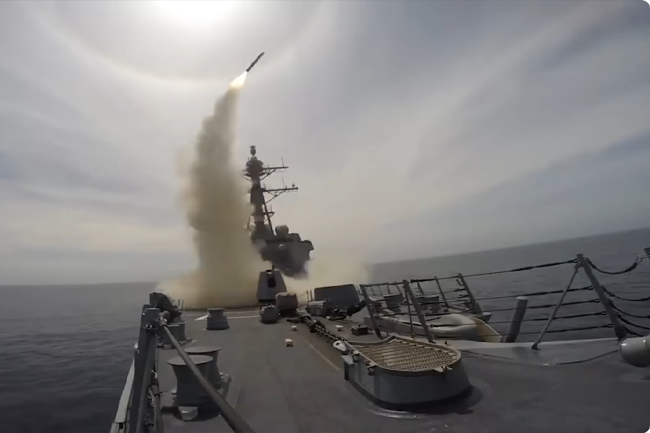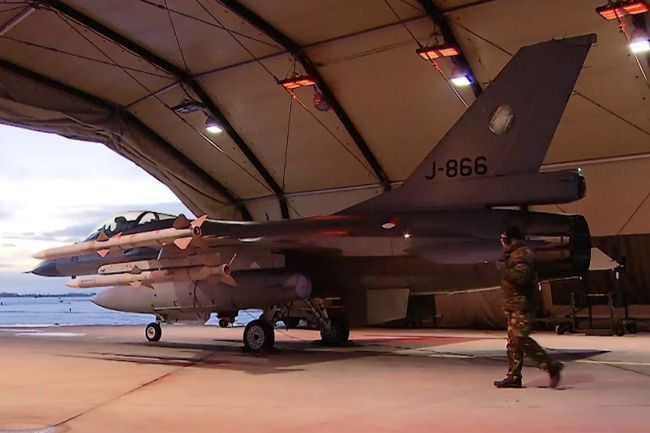
As global military spending surges to record levels, the climate cost of war and rearmament remains largely uncounted, unreported and exempt from scrutiny, writes Wayne Hawkins.
HUMANITY HAS A PROBLEM. Actually, humanity has several, but let us focus on the one where we are simultaneously spending nearly $3 trillion a year preparing to destroy civilisation while solemnly promising to save it.
Welcome to the military-industrial complex's quiet war on the atmosphere. Fought without declaration. Exempt from accounting. Winning convincingly.
The number nobody counts
Here is a figure worth sitting with. Scientists for Global Responsibility estimate that the global military sector produces around 2.75 billion tonnes of CO₂ every year. That is not from active wars. That is peacetime — bases humming, jets training, supply chains churning.
If the world’s militaries were a country, they would be the fourth-largest emitter on Earth, behind only the United States, China and India. They would also be the only “country” explicitly exempt from international climate reporting requirements. Convenient.
The year 2025 was a banner year for the defence industry. Global military spending hit a record $2.887 trillion — the 11th consecutive year of growth. Europe increased defence budgets by 14%. NATO, not to be outdone, set a new target of 5% of GDP by 2035. The United States, briefly the exception, has already approved over $1 trillion for 2026, with $1.5 trillion potentially on the way.
Meanwhile, at COP30 in Belém in November, delegates scrutinised aviation, agriculture, steel and cement for their climate contributions. War did not make the agenda. Presumably, the irony was noted and filed.
When the shooting starts, so does the scoreboard
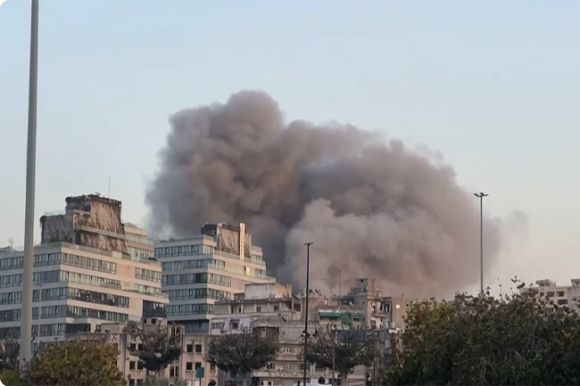
The moment active conflict begins, the numbers stop being merely alarming and start becoming geological. Russia’s invasion of Ukraine has generated an estimated 311million tonnes of CO₂ equivalent — comparable to the combined annual emissions of Belgium, New Zealand, Austria and Portugal. Not accumulated over decades — since February 2022.
The first 15 months of the war in Gaza produced more than 33 million tonnes. And these calculations do not fully capture the elegant brutality of modern warfare’s climate toolkit.
Russia’s strikes on Ukrainian electrical infrastructure have released sulfur hexafluoride – a greenhouse gas 24,000 times more potent than CO₂ – from high-voltage switching equipment. Civilian aircraft rerouting around the conflict zone has added an estimated 20 million extra tonnes of CO₂ equivalent. The planet did not get a vote on any of these design choices.
A 2025 Nature Communications study made the structural logic plain: rising global military spending is directly incompatible with limiting warming to 1.5–2°C. Military industries emit nearly twice the CO₂ per unit of economic output as civilian sectors. Every percentage-point increase in the share of military spending pushes emissions meaningfully upward — and expands fossil fuel-dependent industries that then lobby against the green transition.
The military-industrial complex is not merely burning the planet. It is funding the political opposition to anyone attempting to put out the fire.

The slow damage that outlasts the war
Then there is the legacy: the slow, generation-spanning damage that persists long after the press conferences and the peace agreements. In Gaza, the UN Environment Programme (UNEP) has documented the loss of 97% of tree crops, 95% of shrubland and 82% of annual crops since 2023. Food production at scale is not possible. The aquifer supplying most of Gaza’s water is likely contaminated by collapsed sewage infrastructure.
Cases of acute watery diarrhoea have increased 36-fold. Acute jaundice syndrome has increased 384-fold. Sixty-one million tonnes of debris laced with unexploded ordnance, asbestos and chemical munition residue now blanket the territory.
In Ukraine, environmental damage from soil contamination, heavy metal ordnance residue, landmines and destroyed ecosystems is estimated at over $50 billion. Scientists describe it plainly as a toxic legacy for generations.
Every modern war is also a chemical event, a water event, an atmospheric event — consequences that accumulate in soil and groundwater long after the last ceasefire is signed and the reconstruction contracts are issued to the same companies that manufactured the weapons.
The accountability black hole
Here is the part that should end careers, but does not. A 2025 analysis by the Conflict and Environment Observatory found that military emissions reporting is not merely inadequate; it is actively getting worse.
The top three military spenders, the United States, China and Russia, are either failing to submit data to international bodies or providing figures so incomplete as to be decorative. The solution, apparently, to the largest measurement gap in climate policy is to measure less.
Military emissions were explicitly exempted from international climate accounting frameworks at Kyoto. Countries lobbied for that exemption. It has never been corrected. When the world’s most destructive industry gets to operate outside the ledger, the ledger is not an accounting document. It is a performance.
So here we are. Spending nearly $3 trillion a year on systems that are structurally incompatible with our own survival. Exempting those systems from the accountability frameworks we built specifically to address our survival. Doing so at the fastest rate of increase since the Cold War.
The defence industry calls this deterrence. Climate scientists call it a fuse.
Notably, the planet has not exempted us from the consequences.
Wayne Hawkins is a small business owner in Hobart, Tasmania, and an independent candidate for the federal seat of Clark at the 2028 Election.
Support independent journalism Subscribe to IA.
 This work is licensed under a Creative Commons Attribution-NonCommercial-NoDerivs 3.0 Australia License


Related Articles