Ever thought reality didn't seem quite real? Well, modern science's increasingly supported "simulation hypothesis" suggests you may well be right.
A LOT OF PEOPLE worry about artificial intelligence, but what if the reality is machine intelligence is real and ours is artificial?
Or to put it differently, what if our universe is some sort of highly advanced computer simulation and each of us is a sentient construct existing – if exist is the correct term – unwittingly within this artificial paradigm.
Like the Hollywood blockbuster series The Matrix, but without us having a biological body at all — just a binary series of ones and twos, stored and acting out our fake lives in a vastly capacious computer storage device, not even knowing we’re not really real.
This “simulation hypothesis”, once just a favourite of science fiction, is now a branch of physics swiftly gaining academic support and respectability. For instance, in 2018, respected astrophysicist Neil deGrasse Tyson told NBC News he estimated the likelihood we are in a simulation as "better than 50-50", adding, "I wish I could summon a strong argument against it, but I can find none".
It often seems physics trails lamentably behind the imagination of science fiction, where this hypothesis has been a staple for decades. For example, the Tron and Matrix movies all foresaw a future where fully sentient human constructs could be living within simulated digital environments. Of course, all advanced a largely dystopian vision for the future, something largely shared by most media representations of artificial intelligence today.
An alternative vision of the simulation hypothesis was notably advanced by acclaimed – now sadly deceased – Scottish author Iain M Banks. In his Culture series of stories, published from 1984 to 2012, Banks posited a far more positive future for artificial intelligence. A fascinating vision of a space-faring, post-scarcity (post-money), progressive humanity governed by benevolent, super-intelligent computer minds.
As opposed to the grim future many foresee for AI, such as the one proposed in the Terminator movies, Banks imagined one in which mostly benign super-advanced AI “Minds” would run things for the general betterment of all. Well, except for a few pesky aliens, maybe, but they were always sorted out by the last few pages.
Banks explored the idea of a simulated reality in most detail in his 2010 novel Surface Detail, the last book published during his lifetime.
In this book, for instance, a schismatic offshoot of the Culture staged a simulated war to determine whether their societies, as a punitive justice measure, should be allowed to run artificial post-life “Hells”. In them, the mind-states of criminals were downloaded into human constructs and placed into a Hades-like simulated afterlife. The advanced computer minds of the Culture, fiercely anti-Hell, initially opted to stay out of the war while accepting the outcome as binding. But you know, shit happened...
The idea of afterlives, in which human minds are able to be downloaded digitally and stored in simulated environments -- though not ones in which we are tormented for all eternity -- is a potentially attractive idea when it comes to the simulated reality concept. For instance, one of the main architects of the “cyberpunk” genre, William Gibson, featured an AI-based idea that is becoming more plausible by the day. Such as in his 1996 novel Idoru, in which an AI pop star was transferred into an artificially created, yet essentially human body.
This is no doubt the dream of the middle-aged men popularly portrayed in the media proudly carrying on love affairs with sexy AI screen sirens. You may have even met someone like, for example, Maddison Leigh. And who could doubt that AI androids are [ahem] coming in a decade not too distant from today's.
But there is a big difference between knowingly living in a simulated afterlife, even a hellish one; or being consciously downloaded as a sentient AI to an artificial body; to being an artificial intelligence living in a simulated reality you think is real. And it is this deeply disturbing possibility, not those others, which physicists are increasingly suggesting is the nature of our “reality” — what we perceive as our "Universe".
Iain M Banks, who was widely regarded as the greatest British science fiction author of all time, also, of course, perceived this sinister-sounding possibility. Banks’ “Culture”, mostly set about 1,000 years in the future, was a utopian society, which, despite possessing no written laws and being facilitated by super-intelligent AI Minds, was a democracy — of sorts. For really important decisions – such as going to war against a belligerent race of giant three-legged cat-creatures called "Idirans" – his Culture required a vote of its 30 trillion or so citizens. Or at least, of those possessing brain-augmenting implants, which was almost all of them, for fairly obvious reasons.
Being augmented, amongst other advantages, meant being linked in to the digital world all the time, so these votes could be done instantly, any place, any time. There were votes for everything and mostly the Culture's human citizens abstained. Who could be bothered? Still, Banks' pinko progressive super-intelligent minds insisted all citizens – even its relatively dense biological ones – be fully informed. For instance, to go to war against the Idirans – a potentially civilisation-ending event – Banks had their impossibly powerful computers modelling every conceivable scenario to provide citizens with a simple percentage to aid their vote: let's say, a 76 per cent chance of ultimate victory against the Idirans.
The really interesting thing was how Banks proposed the Culture’s Minds arrived at that deceptively simple percentage. With the advantage of having effectively unlimited computer processing power, the Culture was able to upload every detail of their known universe into a vast simulation to come up with a result. Included in that, crucially, was the downloaded consciousnesses of every single augmented human Culture citizen. Of course, to make the model realistic, these constructs needed to be fully sentient and aware, yet completely unaware they were in a simulated reality.
Banks, almost in passing, had the Minds discussing whether turning the model off after each iteration was complete was, every time, the effective genocide of 30 trillion sentient beings.
Oh... the horror!
We don’t know what the true nature of our universe is at all. Could it be a simulated reality, one in which we are unaware, like those Culture characters, we are merely artificial human constructs? We do know scientists are still frustratingly unable to come up with a unified theory of physics, despite more than 100 years of frantic research since Einstein proposed his groundbreaking relativity theory.
What we can say, is that the simulation theory is as likely as any other explanation of our universe and its laws — a toss of the coin, according to Neil Degrasse Tyson.
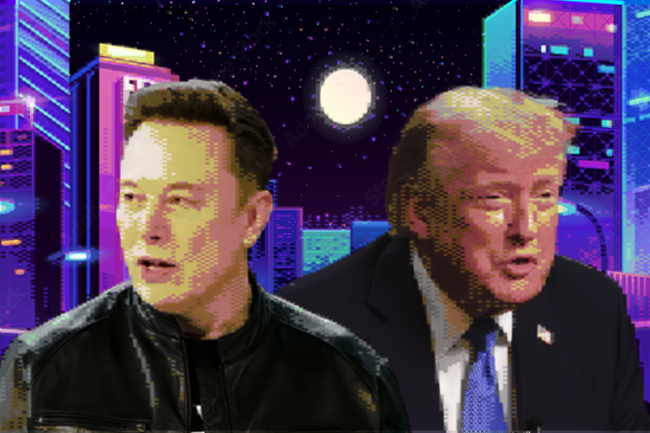
Iain M Banks died in 2012, before the madness and bathos inflicted upon our world by people such as Donald Trump and Elon Musk. One suggestion Banks never proposed was that we are all human constructs in a super-advanced computer game. One in which Trump and Musk are, for argument's sake, players in a game set in what we perceive as our universe and we are all simply realistic extras in this simulated reality. This is, indeed, the plot for the 2021 Hollywood blockbuster Free Guy, in which Ryan Reynolds played one of these non-player drones.
So, maybe Trump and Musk are entitled, bratty kids from the future? It might explain their otherwise inexplicable success. Maybe they may have unlimited lives and cheat codes?
We do know Musk is a big fan of Banks' Culture, which seems a tad suspicious. And the idea Elon is a snotty, entitled, alien kid from the future would explain how, despite being to all appearances a dysfunctional man-child, he has somehow amassed a trillion dollars. Why Tesla is not yet bankrupt after all the court actions, how Twitter still exists after he totally Xed it, and SpaceX is still a thing after all those disastrous crashes. And speaking of SpaceX, trying to build rocket ships to Mars is surely classic ET behaviour.
As for Trump, his bizarre behaviour is even more otherworldly. It could be argued he has obvious tells, where he may be seen as revealing himself in his obnoxious alien overconfidence. Such as his obsession with illegal aliens: a classic case of projection. And how he always talks about having all the cards? His name is Trump: the "trump card"? Just the sort of cocksure arrogance one might expect from a pimply, teenage, off-worlder from the future. Finally, you must surely have noticed that Trump is orange? That's simply not a normal, human skin-tone, only slightly less alien than green. The evidence is stacking up.
But if our reality really is a simulated game in which we are unwitting participants, what may be most concerning is Trump having possession of the nuclear codes. Nuclear annihilation may be what we simulacrums may be programmed to see when an alien brat like Trump has a tantrum and pulls the plug from the wall.
GAME OVER?
Banks was once asked about his benign vision for artificial intelligence. Whether he really thought it would bring a peaceful, utopian, progressive future for humanity, as his Culture writings seemed to suggest.
His reply: “Well, let’s hope so."
Follow IA founder Dave Donovan on X/Twitter @davrosz and Bluesky @davrosz.bsky.social, Independent Australia on Bluesky @independentaus.bsky.social, X/Twitter @independentaus and Facebook HERE.
 This work is licensed under a Creative Commons Attribution-NonCommercial-NoDerivs 3.0 Australia License
Support independent journalism Subscribe to IA.


Related Articles
- The economic problem AI can't solve on its own
- AI is not just technology — it’s reshaping society in ways we don’t control
- Rising AI budgets, falling outcomes: Why enterprise initiatives keep stalling
- Armed with AI: Epicflow’s new Portfolio Optimiser enters trials with the Dutch
- Profits before people: How neoliberalism is hardwiring AI for chaos