Moscow has confirmed that the CIA director visited the Kremlin this week. CIA directors do not visit Moscow to sightsee, writes Professor Vince Hooper.
ON TUESDAY MORNING, a Boeing C-17A Globemaster III (more than seventy-seven tonnes of cargo capacity, four Pratt & Whitney turbofans, and the wingspan of a widebody airliner) descended through overcast skies into Moscow's Vnukovo International Airport. Flightradar24 logged its tail number as 07-7181.
It had staged through Riga from Joint Base Andrews, the airfield that houses Air Force One. Within hours, a motorcade bearing American diplomatic plates was filmed threading through Moscow traffic. The Kremlin said it had no information. Washington said nothing at all.
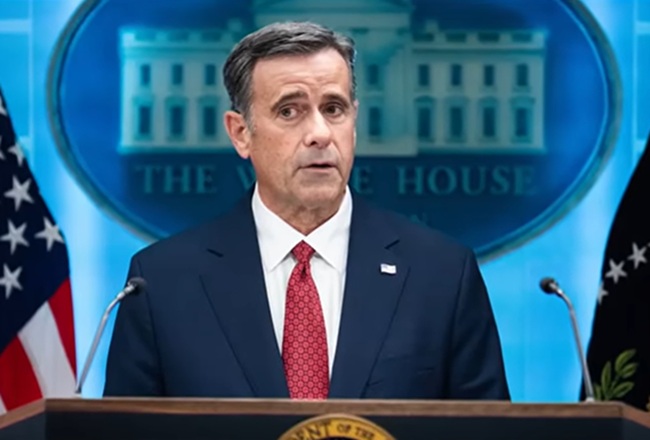
By late afternoon, the silence had cracked. CBS News, Axios, and The Wall Street Journal confirmed what the C-17's provenance had already telegraphed: CIA Director John Ratcliffe was in Moscow for meetings.
It was the first visit by a sitting director since William Burns flew in during November 2021, three months before tanks crossed the Ukrainian border. CIA directors do not visit Moscow to sightsee.
The question is not whether something urgent brought Ratcliffe to Russia. It is which of at least three urgent things brought him there, or whether the answer is all of them at once.
Begin with timing.
Two days before the Globemaster touched down, Volodymyr Zelensky unveiled a joint Ukraine-U.S.-Europe proposal built around three pillars: a ceasefire, a reciprocal withdrawal of forces from the current front line, and security guarantees underwritten by NATO and the European Union.
The proposal was framed during meetings with Steve Witkoff and Jared Kushner, the same envoys who flew to Moscow in January. In financial terms, Zelensky's proposal is a call option on peace: it costs relatively little to table, preserves upside if Moscow engages, and expires worthless if Vladimir Putin refuses.
Real options theory tells us that under radical uncertainty, the value of holding the option open exceeds the value of committing in either direction. Ratcliffe may have arrived in Moscow carrying that option, stress-testing whether there is any counterparty interest before the premium decays.
The second layer is Iran. One day before Ratcliffe's flight, Treasury Secretary Scott Bessent stood at a podium in Washington and announced what he called the "economic asphyxiation" of Tehran ('Operation Economic Outcast'), targeting nearly sixty entities and demanding that every trading partner choose between Washington and Iran.
The war between the United States, Israel, and Iran has now passed its six-month mark with no ceasefire in sight. Russia's role in that conflict has moved well beyond rhetorical solidarity.
Intelligence assessments published earlier this month concluded that Moscow has supplied Iran with upgraded Shahed loitering munitions and targeting data drawn from its own drone campaigns in Ukraine.
The technology feedback loop is now complete: Iranian-designed drones went to Russia, were refined through four years of operational use over Ukrainian cities, and have returned to Iran with improved flight profiles, swarm tactics, and electronic warfare countermeasures specifically tuned to saturate American air defences.
The Herfindahl-Hirschman Index (HHI), ordinarily deployed to measure market concentration, illuminates the strategic dependency. Russia's drone warfare programme is now heavily concentrated on Iranian-origin technology and components.
An HHI approaching monopoly, a single critical supplier, creates precisely the kind of structural vulnerability that a well-timed diplomatic intervention can exploit.
If Washington can persuade Moscow that the cost of supporting Tehran exceeds the benefit, it fractures an axis that has so far proved resilient to sanctions, censure, and battlefield attrition alike. Bessent's sanctions are the stick.
Ratcliffe's visit may be the whispered offer of a carrot: ease the pressure on Moscow's war economy in exchange for distancing itself from Tehran, or face the full weight of secondary sanctions that 'Operation Economic Outcast' has made legally possible but not yet deployed.
Le Chatelier's principle, borrowed from thermodynamics and applied to geopolitics, predicts that any system subjected to an external stress will shift its equilibrium to partially offset that stress.
Western sanctions on Russia since 2022 have driven Moscow deeper into partnership with Tehran, Beijing, and Pyongyang: the compensating shift. But compensating shifts create new dependencies, and new dependencies create new pressure points.
Ratcliffe's mission may be an attempt to identify exactly where the new equilibrium is weakest.
The third layer is NATO itself.
On 6 August, The Wall Street Journal reported that U.S. intelligence assessments had concluded Putin could test the alliance's resolve with actions ranging from cyberattacks and sabotage to a limited land incursion, possibly as early as this autumn and extending through 2029.
The assessment marked a significant shift: previous judgements held that Moscow would avoid provoking NATO while the Ukraine war continued. But a Russian cruise missile that landed in Poland, drones flown into Romanian airspace, and an explosive-laden drone discovered at Leipzig airport, assessed by U.S. intelligence to be of Russian origin, suggest the probing has already begun.
Ratcliffe, who has a documented history of advocating for the retention of CIA advisers in Ukraine even as the Pentagon scaled back, is not the emissary you send if the message is conciliatory. His reputation as a Russia hawk is itself a signal. In the grammar of intelligence diplomacy, the messenger is part of the message.
For Australian readers, the threads converge uncomfortably close to home.
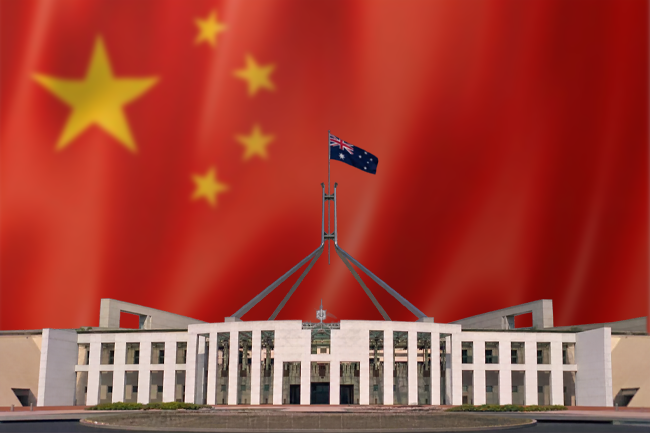
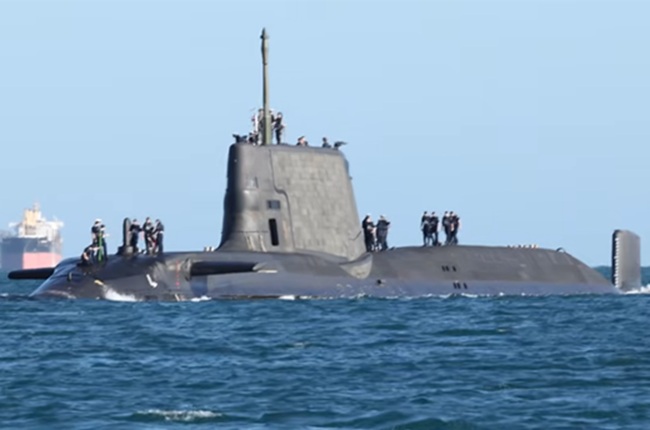
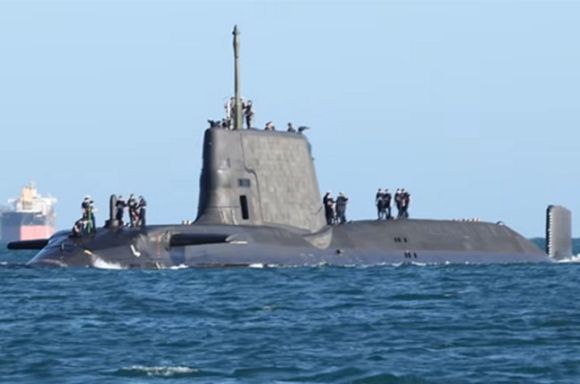
The Iran sanctions regime demands that every country choose sides, and Australia's trade corridors through the Strait of Hormuz carry roughly a fifth of globally traded oil. The U.S. intelligence assessment on NATO probing, meanwhile, sits alongside an American munitions stockpile severely degraded by transfers to Ukraine and the Iran conflict, the broader conventional deterrent on which the AUKUS security architecture rests.
If that deterrent is stretched thin across two active theatres and a third is threatened, the expected shortfall (the average loss in the tail of the distribution, the scenario beyond the worst case you planned for) ceases to be an academic exercise. It becomes a defence procurement question with a deadline attached.
Put-call parity offers a final lens. In options pricing, the relationship between a put and a call on the same underlying asset is fixed: you cannot price one without implicitly pricing the other.
Bessent's sanctions on Iran function as a put option, downside protection, a floor beneath which Washington will not allow its strategic position to fall. Zelensky's peace proposal functions as the call, the upside bet that diplomacy might yet deliver a ceasefire.
What Ratcliffe carried to Moscow, in all likelihood, was neither the put nor the call alone but the demonstration that Washington holds both, and that the strike price is not negotiable.
Whether Putin accepts the frame is another matter entirely.
Russia's Spring-Summer 2026 offensive has failed to make operationally significant gains (roughly eighteen square kilometres per day, what the Institute for the Study of War calls less than footpace) while suffering its highest monthly casualty rate of the war.
Putin has ordered the capture of the entirety of Donetsk Oblast by 31 December, a deadline the same institute assesses as:
"divorced from the reality of battlefield performance."
A leader issuing impossible orders to a grinding war machine is not a leader primed for compromise.
There is, too, a quieter thread.
At least five American citizens remain in Russian detention following the humanitarian release of Robert Gilman on 11 August.
The CIA has been central to prisoner recoveries from Russia in recent years, and Ratcliffe's agency retains the back-channel architecture that made those exchanges possible.
A visit that delivers nothing on Ukraine, Iran, or NATO might still deliver a name.
Fat-tailed distributions teach us that the scenarios we dismiss as implausible (a miscalculated NATO provocation, an Iranian escalation that draws Russia in deeper, a prisoner negotiation that unlocks something larger) carry disproportionate weight precisely because their consequences are unbounded.
The Globemaster departed Vnukovo later the same day.
Whatever Ratcliffe carried into those rooms, whatever he carried out, remains, for now, as opaque as the overcast skies that greeted him. But the aircraft's cargo capacity was never the point. The point was that Washington chose a plane built to move mountains and sent it to a country that will not be moved easily.
The uninvited guest does not always need to stay long. Sometimes the visit itself is the message, and the empty tarmac it leaves behind says more than any communiqué.
Professor Vince Hooper is a proud Australian-British citizen and professor of finance and discipline head at SP Jain School of Global Management with campuses in London, Dubai, Mumbai, Singapore and Sydney.
 This work is licensed under a Creative Commons Attribution-NonCommercial-NoDerivs 3.0 Australia License
Support independent journalism Subscribe to IA.