A well-designed universal basic income can establish the basis of both employment in and secure income from satisfying work because it allows us to engage in a new exchange of certain guarantees, writes Dr Bronwyn Kelly.
WITH THE RISE of artificial intelligence (AI) and the prospect that it could reduce employment opportunities, there has been growing interest in whether the time might finally have come for a universal basic income (UBI). As workers contemplate the possibility of not being able to obtain income by employment, naturally the question arises as to how else we might secure it.
The answer for some – like Elon Musk – is that everyone could simply be paid a UBI (or in his version – a “universal high income”), and that work itself would then be unnecessary. This implies that at some time in the not too distant future we will have succeeded in completely “de-humanising” work — we will have robotised everything and arrived happily in a nirvana.
However, this presupposes that people don’t want to work, and more, that we will all willingly abandon the main means by which we have hitherto defined ourselves, publicised our distinct character, and built our social standing.
Work has always been the principal means of survival for humans; but it has also been the means by which we have each proved the worth of our existence. Work means much more to us than income. It identifies us — more so than anything to do with gender, race, culture or religiosity.
For the entirety of our lives – whether we are working unpaid in and outside the home or in paid employment – work is who we are. And so our share of worthiness and status either at home or in the community cannot be replaced by a robot.

This means humans are unlikely to fall readily into a workless world — and certainly not without severe discomfort and mental anguish. We will instinctively resist attempts to “unemploy” us, knowing that it will rob us of our sense of self-worth and negate much of the value of our very existence.
So no matter how hard the Musks of the world try to cast us onto the scrap heap, we are not at all likely to abandon our natural and ingrained thirst for work. And we are a long, long way from giving up desires for meaningful work and slipping resignedly into a purposeless life.
Nevertheless, getting work is still a challenge and keeping income when we can get it is even harder. But fortunately, this is where a UBI comes to our aid, although not the sort of fanciful and destructive UBI that Musk imagines in his illusory work-free world. The sort of UBI that is urgently needed (with or without the rise of AI) is the one that would make it possible to work for as long as we want to in the jobs of our own choosing.
The time is ripe for a UBI that will help ensure we can continue to work for as long as we might wish and derive the essential life satisfaction that can really only come from work we have freely chosen.
But the question for many is how can a UBI be set up to achieve that? Is it a practicable option? How can we afford it? How can we avoid any inflation it might cause? And how exactly can it lead to both income security and security of decent employment?
A straightforward answer can be posited if we recognise that a well-designed UBI can establish the basis of both employment in and secure income from satisfying work because it allows us to engage in a new exchange of certain guarantees.
Inasmuch as it establishes income security for all, a UBI frees people from the fear of falling into poverty. And freedom from that fear can enable people, for the first time, to make a trade with the government that will guarantee both the fairness of taxation and the sufficiency of public spending on the essentials of our wellbeing.
This trade can be structured in a sequence to establish what we can call a “social new deal”:
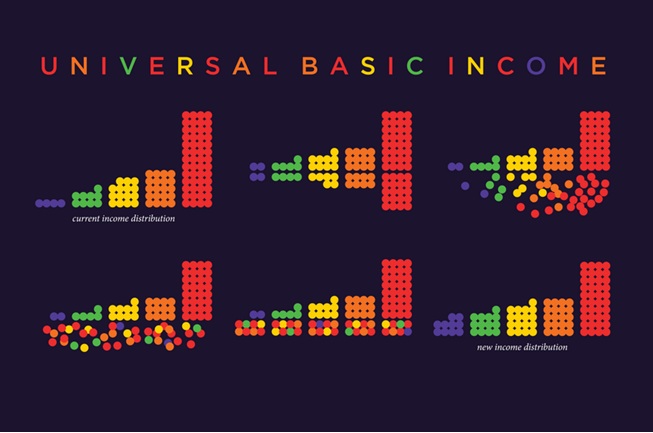
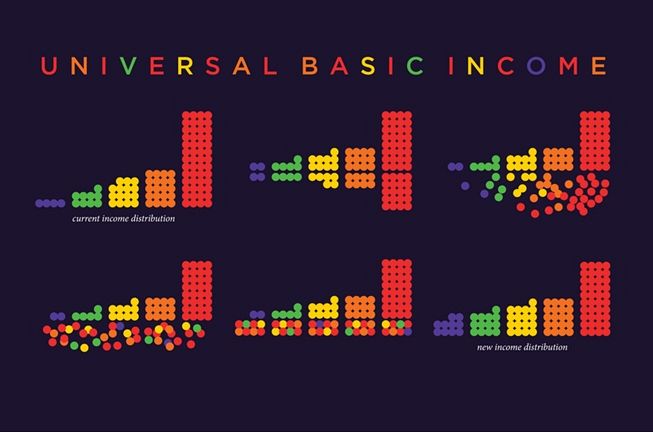
- First, the government commits to pay all citizens, permanent residents (and perhaps anyone eligible to apply for residency or citizenship) a UBI at or above the poverty level and to guarantee that this payment will be unconditional and untaxed. It will be uniform for everyone for life. And it will be indexed.
- The community can then reciprocate by redesigning how tax is to be paid on income earned above the UBI. They can design this new arrangement of taxation to ensure that enough of any increased spending power arising after the UBI is taxed back out of the economy to stabilise inflation, but that this amount is taxed back out in a much fairer distribution. At the same time, specified portions of any tax we may consent to pay can be hypothecated to any areas of public spending that the community deems to be essential for our health, wellbeing and safety. This will give people greater control in decisions about what public money is spent on.
Depending on the choices we might make about tax, this trade can be designed to ensure that all individuals (even the highest income earners) will always be net better off after tax than they are now, and those on lower incomes will be substantially better off.
This may sound ambitious, but governments have the monetary capacity to initiate and sustain it. They can create the money required to fund both a UBI and all the public services essential to health and wellbeing.
With this sort of design for the fair circulation of public money into and back out of the economy, there is no longer any need to achieve a stabilisation of prices by transferring income away from one group (say, mortgage holders, as we currently do) to benefit another group.
Instead, a substantially larger proportion of the total money supply each year will be fed into the economy by direct basic payments from the government – equally to everyone – and enough can then be safely drawn back out again by a fairer sharing of the total tax burden.
Some of that tax can also be hypothecated to guarantee sufficient government spending on the sort of services that are essential for our prospects of employment, including most notably health, education, childcare, aged care, disability services, environmental sustainability and natural resource conservation.
The overall economic benefit that can arise from this trade is such as to stimulate the capacity of the productive parts of the economy to achieve productivity growth. By guaranteeing sufficient services in health and wellbeing (that is, by prohibiting austerity), we can build our own healthy and educated workforce, which is absolutely necessary for productivity.
At the same time, the UBI will stabilise the cost of labour for businesses without requiring any sacrifice of living standards by us — assuming, of course, that the government passes laws to prevent wage reductions and also pays people working in public services well enough to force private employers to compete for labour at fair and reasonable prices.
All up, a social new deal designed in this basic configuration will result in a UBI that can ensure work at adequate rates of pay is always available. Instead of Musk’s UBI, which is designed to replace work, we can design a UBI to sustain all the employment we need and even all the sort of work we might want.
It will depend on how clever we are at collaborating in the public interest to design the social new deal, but it is entirely feasible. An example of how a UBI can be designed so that it is feasible and beneficial for individuals, the government, the economy, and our prospects for full employment can be seen here.
Dr Bronwyn Kelly is the Founder of Australian Community Futures Planning (ACFP). She specialises in long-term integrated planning for Australia’s society, environment, economy and democracy, and in systems of governance for nation-states.
 This work is licensed under a Creative Commons Attribution-NonCommercial-NoDerivs 3.0 Australia License
Support independent journalism Subscribe to IA.


Related Articles
- A universal basic income could rebuild social cohesion
- Universal basic income for a more prosperous Australia
- A Universal Basic Income will work
- Is there room for Universal Basic Income in Australia?