Declining social cohesion and rising financial stress point to the need for a universal basic income, writes Dr Bronwyn Kelly.
THE AUSTRALIAN Bureau of Statistics (ABS) has recently released its latest General Social Survey and the results are quite disturbing.
They indicate that Australians are less satisfied with their lives than they were during the COVID-19 lockdowns of 2020 and significantly less satisfied than in the decade before the pandemic. The Bureau has also recorded a very significant drop in appreciation of multiculturalism, with only 75% of those surveyed agreeing that ‘it is good for society to be made up of different cultures’, down from 85% in 2020 and 81% in 2019.
This decline in social cohesion appears to be coincident with a growth in the percentage of households experiencing financial stress.
The ABS does not venture into a discussion of whether financial stress has been a causal factor in the apparent decline in cultural tolerance. Doubtless, the decline is a function of a web of interrelated factors, not all of which are economic. But the extent of the decline in social cohesion ought to be of great concern to our governments.
Social breakdowns are incredibly hard to recover from; they are much better prevented than cured. So any potential economic factors that may aggravate problems in social cohesion should be neutralised before the breakdown gets any worse and spirals into frequent civil unrest or – to use less polite and sanitised descriptors – mass protests, mass shootings, police brutality and riots reminiscent of pre-World War II fascism.
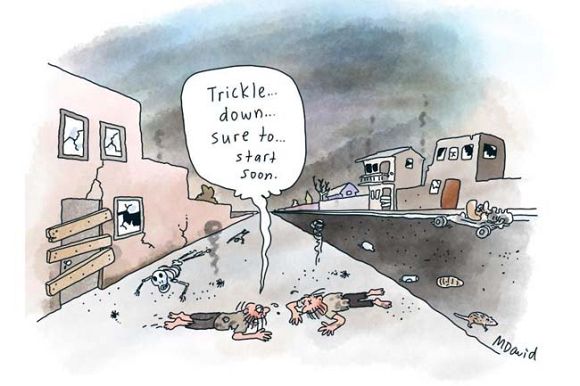
In Australia, the incidence of some of these forms of civil unrest is increasing. Witness the recent Bondi Beach shootings and the police brutality in the protest in Sydney against the visit of the President of Israel in early 2026. These are unusual events in Australia and any government would be well advised to remove as many contributors to this unrest as they can.
The ABS is not the only agency whose research is pointing to a breakdown in social cohesion in Australia. And it is not the only agency noting the coincidence of the growth in financial stress with declining cohesion.
The Scanlon Foundation, in its most recent research, has implied that there is a direct correlation between the two, saying that ‘financial circumstances remain the most important factor associated with social cohesion’. And if the Scanlon Foundation is right about that connection, then the Government should be very concerned, given the magnitude and speed of the growth in poverty and financial difficulties for families and individuals over the last decade.
Since 2015, according to the Australian Council of Social Service (ACOSS) and the University of NSW, the number of Australians living in poverty has grown from 3.05 million to over 3.7 million. And each year since COVID, according to the Scanlon Foundation and the Australian National University, between 35% and 40% of adult Australians – which equates to about 8.5 million adults – have suffered financial difficulty.
This is a scale of financial stress that the Government would be very unwise to ignore. If social harmony is desired by the current Government – and we might hope that it is – it would be best to attend to the diverse causes of unrest before millions more are added to the ranks of the financially insecure.
It should be good news to the Labor Government, then, that there is a way to stop the potential fragmentation that may yet arise in Australian society from the growth in financial insecurity.
The Government can collaborate with Australians to build a new agreement that will protect everyone from the possibility of falling into poverty and, at the same time, protect the Government from being unable to provide us with full access to services sufficient for our health and wellbeing. An option for a process in which Australians and the Government could come to this agreement has been sketched out by Australian Community Futures Planning (ACFP) as an Australian Public Interest Collaboration.

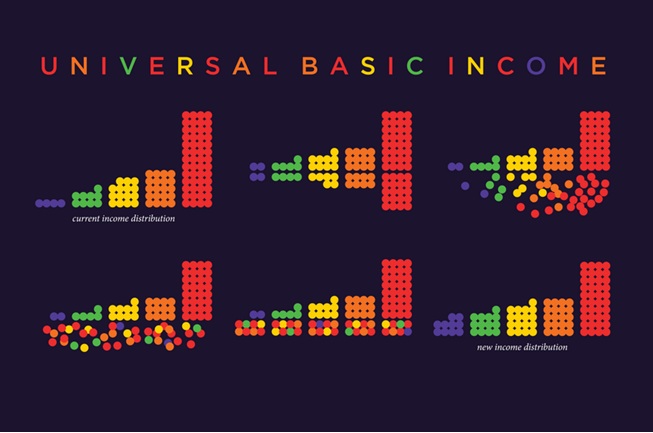
At its core, the proposed Collaboration would establish a process through which the community could design a truly universal basic income (UBI). In contrast, the Government, for its part, could work in a parallel process to design an orderly program to shore up the security of services essential for our wellbeing, starting with the reintroduction of fee-free tertiary education.
The two strands of design activity can then be integrated to ensure that everyone in the country can participate in the economy to the level of their fullest potential. This, in turn, will restore the possibility of life satisfaction and the result of that will be the sort of flourishing economy we can expect to arise from sustained optimism among its members. This will translate into political, social and democratic stability.
In effect, the Collaboration will gear Australians to redesign their welfare and taxation systems so that they are fully fair; and in this process of establishing income security for everyone, they can also, for the first time in our history, establish universal services security.
How can this happen? It can happen easily if Australians and the Federal Government decide to make a fair trade in the way welfare is distributed and taxes are collected.
In this trade, Australians can offer to enter into new arrangements for the fair payment of taxes in exchange for:
- a guarantee of a universal basic income for everyone at or above the poverty level (untaxed and for life, no questions asked beyond proof of citizenship, permanent residency or eligibility to apply for residency); and
- a second guarantee that the Government will spend everything we need them to spend on the services we deem to be essential for our wellbeing — we can, in this deal, be quite specific about what the Government must spend on each essential service (in effect, it is a deal to eliminate austerity in federal budgets).
ACFP has given this trade the provisional title of the “social new deal”, which might make it sound a little like the “green new deals” that political parties sometimes offer to people at election time. But a social new deal that can be developed by collaboration according to the community’s preferred design for the distribution of welfare and tax is actually the opposite of the sort of deals (green or otherwise) that politicians tend to dangle at election time.

Those deals come with no guarantees and, typically, they are abandoned after elections. But a deal in which the community has laid out what it can offer and what it is prepared to accept in exchange is a very different thing, if only because it puts the community in control of the terms of the exchange.
The deal, of course, must be economically viable. It is, after all, a total rearrangement of public spending, taxing and welfare. And that means it must be designed to cancel out economic and financial risk for both the Government and the community.
But if the design of the deal is organised within a public interest collaboration, the community and the Government can integrate its terms so that:
- the UBI will function to eliminate all risk of poverty for people;
- the agreement on taxation will function to eliminate unfairness in taxation, as well as, most notably, the risk of inflation; and
- the agreement on essential public spending will eliminate the risk of loss of services vital for wellbeing and therefore for maximum economic participation.
Altogether, we can achieve an unprecedented enhancement of economic and financial security in terms that establish fairness for everyone.
This sort of deal can only arise if the Government is prepared to countenance the idea of a UBI. Without a UBI that is designed to ensure everyone has fair access to opportunity and the benefits of the economy, we can’t even get started on developing a deal to ensure fairness in taxation, much less security of services.
To that end, Labor might contemplate the benefit of this sort of social new deal for its prospects for re-election. The Government can find out how the process can be set in train here.
Dr Bronwyn Kelly is the Founder of Australian Community Futures Planning (ACFP). She specialises in long-term integrated planning for Australia’s society, environment, economy and democracy, and in systems of governance for nation-states.
 This work is licensed under a Creative Commons Attribution-NonCommercial-NoDerivs 3.0 Australia License
Support independent journalism Subscribe to IA.


Related Articles
- Universal basic income for a more prosperous Australia
- A Universal Basic Income will work
- Is there room for Universal Basic Income in Australia?