Australia says it desperately needs teachers, nurses, social workers and care professionals, yet still forces students in these fields to work unpaid placements while losing the income they rely on.
If placement is essential work in an essential industry, students should be paid what they are losing, not pushed into poverty for trying to become qualified and fill a skills shortage.
Placement poverty has been making the news cycle again, with the ABC reporting on the lengths students go to survive the placement poverty trap, including students camping while completing mandatory placements. The Australian Veterinary Association has also called for financial assistance for veterinary students undertaking mandatory clinical placements.
This issue of placement poverty has been championed for some time by Independent Member for Indi, Dr Helen Haines MP and A.C.T. Independent Senator David Pocock. While their advocacy is certainly welcome, they are still only calling for the expansion of the Commonwealth Prac Payment Scheme, a $338.60-per-week payment that still leaves people in poverty wondering how they will make ends meet and pay the bills while on placement.
Mandatory placements are often described as simply part of professional training for a specific vocation. It is found in teaching, the medical professions, nursing and early childhood education, among others.
In just about all of these cases, students are not just passive observers. They are performing real work under supervision while losing any income they rely on to survive in the process. They are required to absorb the financial costs of travel and unpaid work, which often involve many hundreds of kilometres to their placement site.
Nursing, aged care and early childhood education are all industries with high demand for qualified workers, and yet we essentially punish these students financially for entering these professions. Many of these students are not just your typical school leavers living at home while studying at uni. They are also working full-time to support their full-time or part-time study and associated Higher Education Contribution Scheme (HECS) debt at the end of their degrees.
Australia says we desperately need these graduates, but it does not make their lives easy, with some early childhood teaching degrees requiring 90 days of professional experience placement to complete their studies.
Case study: Maxine, early childhood teaching
Maxine, whose name has been changed to protect her privacy, is a 20-plus-year childcare industry professional, with 15 years as a diploma-qualified lead educator. She is studying a Bachelor of Education in Early Childhood while working full-time in an early education setting in a regional town that requires more early childhood teachers.
There are four ECT positions available in the area at the time of writing. Maxine already understands children, families, routines, documentation and the realities of early education settings. However, to complete her qualification, she must undertake 90 days of professional placement. During that time, she has to lose her normal full-time income while still needing to pay her mortgage, bills, food, fuel and family expenses as the sole income earner in her household.
To afford to do this, she needs to juggle her holidays to ensure she can live while on placement, essentially having no time off and working every week for two years straight. The chances of suffering burnout in an already demanding industry are already high and that is without having any downtime at all for extended periods.
This shows the absurdity of the current system. Maxine is not refusing to work. She is trying to become more qualified in an area of high demand for graduates. Yet the system effectively punishes her by requiring unpaid labour as the price of professional advancement. Her case shows that unpaid placement is not a small student inconvenience. It is a barrier that can stop experienced workers from becoming the teachers the sector needs.
Yes, the Government will pay her $338.60 per week for the placement, but only if she is not being paid holiday pay and meets the eligibility requirements. Under current provider guidance, students may need to meet a weekly income threshold, with TAFE Queensland listing the 2026 threshold as $1,536.37-per-week gross income.
What someone like Maxine needs is not tokenism or an almost impossible-to-receive payment that is below the poverty line. She needs to be paid her actual income while doing the actual work of a teacher while on placement. She is being observed doing the actual work. She deserves better than less than JobSeeker, which is $808.70 per fortnight for a single person with no children, or about $404.35 per week.

Unpaid placement discriminates against mature-age and low-income students
Unpaid placements affect students in different ways. The effect on their lives will vary based on their age, career progression, income and family responsibility. While a younger student who is still living at home might be able to survive a few weeks of financial disruption, the predicament this places on those living independently of family support, or mature-aged, mid-career advancers, can be quite severe.
These students are paying rent, have mortgages, children and everyday living expenses like everyone else, but we say to them that to advance in their career, they need to struggle and not be able to afford to live. For someone like Maxine, unpaid placement means losing the income that pays for housing, food, transport and family needs. This creates a system where only people with enough financial backing can afford to complete essential qualifications.
The current legal framework allows some vocational placements to be unpaid if they are required by a course and meet the legal definition of a vocational placement. According to the Fair Work Ombudsman, placements that meet the definition under the Fair Work Act are lawfully unpaid and students completing those placements are not considered employees entitled to minimum wages or other employee entitlements.
However, legal does not automatically mean fair. The existence of the Commonwealth Prac Payment also shows that governments recognise placement poverty as a real issue, even if the payment itself is far below a full wage and is even below unemployment payments. Employers of apprentices are paying their wages to attend the college component of their training; the least we can do is ensure students on placement have their existing wages covered.
Unpaid placement does nothing more than entrench inequality by making professional qualifications harder for the very people who may bring the most life experience to teaching, care and community work, and those already working in an industry of high demand.
Placement students perform real work and should be paid for it
Students on placement who are not merely observing how teaching is done ought to be paid because they are performing real work that benefits the workplace.
In early childhood teaching, students on placement are not passive observers. They are required to run the entire class and room program. They create lesson plans, they implement and deliver those lesson plans, and they complete the government-mandated documentation required of early childhood teachers. Yes, they might be supervised, but their supervisor is more of a hands-off invigilator who only intervenes when appropriate.
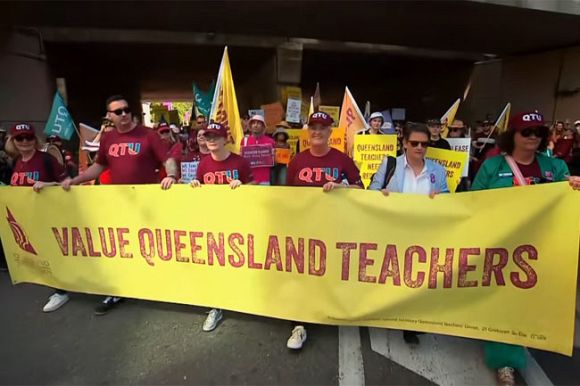
Apprentices are also learning under supervision and we accept that they are worth their wages, often full adult wages, not the fraction of a wage of years ago. The same principle should apply to other students on placement. Their work has value to the workplace it is being performed in, and they should be compensated for that work rather than being forced into poverty and difficult decisions just to get their qualification.
Professional placements should be treated like professional development in every other workplace: paid for by the employer in work hours. This then shows that the system recognises that workplace learning is essential to professional competence. If the placement is important enough to be compulsory, then the labour performed during that placement is important enough to be valued.
Paying students the equivalent of their current income would recognise that learning and labour can happen at the same time, rather than pretending that supervised work has no economic value.
Unpaid placement worsens workforce shortages
Unpaid placements are bad policy. They discourage people from career advancement and entering career paths with a shortage of workers because of the financial strain this can cause.
Australia already has a shortage of ECTs, a shortage that will progressively get worse through industry professionalisation and changes to legislation and departmental guidelines. However, unpaid placement makes the pathway harder, especially for experienced educators trying to upgrade their qualifications.
In Maxine’s case, the system should be helping her move from a diploma-qualified educator to an early childhood teacher. Instead, it creates a financial obstacle that may force people like her to delay study, reduce their load or abandon the pathway altogether.
Jobs and Skills Australia has identified the need for many more qualified early childhood educators, reporting that Australia needs 21,000 more qualified ECEC professionals to meet current demand. This makes unpaid placement especially irrational. If the country needs more teachers and educators, then it makes no sense to design training pathways that push people out through lost income.
Paid placement would not only help individual students, but it would also support workforce development in a sector Australia already knows is under pressure.

Unpaid placement devalues work in feminised industries
Unpaid placement also reflects the broader undervaluing of work in feminised industries, which becomes more apparent when that work is performed in lower-paid, feminised or care-based industries.
Early childhood education, nursing, aged care, teaching and social work are all treated as essential to society. However, the people performing these roles that allow for the essential functioning of our society are often lowly paid, have to endure emotional pressure and are required to give personal sacrifice. This happens because we treat these industries as caring rather than the professional and skilled vocations that they are.
How we frame this matters because it allows society to praise these workers while still resisting the need to value their work properly. This same logic sits within unpaid placements. Students are told that placement is necessary, valuable and professionally important, but they are not paid as if their contribution has real economic value.
Maxine’s situation shows this clearly. She is already an experienced early childhood worker with a diploma qualification, yet she is still expected to complete compulsory placement while losing her normal income. Her work requires responsibility, planning, observation, communication and professional judgement. It is not just practice in an abstract sense; her work contributes to a real workplace in a sector Australia relies on.
This broader undervaluing can also be seen in political debates where even modest wage increases for early childhood educators are criticised, as though care work should remain cheap simply because it is socially meaningful. The Federal Government has funded a 15 per cent pay rise for early childhood education and care workers, yet public debate around childcare, women’s work and care industries still often treats this work as a cost to be contained rather than labour to be properly valued.
Therefore, paying placement students an actual wage would do more than reduce student hardship. It would challenge the wider assumption that essential human work can be praised in public while being underpaid, unpaid or treated as a personal sacrifice.

The current payment model is not enough
Small placement payments are a step forward, but they are not a substitute for an actual wage or the loss of earnings that a student has to endure to complete their placement.
The Commonwealth Prac Payment acknowledges that unpaid placement creates financial hardship. However, a payment of a few hundred dollars per week does not replace a full-time wage. For someone like Maxine, it would not cover a mortgage, bills, food, transport and the costs of education. If the problem is lost income, then the solution must be income replacement, not symbolic assistance.
The Commonwealth Prac Payment provides eligible students with a weekly payment during mandatory placement, but it is benchmarked to student support rather than to the actual wage being lost or the value of the work performed. This means it may help some students, but it does not solve the deeper injustice of requiring unpaid professional labour.
Therefore, the policy goal should be a real placement wage, ideally linked to the relevant award or at least to the amount of income the student is actually losing to undertake the placement, rather than a token payment that is less than JobSeeker and still leaves students financially exposed.
Australia cannot keep forcing students to fund the workforce pipeline
Maxine’s case shows why unpaid placement is not just unfair, but irrational. She is not avoiding work. She is already working in an essential field and trying to become more qualified in a sector that desperately needs people like her. Yet the system asks her to lose the income that pays her mortgage, bills, food and fuel in order to perform compulsory professional work.
A $338.60 weekly payment does not solve that problem. It simply makes poverty official. If Australia needs early childhood teachers, nurses, social workers, aged care workers and other essential professionals, then it cannot keep forcing students to personally fund the workforce pipeline.
Students on mandatory placement should be paid what they are actually losing, especially in essential fields where their labour already supports the public good. Anything less is not training. It is exploitation dressed up as opportunity, something that a decent society should want to avoid.
Rob Powell is a retired mature-aged student currently studying politics and philosophy, focusing on how ethical frameworks shape public policy and political behaviour.
 This work is licensed under a Creative Commons Attribution-NonCommercial-NoDerivs 3.0 Australia License
Support independent journalism Subscribe to IA.