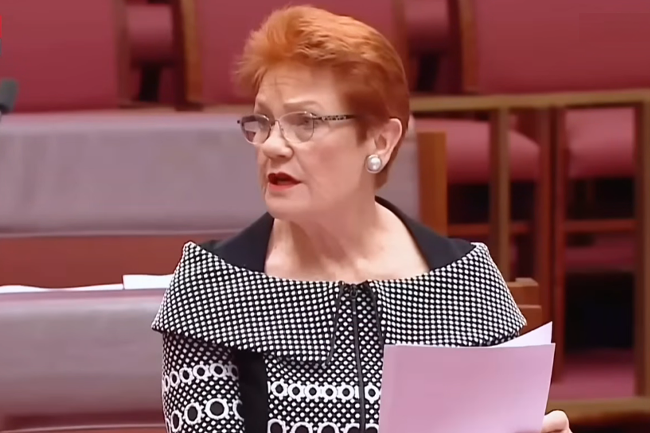
Pauline Hanson’s apparent acceptance of a multiracial Australia may expose deep tensions within her own support base, writes Paul Begley.
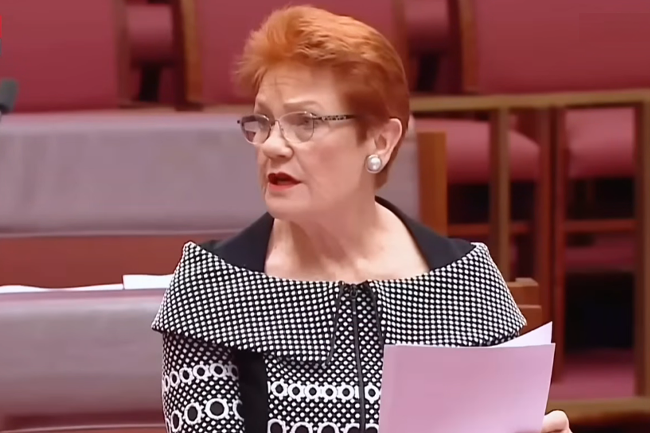
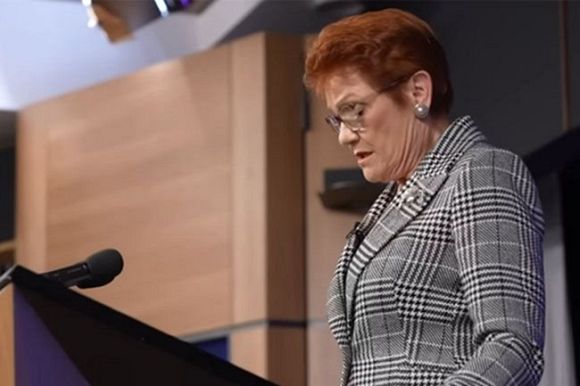
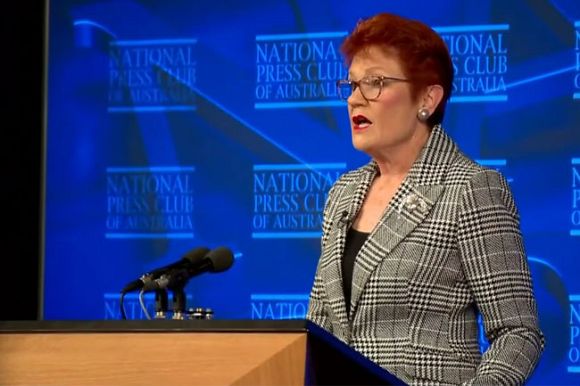
WITHIN DAYS of Senator Pauline Hanson’s address to the National Press Club on 17 June, there were widespread calls on social media, News Corp tabloids and Sky News Australia for Prime Minister Anthony Albanese to authorise high-level security to protect the One Nation leader.
The Herald Sun led with a page four “exclusive” by Jason Morrison on 20 June under the headline: ‘Plea to Albo: Protect Pauline.’
The premise of Morrison’s story was that Hanson is a hapless victim of death threats and that the Prime Minister is in a position to protect her, despite him saying that decisions about the protection of public figures are a matter for the Australian Federal Police and officials from the Department of Home Affairs.
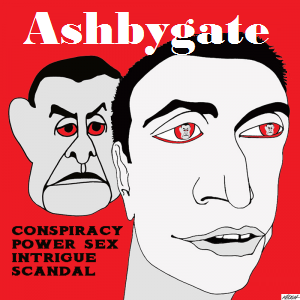
The principal source for Morrison’s story was Hanson’s chief of staff, James Ashby. The record shows that Ashby has form in naming victims and making rash assertions.
For those with a short memory, in April 2012, Ashby named himself as the victim of House of Representatives Speaker, Peter Slipper, whom he accused of unwanted sexual advances and lewd text messages in a Federal Court action. The record also shows that he withdrew the allegations once the court of public opinion had gathered enough momentum to destroy Peter Slipper and bring down the Gillard Government.
The media reporter central to that series of events was Daily Telegraph’s Steve Lewis, whom Federal Court judge Steven Rares may have had in mind in December 2012 when assessing the Ashby text exchanges presented as evidence in the case.
Justice Rares found they “do not read like those concerning a man claiming to feel sexually harassed or emotionally distressed by such conduct”. The judge ruled that Ashby’s allegations were an “abuse of process” and were simply designed to cause “significant public, reputational and political damage”.
Rares might also have added that Lewis had been conned by Ashby in running his front-page scoop. That said, it achieved its likely purpose in giving rise to a News Corp campaign denigrating Slipper. For his part, Ashby decided against taking up the invitation when the Federal Court gave him leave to appeal against the Rares’ ruling against him in May 2013.
And by February 2015, nearly two years after PM Julia Gillard had resigned, Slipper had been comprehensively cleared on all matters related to the initial allegations and those that followed from them in the Murdoch media, including unauthorised use of a Commonwealth car and a $954 purchase of wine. Slipper’s exoneration barely rated a mention in the newspapers that had relentlessly run the bogus tabloid campaign against him for months during 2012 and 2013.
In the Herald Sun story, Ashby cited the assassination of right-wing provocateur Charlie Kirk in America, along with recent reported attempts on the life of President Trump, as examples of what could happen to Senator Hanson.
Hanson herself was quoted as saying she feels safe in Queensland but not in other places where just one mentally unstable person could present a safety risk, suggesting that Australians found south of the Queensland border are more likely to be citizens inclined to mental instability when a prominent politician from the Far-Right talks stridently of ridding the nation of people who don’t fit into a Judeo-Christian monoculture.
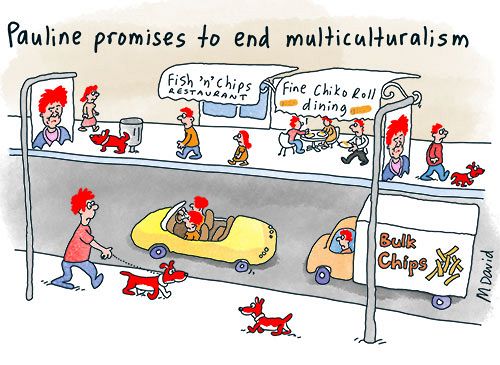
While many Australians in 2026 would not know what such a monoculture would look like, Hanson contributes to their fear that it might not include them, especially if they make up the throngs of immigrants with a Muslim heritage or the hordes of transgender athletes who are swamping elite sporting contests and invading women’s restrooms.
Were Hanson to make a great many citizens fearful, Ashby may have a point. However, the history of political assassinations in Australia can be reduced to an attempt by 19-year-old Peter Kocan on Arthur Calwell when the latter was speaking against conscription as the Labor Party leader of the Opposition in 1966.
Kocan revealed after the unsuccessful attempt that he didn’t really have much against Calwell but that he needed to do something “out of the ordinary” to set him “apart from other nobodies”. He added that assassinations were in the air with the public killing of Malcolm X in 1965 and the assassinations of President John F Kennedy in Dallas just two years earlier.
Something similar could be said of 20-year-old Thomas Crooks, who was shot dead after firing a rifle at President Trump during a rally in Butler, Pennsylvania, on 13 July 2024. Crooks was a registered Republican who was found by the FBI to have searched online for both Republican and Democrat campaign events as potential ‘targets for opportunity’.
On that reading, Crooks' target could just as easily have been Joe Biden, who was the other presidential candidate at the time. Like John Wilkes Booth, who assassinated Abraham Lincoln in 1865, there is a reasonable likelihood that Crooks was looking for an event, any event, that could immortalise his name.
The assassination of Charlie Kirk by 22-year-old Tyler Robinson was in a different category, in that Robinson appears to have had a personal motive. In family conversations before the shooting, he allegedly accused Kirk of spreading hate.
Prosecutors said that Robinson left a note for his partner, Lance Twiggs, who was transitioning from male to female. The note read: ‘I had the opportunity to take out Charlie Kirk and I'm going to take it.’ Kirk had weaponised transgender issues at his rallies.
While Hanson’s rag-bag of grievances includes transgender resurgence, it also includes other issues that would adversely affect many ordinary Australians if put into law. When looking for a likely voter base, Hanson doesn’t appear to have noticed that a great many multicultural and multiracial Australians now make up the Australian populace, significantly more than when she first stood for election 30 years ago in 1996.
That does not necessarily mean an assassination threat would come from those Australians, though Ashby may like that thought to function as a dog whistle.
Such a threat is just as likely to come from other places, including Hanson’s own supporters and particularly those who listened with disappointment to what the One Nation leader said in her prepared speech about a multiracial Australia being acceptable, distinguishing the notion from the evil of a multicultural Australia.
It’s anyone’s guess how many One Nation supporters make up its White supremacist constituency, but it can be taken as certain that the most zealous among them would have heard that distinction as a heretical sellout of Hansonist orthodoxy. It would have been useful if a journalist at the Press Club had tested Hanson with a probing question about the distinction to get a better sense of where she might sit with it once she moved off her prepared script.
To get a historical perspective on assassinations by supporters, Mahatma Gandhi’s assassin in 1948 was Nathuram Godse, a Hindu nationalist who acknowledged Gandhi’s Hindu allegiance but saw his pacifism as an unacceptable betrayal of the Hindu abomination of the Muslim nemesis.
At the very least, in her own interest, there is a case for getting Pauline Hanson to “please explain” her apparent belated embrace of a multiracial Australia.
Paul Begley is a Melbourne writer who worked for many years in public affairs roles, most recently as general manager of government and media relations with the Australian HR Institute.
 This work is licensed under a Creative Commons Attribution-NonCommercial-NoDerivs 3.0 Australia License
Support independent journalism Subscribe to IA.


Related Articles
- The A to Z of who Pauline Hanson does and does not represent
- How Pauline Hanson turned grievance into political power
- Pauline Hanson targets multiculturalism while ignoring the real crisis
- No, Pauline, 63 per cent of Australians do not use candles
- CARTOONS: Pauline is playing up her populism