You cannot swap a few decades of fragile, reversible tree growth for the release of carbon the Earth took an almost incomprehensible span of time to lock away and call it an offset — that's commerce, dressed up as science, writes Wayne Hawkins.
THE LARGEST FARM in Tasmania is no longer a farm.
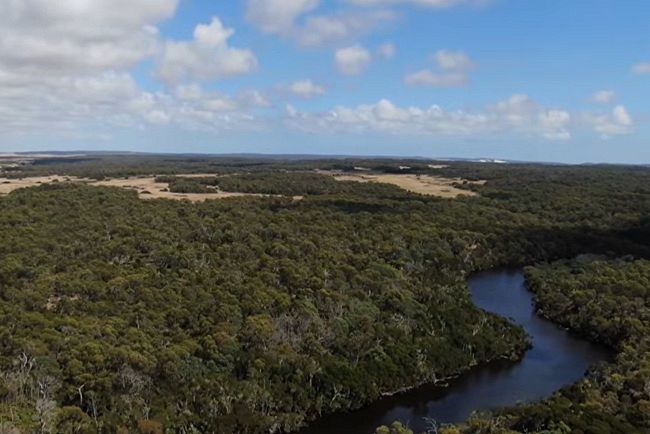
Rushy Lagoon and its neighbouring property East Wyambi – 21,744 hectares of dairy, beef and cropping country near Cape Portland, in the state's remote north-east – have been sold to the Tasmanian Natural Asset Trust, a vehicle managed by Gresham House, Britain's largest forestry asset manager.
The Federal Treasurer, Jim Chalmers, signed off on the deal in early July, backed by the Foreign Investment Review Board (FIRB).
The price tag was north of $100 million. Some of that money, it later emerged, came pre-committed from the government's own Clean Energy Finance Corporation (CEFC) — before the sale had even been formally approved.
The plan is to convert thousands of hectares of grazing and irrigated cropping land into a pine plantation, generating Australian Carbon Credit Units under the Emissions Reduction Fund.
TasFarmers surveyed its members and found 99 per cent opposed the sale. The Federal Treasurer called it a rigorous process. Locals called it something closer to a stitch-up, quietly waved through during the winter parliamentary recess.
Both sides are arguing about process. I want to argue about the arithmetic, because that's where this deal actually falls apart.

The offset logic, plainly stated
Here is the pitch, stripped of the consultant language: plant enough trees on Rushy Lagoon and somewhere else in the country, a coal-fired power station, a gas plant, or an industrial polluter gets to keep doing exactly what it's doing.
The carbon the trees supposedly lock away cancels out the carbon someone else keeps putting into the air. One offsets the other. The books balance.
Except they don't and the scale of the mismatch is so large it's almost absurd once you actually look at it.
Coal, oil and gas took millions of years to form — organic matter buried, compressed and slowly cooked under geological pressure across timescales that dwarf human history. We are pulling that up and burning it in seconds.
A tank of petrol, a shipload of coal, a day's output from a gas plant – fuel that took the planet millions of years to lay down – released into the atmosphere in an afternoon.
And the proposition on the table is that a pine plantation, grown over 25 to 35 years, can counterbalance that. It cannot.
No version of forest growth operates on anything close to the timescale on which fossil carbon was sequestered in the first place. Pretending otherwise isn't science. It's an accounting trick wearing a lab coat.
Trees do genuinely draw down carbon — but slowly, over decades, and only if they stay standing, don't burn, aren't logged early and aren't undone by the next drought or bushfire season.
Meanwhile the fossil emissions they're supposedly cancelling out represent millions of years of stored carbon, released instantly, with immediate atmospheric effect.
You cannot swap a few decades of fragile, reversible tree growth for the release of carbon the Earth took an almost incomprehensible span of time to lock away and call it a wash. That's not an offset. That's commerce, dressed up as science.
And then the trees get cut down
There's a further problem the offset pitch quietly skips over: pine plantations are not conservation forests. They are a commercial crop, grown by a forestry asset manager, for eventual harvest.
Somewhere around the 25 to 35-year mark, those trees at Rushy Lagoon will come down. When they do, most of the carbon they've stored gets released back into the atmosphere — as offcuts and slash burned or left to rot on site, and eventually as timber that itself decomposes or burns at the end of its working life.
So this was never a genuine one-for-one swap. It was a rental. Somebody gets to keep polluting today, in exchange for a few decades of temporary storage that unwinds the moment the harvester arrives.
The emissions it was meant to cancel out happened immediately and permanently. The storage was always going to be temporary and reversible. Calling that an offset assumes nobody looks past the first harvest cycle.
Why this matters more on a working farm than on marginal land
There's a version of forestry offsetting that at least has a coherent logic: revegetating genuinely degraded land that was doing nothing productive anyway.
Rushy Lagoon is not that. It is prime, irrigated, food-producing country — 1,170 hectares under irrigation, backed by 12,500 megalitres of water entitlements, running 4,000 dairy cows and thousands of head of beef cattle as recently as a few years ago.
Converting productive agricultural land into a plantation for carbon credits doesn't just make a shaky offset claim shakier. It trades something we can measure and eat – food, actually produced, actually feeding people – for something we can only measure on a spreadsheet, sold to whoever needs to keep polluting elsewhere.
We are told this is good for the climate. What it is, more precisely, is good for the balance sheet of whoever bought the credits and good for Gresham House's Tasmanian portfolio.
Tasmania supplies the trees. Someone else keeps the emissions.
Who actually benefits?
This is the part that should worry Tasmanians regardless of what they think about carbon policy generally. The Clean Energy Finance Corporation – funded by Australian taxpayers, mandated to reduce emissions – helped finance a foreign firm's purchase of Australian food-producing land, ahead of formal government approval, so that firm can sell carbon credits back into the Australian market.
We are, in effect, subsidising the conversion of our own biggest farm into a product that lets someone else's factory keep running.
Meanwhile the actual, physical output of Rushy Lagoon – the milk, the beef, the food security that a farm of that scale represents – disappears from the ledger entirely.
It isn't counted as a loss anywhere in the carbon accounting, because the carbon accounting was never built to count it.
What Tasmania should be asking for
None of this means forestry, revegetation or genuine carbon farming are worthless. It means the accounting has to be honest about what it's actually trading.
A tree planted this decade is not a fair exchange for a tonne of carbon burned this decade — the timeframes alone make the swap dishonest, before you even get to fire risk, land-use loss or who profits.
If Australia is going to keep approving sales like this, the least Tasmanians should demand is a straight answer to some simple questions: whose emissions does this pine plantation actually cancel out, when and how do we know the trees will still be standing when the bill comes due?
So far, nobody in Canberra has been willing to show their working.
Wayne Hawkins is an independent commentator based in Tasmania and an independent candidate for the federal seat of Clark.
 This work is licensed under a Creative Commons Attribution-NonCommercial-NoDerivs 3.0 Australia License
Support independent journalism Subscribe to IA.