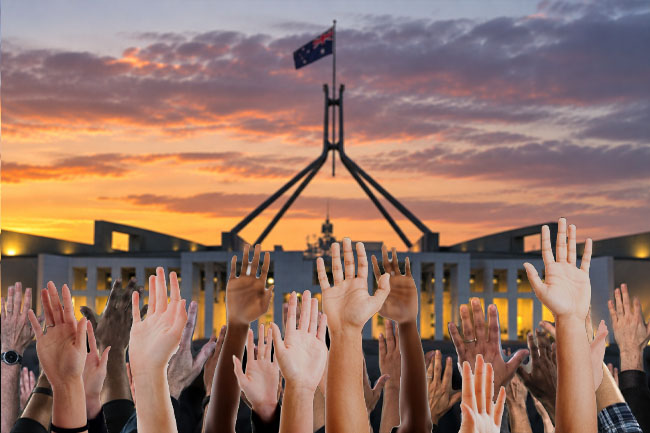
David Higginbottom examines who really holds power in Australia and how democratic institutions can better serve the people they represent.
WHEN AUSTRALIANS talk about democracy, it is often with quiet confidence.
After all, we hold elections, governments change without violence, votes are counted honestly, courts are independent, and the right to speak, organise and criticise government is broadly protected. These are real achievements. They deserve to be defended.
However, before Australians use democracy as a test to judge China, India, the United States, or any other country, we should begin with a less comfortable question.
How much power do ordinary Australians exercise over the people and institutions that govern us?
The question is not whether Australia is a democracy or an autocracy. That is too crude — democracy is not an on-off switch. It is a continuing contest over who has access to power, who can challenge it and whether government serves the people in whose name it acts.

Lincoln’s phrase remains useful: “government of the people, by the people, for the people”. To it we should add one more requirement: government must be open to the people’s scrutiny.
Without that fourth condition, the other three become fragile. Representation can become party patronage; participation can be reduced to an occasional vote; public service can give way to private access; and good policies can become cover for patronage and self-protecting initiatives.
Australia passes important tests. Compulsory voting produces high turnout. The Australian Electoral Commission has a deserved reputation for competent and impartial election administration. Citizens can form parties, campaign, publish criticism and remove governments. Public health, education, welfare and infrastructure systems – though under pressure – have contributed to high levels of human development.
Yet the democratic story cannot end there. More than half a century ago, Peter Cook’s political satire The Rise and Rise of Michael Rimmer imagined an advertising executive who used polling and public frustration to rise to power. Its warning was not that citizens are foolish. It was that participation can be made shallow, exhausting and easy to manipulate.
A democracy can make people feel consulted while treating them as data to be measured and managed; polling and political communication should help citizens exercise judgement, not enable others to manage them.
The first question we should ask is whether government is truly of the people. Most citizens can vote for a candidate, but they have no say in who becomes that candidate. Major-party pre-selections occur within relatively small party memberships and are shaped by factional arrangements and other power structures. This matters, particularly in the Senate, where a high place on a party ticket can be close to an election guarantee.
The voter is asked to choose from a menu prepared before most voters are aware that an election will be held.
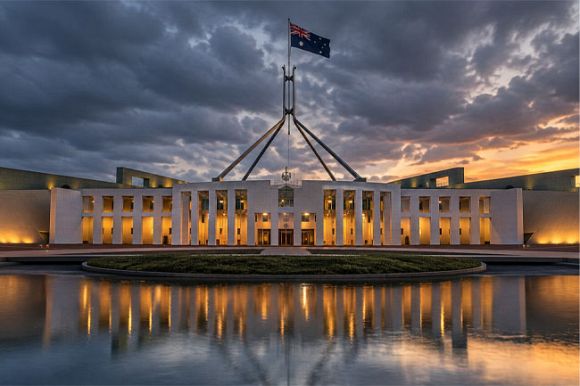
There is nothing inherently improper about political parties selecting candidates. Parties are necessary vehicles for collective politics. The problem arises when selection becomes too narrow, too opaque or too dependent on loyalty to internal machines. Then a candidate’s prospects can depend less on their capacity to represent a community than on their ability to survive factional contests, raise money, cultivate networks and avoid offending those who control endorsement.
As the Parliamentary Library’s account of Australia’s electoral and party systems makes clear, party pre-selection is an internal process rather than a public primary in which ordinary electors choose the major-party nominee.
That takes us to government by the people. Voting is vital, but it is only one form of participation. Citizens need timely information, a realistic opportunity to influence policy before decisions are locked in and confidence that dissent will not be dismissed as disloyalty.
Too often, consultation begins after the essential choices have already been made. Lobbyists, well-connected companies, industry bodies and professional advocates have access to ministers, staff and departments long before the wider public knows what is being proposed. Their involvement is not automatically corrupt — expertise and advocacy can improve policy.
However, unequal access creates unequal influence, especially when the public cannot see who has met whom, what was discussed, or whether it shaped a final decision.
This is why corruption is not merely a moral failure; it is a systems failure. As I argued in an earlier article, corruption becomes predictable where rules reward loyalty, access and survival — as opposed to accountability, transparency and the public interest.
People enter public life with different motives, normally honourable ones. But systems teach people what behaviour is rewarded and people who do not toe the line face dis-endorsement.
A politician who wants re-election, influence or promotion learns to prioritise party management. A public servant operating in a politicised environment learns caution. A lobbyist exists because private access is more effective than public argument or scrutiny.

Lord Acton’s warning that power tends to corrupt and absolute power corrupts absolutely is often heard as a judgement on personal character. It is more useful as a warning about institutional design.
Every system needs institutions that make power visible, contestable and correctable:
- independent media;
- effective freedom-of-information laws;
- transparent lobbying and donation rules;
- properly funded audit and anti-corruption bodies;
- protected whistleblowers;
- impartial public administration; and
- open candidate selection.
The test of government for the people is equally demanding. It asks not only whether national income rises, but whether people can afford housing, obtain health care, educate their children, travel on functioning public transport and look ahead without fear that one illness, rent rise or job loss will undo them.
A country may be wealthy and still leave too many people unable to enjoy the security that makes political participation meaningful:
- a citizen burdened by insecure housing and casual work has less time and confidence to participate;
- a government dependent on closed networks is less likely to hear anything “inconvenient”;
- a party whose candidates are chosen by a narrow machine can lose touch with the people it claims to represent; and
- a society that cannot see how power is used will struggle to correct it.
Reform begins with honest assessment, not congratulatory handshakes. Democracies are never finished. Australia’s strength is that it has institutions and civic traditions capable of reform.
We should not use democracy as a medal awarded to ourselves, while withheld from others. We should treat it as a standard that must be renewed. The rest of this series will apply the same test elsewhere. China’s extraordinary reduction of poverty, India’s immense electoral experiment, America’s primary system and the role of foreign institutions that claim to promote democracy all raise different questions. None should be judged by a single label.
Every system has ways of exercising power over people. Democracy includes the work of making those arrangements visible and correctable.
This is part two of our series on democracy. You can read part one here.
David Higginbottom is a member of the coordinating committee of the Independent and Peaceful Australia Network (IPAN) and coordinator of the Make Peace A Priority campaign (mpap.au).
 This work is licensed under a Creative Commons Attribution-NonCommercial-NoDerivs 3.0 Australia License
Support independent journalism Subscribe to IA.


Related Articles
- Democracy and the secular faith of economics
- Strengthening democracy in Australia an example worth demonstrating
- 'Democracy is a system in which parties lose elections.' So they should
- Get rid of running the gauntlet — bring back Democracy Sausages
- EDITORIAL: Dutton, Trump and the dangers of both-sidedness