Australia’s major political parties are failing to address growing permanent visa backlogs, risking legal challenges, longer processing times and mounting pressure from employers and families. Dr Abul Rizvi writes.
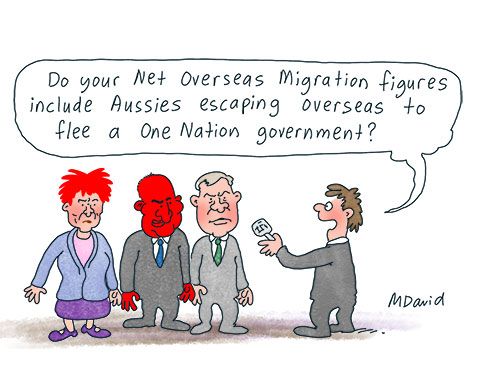
DESPITE THE NOW strong focus on their respective Net Overseas Migration (NOM) targets, Labor, the Coalition and One Nation have all either ignored or suppressed the challenges of managing the permanent migration program. There are serious legal, policy and political implications of doing so.
Both Labor and Coalition policy is to maintain the permanent migration program at 185,000 per annum within a NOM target of 225,000 and 100,000, respectively. One Nation has decided, in its eagerness to announce its negative NOM target for three successive years, that it will simply avoid talking about the permanent migration program altogether.
There are two major challenges that are being ignored/suppressed. First is the ongoing growth in the partner visa backlog — this is a visa category that by law must be managed on a demand-driven basis. The second is pressure from employers and state/territory governments for additional places to meet their needs, which are currently well in excess of the places allocated.
Partner visas
The Migration Act makes it abundantly clear that partner visas must be managed on a demand-driven basis. The Department of Home Affairs (DHA) knows this and accordingly puts a footnote to the annual planning levels and outcomes for this visa that proudly states DHA manages this visa on a demand-driven basis. It is a totally misleading footnote, as the Department over the last decade has always delivered partner visa numbers to whatever planning level the Government sets irrespective of demand.
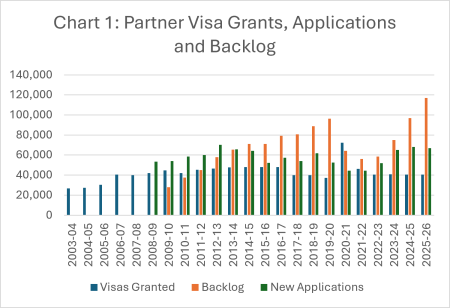
For example, in both 2024-25 and 2025-26, the partner planning level was 40,500 and the outcome was – you guessed it – 40,500. The planning level is clearly being used as a cap when s87 of the Migration Act makes it clear partner visas cannot be capped.
The illegal behaviour started around 2014-15 when former Immigration Minister Peter Dutton and his Secretary, Mike Pezzullo, decided either to ignore the requirements of the law or were not advised of it — the latter would seem unlikely.
In the face of a forthcoming audit of partner visa processing by the Auditor-General, the then-new Immigration Minister, Alex Hawke, quickly cleared the backlog in 2020-21 by allocating a record 72,000 places for partner visas. New applications also fell during COVID, assisting DHA to be able to tell the Auditor-General that it was indeed managing partner visas on a demand-driven basis.
After the audit, the Coalition Government went back to limiting places for partner visas to around 40,000 per annum. The new Labor Government, which had been critical of the Coalition Government’s illegal practice and had encouraged the Auditor-General to call out the illegal practice, went back to doing the same — limiting places for partner visas and allowing the backlog to blow out. In 2025-26, with places limited to 40,500 and new applications during that year at 66,916, the backlog blew out to an astonishing 116,917 by end June 2026.
In 2026-27, the Government has marginally increased the number of places for partners to 41,500. If new applications in 2026-27 are again over 65,000 (highly likely), that means the backlog will grow further, possibly to around 130,000. And the Government will continue to pretend that it is abiding by the law and managing partner visas on a demand-driven basis.
But at some stage, it will be forced by either the courts or the Ombudsman to face the reality of its illegal behaviour.
Demand from employers and state/territory governments
Unlike partner visas, the Government has tried to manage the booming demand for permanent employer-sponsored visas in a manner that is slightly more responsive to demand.
Applications have increased from 41,992 in 2022-23 to 87,055 in 2025-26. To try to deal with this, the Government has increased places for this visa from 26,103 in 2021-22 to 44,022 in 2025-26. The increased number of places has not, however, kept pace with rising applications and hence the backlog has boomed from 27,523 at end June 2023 to 99,144 at end June 2026.
For 2026-27, the Government has further increased places to 58,040. This has been achieved by shifting places from the Regional Visa, where places in 2026-27 have been reduced by around 14,000. That has made a number of states/territories and regional authorities angry, with the Government struggling to reach agreement with them on their respective allocations for 2026-27.
The larger number of places for the permanent employer-sponsored visa in 2026-27 will not be enough, even to cover the current application rate, let alone reduce the backlog. Applications will continue to be high due to the very large number of people on the temporary employer-sponsored visa, which at end September 2026, was almost 280,000 and rising.
That means the permanent employer-sponsored visa backlog will keep rising through 2026-27 and most likely into 2027-28. Processing times will continue to blow out and employers will become increasingly angry.
Poor long-term planning
The situation the Government finds itself in is due to its failure to respond adequately and quickly enough to the boom in NOM in 2022-23 and 2023-24. The flow-through of that surge to pressure on the permanent program was inevitable. Despite committing to developing a long-term migration plan prior to the 2025 Election, Labor reneged on that commitment.
It has at last committed to managing NOM to a target. But that is not sufficient. Long-term migration planning requires a plan for managing both NOM and the permanent program. Labor has no such plan.
The NOM target and immigration policies announced by the Coalition will in fact exacerbate the challenges of managing the permanent migration program, as it proposes to significantly boost places in the temporary employer-sponsored visa. That will inevitably flow through to the permanent employer-sponsored visa and increase the backlog and processing times even further. While the Coalition would not intentionally make employers angry, that is what its currently announced policies would do.
One Nation’s immigration policy manifesto just ignores the permanent migration program altogether, suggesting it is oblivious to the challenges.
Dr Abul Rizvi is an Independent Australia columnist and former Deputy Secretary of the Department of Immigration. You can follow Abul on Twitter @RizviAbul or Bluesky @abulrizvi.bsky.social.
 This work is licensed under a Creative Commons Attribution-NonCommercial-NoDerivs 3.0 Australia License
Support independent journalism Subscribe to IA.


Related Articles
- Migration numbers fall as political promises face reality
- Student visa crackdown puts international students and families in limbo
- NSW DAMA to test One Nation and the Coalition
- Coalition and One Nation migration plans built on false assumptions
- Coalition boxed in by working holiday visa policy