Pauline Hanson thrives when journalists fear being shut out, but the media holds more power than it realises if it's willing to use it, writes Dr James Beattie.
THERE HAS ALREADY been some commentary about how journalists could have been more probing in their questioning of Senator Pauline Hanson in her recent Press Club address.
But little has been said about why there were so few penetrating questions from this elite band of Australian media practitioners and how they should – or should not – cover her in future. Did most of them just switch off their moral compasses along with their mobile phones when they entered the room? Or was something else going on? Were they driven by moral cowardice, or perhaps just polite deference?
Or was it more a matter of professional FOBB: fear of being banned?
Pauline Hanson’s problematic relationship with the media is on the record. But she still needs the mainstream media just as much as any other politician, as I’ll explain below. Nevertheless, she has already banned two media outlets, confirming and extending her party’s exclusion of the ABC and The Guardian from One Nation media events when replying to a question from The Guardian’s Sarah Martin during her Press Club appearance.
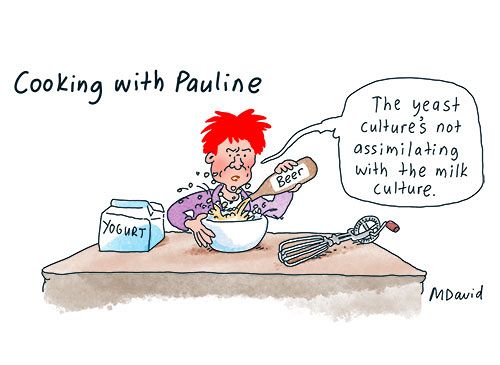
Every journalist at the event would have been aware of this ban before they arrived, so it’s understandable that many of them may have been quaking in their boots, lest they suffer the same fate themselves.
In her speech, Hanson also announced she would abolish the SBS and convert the ABC into a mostly subscription-funded organisation. With policies – or threats – such as this, who wouldn’t be fearful of provoking Hanson’s ire?
But does this need to be the case? Why should she hold all the cards?
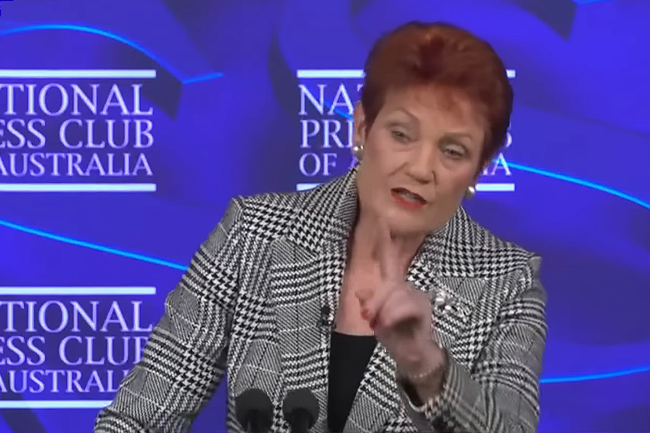
This is how tyranny works: intimidate those who dare to challenge you by banning them, which many journalists seem to see as equivalent to professional assassination. But given that there are already a few brave souls like Sarah Martin who have stood up to her, why are there not more? Why were her colleagues in the room conspicuously silent about Hanson’s attack on Martin’s professionalism when she called Martin a “trashy journalist”?
Did any of those present walk out in protest against this insult? No. Did the host intervene to assert some standards of decency in relation to Hanson’s treatment of Martin? No.
The union representing Australian journalists, the Media, Entertainment and Arts Alliance (MEAA), published a statement later that day condemning Hanson’s ‘continuing abuse’ of Martin and the International Federation of Journalists endorsed that statement the next day. Several media outlets wrote stories about her behaviour, but there have been no official media releases from these organisations and the Press Club itself has apparently decided not to take a stand on the incident.
What most journalists may not have realised is that, behind her apparent channelling of Lewis Carroll’s tyrannical Queen of Hearts, Hanson is as much a construct of the media’s imagination as this Wonderland Queen is for Alice. She bans media outlets and practitioners because she lacks confidence in her ability to handle their curly questions competently. Perhaps she realises she doesn’t have the capacity to discuss her talking points in terms of their policy implications.
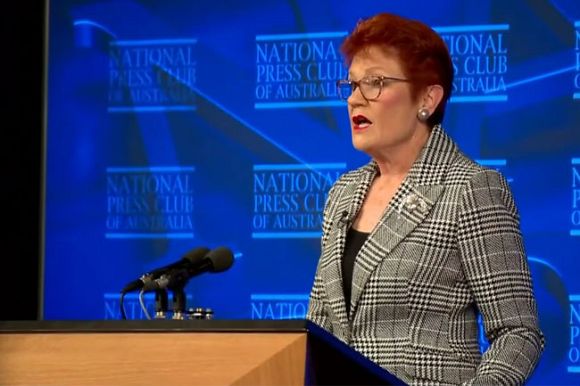
If anyone should have the upper hand here, it’s the media, given how thoroughly they usually do their homework on issues in domestic politics. The cream of Australian journalists who were assembled for the Press Club address should have predicted what areas Hanson would canvass, what her weak spots would be and how best they should scrutinise her claims and proposals. So one vital message for the media is this: don’t be bullied by Hanson’s brand of political cowardice camouflaged as toughness.
Perhaps the event’s most egregious failure of moral – or was it professional? – courage was the absence of any serious challenge to Hanson’s ambition to make Australia a monocultural nation. No journalists sought to clarify exactly what monoculturalism would mean for Australia; what would change if Hanson achieved this goal?
Hanson acknowledges that we’re a multiracial nation, so for her, “cultural” should mean something other than “racial purity”. But what, exactly?
Several journalists have since discussed her monocultural “vision” from a variety of perspectives. But none of the Press Club journalists sought to interrogate her thoroughly about how pervasive and invasive her monocultural mission would be if she were ever given the reins of power.
This was a precious opportunity wasted; a glaring failure on the part of the assembled representatives of the Fourth Estate, given how rare it is for the mainstream media to question her in person.
So, where to from here? I have one suggestion: that the MEAA have two t-shirts – or even medals – produced, one saying, ‘I was banned by Pauline Hanson’, the other saying, ‘I don’t suffer from FOBB’. The first could be awarded to journalists if they achieve the honour of being excluded from one or more of Hanson’s media events. The second could be available to any journalist who wants to stand in solidarity with those who have already been banned.
Like all politicians, Hanson relies on the oxygen tank of the media and any coverage of her will help to mobilise her supporters. The more media organisations and individuals she excludes, the less oxygen she gets.
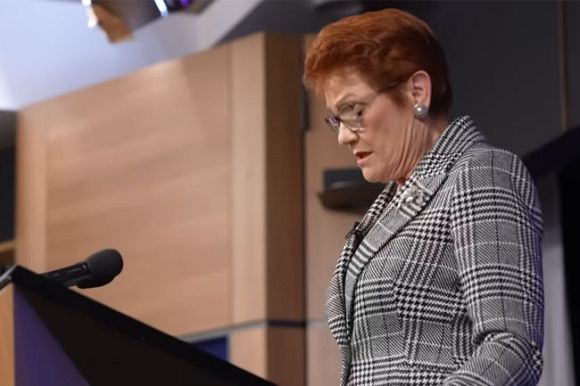
We should also mobilise several social media hashtags. One might be #BanMe, or even better, #BanhMiTooPauline. Another might be #NoFOBB.
Former legal correspondent David Solomon suggests the ABC should simply ‘cease reporting anything she says’, while journalist Barrie Cassidy goes further, suggesting the media as a whole should “collectively resist this kind of interference in their work. How can any journalist go to a news conference while some of their colleagues are being locked out?”
I agree with these sentiments. But it’s hard to imagine Sky News journalists standing shoulder to shoulder with ABC or Guardian reporters to boycott coverage of Pauline Hanson. Nevertheless, the way journalists handle Hanson in the future will be a litmus test for the value they place on professional comfort versus moral courage. Their silence or professional timidity will amount to an implicit acceptance of her party’s “values” and “policies”.
Political analyst Amy Remeikis reminds us that Hanson can bypass the mainstream media:
‘Her social following... means she is free to speak directly to her supporters with as many mistruths, lies and malinformation as she wants.’
True. But this applies less to urban residents, who comprise the majority of voters and are apparently still sufficiently numerous to make mainstream media outlets economically viable, even if this is now mainly via digital delivery systems. These city dwellers still largely determine the outcome of federal elections.
Moreover, a 2026 study found that ‘TV is hanging on as the main source of news (57%)’, with ‘almost half of news consumers saying public service media [ABC and SBS] has a positive effect on life in Australia’.
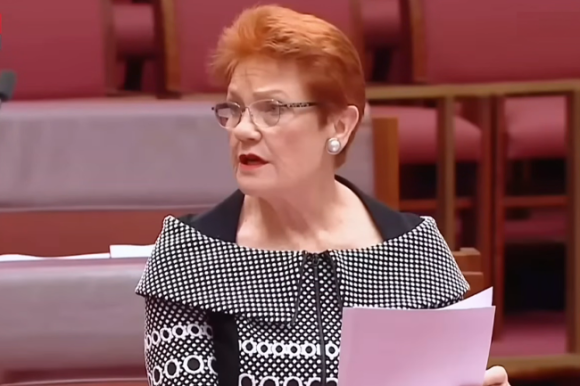
The report, from the University of Canberra’s News and Media Research Centre, shows that the majority of Australians still get their news through mainstream media. The top five offline (radio, television and newspaper) sources are ABC News, Channel 9, Channel 7, Sky News and The Australian, while the top five online sources are News.com.au, ABC News online, 9news.com.au, Guardian Australia online and Skynews.com.au (pp.104-5). All but one of these ten sources increased their percentage share of the news market since 2025.
So it’s still vital that the mainstream media take responsibility for either criticising Hanson or, if banned, boycotting her socially corrosive pronouncements and “values”. If, instead, they choose to amplify Hanson’s voice by apparently neutral, non-judgmental reporting, then we, as media consumers, should boycott those media outlets.
There are worse professional fates than not being allowed to attend Hanson’s press conferences and campaign speeches. But the easy path is simply to allow FOBB to win the day and retain the right to ask her bland and unchallenging questions.
The more uncomfortable path is to lean into the hard questions, saying, “Bring it on, Pauline. Exclude me if you dare”. I encourage journalists to rummage for that moral compass they were squashing as they sat and listened to Hanson’s speech and her attack on their colleague.
They should turn it back on and do their best to hold Hanson to account, even at the risk of being excluded from her subsequent media events.
Dr James Beattie is a philosopher and writer with a long career as a broadcast journalist-producer with the ABC (1970s to 1990s).
 This work is licensed under a Creative Commons Attribution-NonCommercial-NoDerivs 3.0 Australia License
Support independent journalism Subscribe to IA.


Related Articles
- CARTOONS: 'Mono' is an avoidable virus
- Pauline Hanson's multiracial Australia shift puts supporters to the test
- The A to Z of who Pauline Hanson does and does not represent
- How Pauline Hanson turned grievance into political power
- Pauline Hanson targets multiculturalism while ignoring the real crisis