
Our new series, WARFARE TO WEALTH, is a progressive critique of the Federal Government's defence and foreign policy trajectory. It provides in-depth analysis of Australia's $368 billion AUKUS commitment and the broader militarisation of our economy.
It is timed to precede the ALP national conference (July 23-25) – which will shape the Government's policy platform and strategic direction for at least the next two years – in the hope that, along with growing pressure from the broader community, the arguments against this militarisation may be compelling enough to make their mark.
This article is part one of the series, Warfare to Wealth: Redirecting Australia's Future. You can read part one HERE and part three HERE. The next chapter will be published soon.
Part 1: The $368 billion question: What AUKUS is really costing us
The Australian Government's promise of 20,000 jobs from the $368 billion AUKUS submarine program masks an economic reality: we are funding a jobs bonanza in the UK and U.S. while starving our own domestic industries of critical investment. David Higginbottom reports.
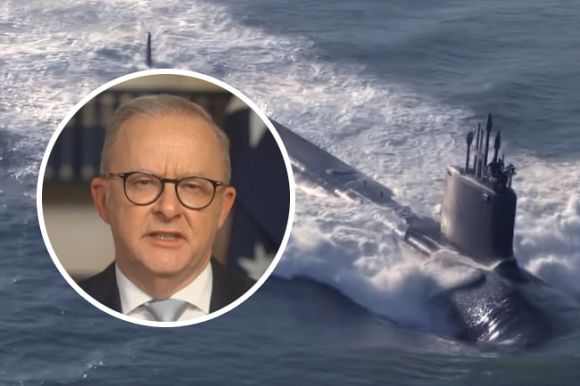
WHEN THE Albanese Government attempts to sell the AUKUS nuclear submarine program to a sceptical public, it relies on a single, repetitive claim. The promise of ‘around 20,000 direct jobs over the next 30 years’ to counter concerns about sovereignty, nuclear waste and the huge cost.
But the official figures reveal a different reality. At approximately $18.4 million per Australian job created, it represents perhaps the most inefficient employment program in our nation's history.
Worse, the true “jobs bonanza” is happening overseas, funded by the Australian taxpayer.
As the ALP approaches its National Conference in Adelaide, it is time to subject these defence claims to the same rigorous economic scrutiny applied to civilian infrastructure.
The $18.4 million job
The arithmetic of the AUKUS jobs claim is as simple as it is damning. The Parliamentary Budget Office estimates AUKUS will cost $368 billion. The Australian Submarine Agency projects a peak workforce of roughly 8,500 personnel in the 2040s, with a cumulative total of 20,000 jobs created over three decades.
Divide the cost by 20,000 and the result is $18.4 million per job.
AUKUS, by contrast, sinks hundreds of billions into military hardware that generates no ongoing economic return — a sunk cost in all meanings of the word.
To understand how extraordinary this figure is, compare it with major domestic infrastructure projects. The Suburban Rail Loop East in Melbourne will create 8,000 direct jobs for $34.5 billion, or roughly $4.3 million per job. The complex North East Link twin-tunnel project creates jobs at $2.18 million each.
Even the original, fully funded Inland Rail project (before its recent truncation) was projected to create 16,000 peak jobs for $9.9 billion — a cost of just $619,000 per job.
These domestic projects are highly capital-intensive, yet they create employment at a fraction of the cost. More importantly, they leave behind productive, revenue-generating assets: railways that move freight, tunnels that ease congestion and infrastructure that drives broader economic growth.
AUKUS, by contrast, sinks hundreds of billions into military hardware that generates no ongoing economic return — a sunk cost in all meanings of the word.
Funding the overseas industrial base
If the domestic jobs figures are poor, the international figures are a scandal. The Australian public has been told that the $368 billion is an investment in sovereign capability. In reality, it is a massive capital injection into the struggling defence industrial bases of the United Kingdom and the United States.
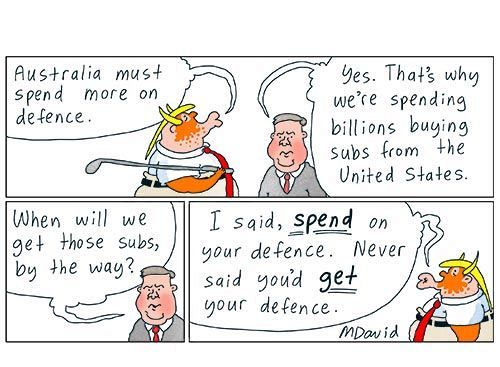
To secure our place in the queue for nuclear submarines, Australia has been forced to subsidise our allies. We are transferring $4.7 billion to the UK Ministry of Defence to expand the Rolls-Royce nuclear reactor plant in Derby and the BAE Systems shipyard in Barrow-in-Furness. We are sending a further $4.3 billion to the United States to prop up its submarine industrial base.
What does this buy? Jobs — just not here
An analysis of official UK and U.S. defence announcements reveals the stark imbalance. In the current initiation phase (2023–2026), Australian funding is supporting approximately 1,000 new jobs in the UK and 1,000 in the U.S., matching the 1,000 created domestically.
By 2035, when the domestic build of the SSN-AUKUS is supposed to begin in Adelaide, Australian funding will be supporting 6,500 jobs at home — and 10,000 new jobs across the UK and U.S.
At peak production in the 2040s, the Australian taxpayer will be directly funding 10,000 overseas jobs while generating only 8,500 domestically. We are not building a sovereign industry; we are acting as a financial lifeline for the shipyards of our “great and powerful friends”.
By locking $368 billion into the least job-efficient sector of the economy, the Albanese Government is actively suppressing employment growth and diverting capital away from the industries that will define the 21st Century.
The opportunity cost of war preparation
The tragedy of the AUKUS expenditure is not just what we are buying, but what we are giving up. Every dollar spent on a nuclear submarine is a dollar denied to healthcare, education, renewable energy and social housing.
This is not merely a moral argument; it is a proven economic fact. Research from the Political Economy Research Institute (PERI) at the University of Massachusetts Amherst has consistently demonstrated that military spending is the least effective way for a government to create employment.
According to PERI's analysis, an investment of $1 billion in the military creates approximately 11,200 jobs. That same $1 billion invested in clean energy creates 16,800 jobs (50 per cent more). Investing it in healthcare creates 17,200 jobs. Investing it in education creates 26,700 jobs — a staggering 138 per cent increase over military spending.
These figures expose the fundamental deception of the “jobs and growth” defence narrative. The militarisation of the Australian economy is not an engine of prosperity; it is an anchor dragging down our potential.
By locking $368 billion into the least job-efficient sector of the economy, the Albanese Government is actively suppressing employment growth and diverting capital away from the industries that will define the 21st Century.
A cathedral in the desert
As Professor Al Rainnie argues in the Journal of Australian Political Economy, proponents of AUKUS often point to the promised revitalisation of South Australia, arguing that the Osborne shipyards will become a hub of advanced manufacturing and high-tech innovation. But history offers a sobering warning about the reality of nuclear submarine towns.
Barrow-in-Furness, the remote UK town where BAE Systems builds Britain's nuclear submarines, has been constructing these vessels for over 60 years. It is the very model of the industrial hub AUKUS promises to create in Adelaide.
Yet despite decades of massive defence investment, Barrow remains economically depressed. It suffers from above-average unemployment, below-average wages and some of the lowest educational attainment rates in the country. The submarine shipyard operates as an enclave – a “cathedral in the desert” – drawing in specialised labour and capital but failing to generate broader regional prosperity.
Advanced military manufacturing is highly siloed. The skills required to build a nuclear reactor compartment do not easily transfer to the civilian economy. Security classifications restrict collaboration. Supply chains are narrow and rigid. AUKUS will not transform South Australia's economy; it will simply create a heavily subsidised, highly classified enclave that drains engineering talent from the productive sectors of the state.
It is time to abandon the costly illusion of AUKUS and start building a nation that prioritises peace, prosperity and genuine independence.
Time for a new security choice
The AUKUS jobs narrative is a mirage. It promises a domestic manufacturing renaissance but delivers an $18.4 million-per-job subsidy to foreign shipyards. It ignores the massive opportunity cost of diverting capital from education and clean energy. And it ties Australia's economic future to a military-industrial model that has consistently failed to deliver broad-based prosperity.
As the ALP National Conference approaches, delegates must confront this reality. The Make Peace a Priority (MPAP) campaign is calling for a fundamental reassessment of our national security posture — one that measures defence decisions against tests of cost, sovereignty and public purpose.
True security does not come from mortgaging our economic future to buy a handful of nuclear submarines in the 2040s. It comes from building a resilient, diversified economy, investing in the health and education of our citizens, and leading the transition to a clean energy future.
It is time to abandon the costly illusion of AUKUS and start building a nation that prioritises peace, prosperity and genuine independence.
David Higginbottom is a member of the coordinating committee of the Independent and Peaceful Australia Network (IPAN) and coordinator of the Make Peace A Priority campaign (mpap.au).
This article is the sixth in a multi-part series, FROM WARFARE TO WEALTH, examining the real costs of our current defence trajectory and exploring the alternatives proposed by the Make Peace a Priority (MPAP) campaign.
Read the other chapters in this series:


 This work is licensed under a Creative Commons Attribution-NonCommercial-NoDerivs 3.0 Australia License
Support independent journalism Subscribe to IA.