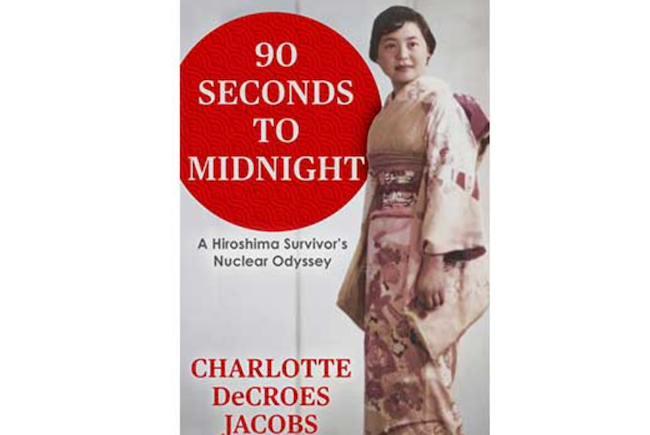
Charlotte DeCroes Jacobs' '90 Seconds to Midnight: A Hiroshima Survivor’s Nuclear Odyssey' is a solid and challenging read. Anne Layton-Bennett reviews the comprehensive account of destruction.
AS WELL AS ‘Auschwitz’ and ‘Holocaust’, ‘Hiroshima’ and ‘Nagasaki’ were words redolent with shock, horror and disbelief for those, like me, growing up in Britain during the post-war 1950s and ‘60s.
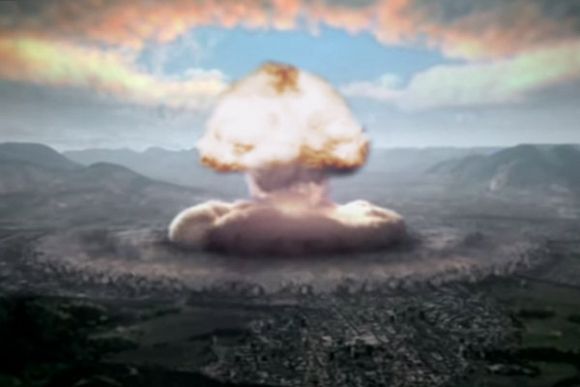
But unlike newsreel images of the death camps, photographs showing the obliteration of the two Japanese cities were scarce. Whether the nuclear bomb devastation was considered too appalling and shameful, or there really were few images taken that recorded such comprehensive destruction is unknown.
But it’s likely the team’s co-pilot responsible for dropping the bomb on Hiroshima was permanently scarred by the experience, given the entry in his logbook:
'My God, what have we done?'
The bombs certainly signalled Japan’s surrender, and saw the end of World War ll in the Pacific, but achieving this outcome meant unimaginable deaths for tens of thousands of mostly Japanese civilians who were incinerated, vaporised, or buried under tons of rubble.

Thousands more died slow and agonising deaths from their injuries, radiation sickness – which nobody knew how to treat – and a lack of uncontaminated food and water. Others died weeks, months or years later from cancer. But there were survivors to bear witness to this unprecedented destruction from a newly-developed – and barely tested - weapon of war.
One of them was Setsuko Nakamura, a 13-year-old schoolgirl, who, as part of Japan’s war effort was about to start her official decoding duties on that hot and humid August day in 1945, along with 29 of her classmates at the Second Army Headquarters. She was one of only two who survived.
'90 Seconds to Midnight' is a solid and challenging read. The physical layout of the book doesn’t make it any easier with a typeface and choice of font that is both dense and unappealing for the general reader. Even so, and for all its academic approach that includes over thirty pages of notes, references, a comprehensive bibliography and an index, the book is worth the effort, because it is very readable.
Although harrowing, the description of how Setsuko emerges from the rubble and sees the smoking, flattened ruin of her beloved city, completely destroyed in a blinding flash and toxic cloud of ash, is graphic.
Reading her description of the days and weeks that followed should give anyone still supportive of developing an arsenal of nuclear weapons pause. Although both her parents survived, most of her siblings didn’t.
Setsuko watched her hideously disfigured sister and nephew die in agony, while wondering when she would also succumb to the mysterious ailment affecting so many survivors that caused clumps of hair to fall out, nose and gum bleeds, and discoloured urine.
'She dreaded going to the bathroom. Chewing hurt, and the food she didn’t throw up surged through her bowels. Then purple spots erupted on her legs.'
For many people, such symptoms resulted in a painful death, but her graphic description of life in the weeks and months that followed the dropping of the bomb was honed and refined by Setsuko. She made a vow and a commitment to “share the warning of Hiroshima until my last breath.”
This is exactly what she did, speaking out at every opportunity, urging governments everywhere to abolish the use of nuclear weapons. Setsuko presented her account as a hibakusha or Hiroshima survivor. Together with her husband James Thurlow, a Canadian she met and fell in love with while they were both volunteers at a Christian camp, organised by the National Council of Churches for university students and teachers from around the world, she’s written numerous papers and presented at hundreds of anti-nuclear meetings, seminars, conferences and events held around the world.
Her tireless dedication and commitment culminated in accepting the Nobel Peace Prize in 2017 on behalf of the International Campaign to Abolish Nuclear Weapons.
She said:
“I suppose that to some extent it is necessary to lead a double life, not just for survivors like myself but for everyone in the world. We make plans for the future assuming there will be a tomorrow; at the same time, we know that we and everyone dear to us could be incinerated today.”
In the wake of the 80th anniversary of Hiroshima, and with much of the world once again mired in escalating conflicts that could involve the use of nuclear weaponry, Setsuko Thurlow-Nakamura’s message of the devastation this would unleash has never been more urgent.
90 Seconds to Midnight: A Hiroshima Survivor’s Nuclear Odyssey is available from Melbourne UP for $25.99 RRP.
This book was reviewed by an IA Book Club member. If you would like to receive free high-quality books and have your review published on IA, subscribe to receive your complimentary IA Book Club membership.
Anne Layton-Bennett is a writer based in Tasmania.
 This work is licensed under a Creative Commons Attribution-NonCommercial-NoDerivs 3.0 Australia License
Support independent journalism Subscribe to IA.


Related Articles
- ‘Hear Me Roar’: What female animals can teach us about women and power
- 'Southern Frontier': Australia’s cold pursuit of empire and identity
- The Existential Playbook promises purpose but at a price
- BOOK REVIEW: 'Truth Abandoned' misses the mark on trans issues
- The life and crimes of Australia's most daring fugitive