Historian Michael Pembroke has offered valuable insight into how China has developed into the country we know today, both economically and psychologically, says Anne Leyton-Bennett.
WHEN PEOPLE are asked to name ancient civilisations it’s likely the reply would be: Ancient Rome, Ancient Egypt and Ancient Greece. These cultures have been the focus and feature of countless books, films and documentaries, while art galleries and private collections around the world include the artefacts found and donated over the years by archaeologists and intrepid travellers.
Arguably, there is less knowledge or awareness of Ancient China and the important role it played in shaping European history, particularly the trade in Chinese silk and porcelain, and later silver, tea and opium. They all played a crucial part in the geopolitics of the era. These highly prized goods influenced relationships between Spain, Portugal, France and Britain, as they vied for economic and political dominance on the world stage, especially during the 16th and 17th centuries.
The son of a father whose career involved the family travelling the globe ‘in the final decades of the colonial era’, historian Michael Pembroke absorbed the rich diversity of cultures across the British Commonwealth as he grew up.
His aim in writing Silk Silver Opium, he says, is to ‘shine a light rather than unravel; to reveal rather than resolve; to explain rather than analyse’. And thereby show not only how trade in the must-have commodities of the day made and broke economic and political fortunes, but also to compare how trade today has its parallels with modern-day must-haves in the making and breaking of economic and political fortunes.
The flipside to the beauty and artistry of China’s silk and porcelain – for which manufacturing secrets were closely guarded for years – was the cruelty and brutality towards the Chinese people that characterised much of the country’s earliest history. In describing the rise and fall of ruling dynasties, such as the Song, the Ming and the Qing, and the determination of various dynastic rulers to remain in power – as well as increase their wealth – Pembroke documents how the disregard for human life being called out in respect of the current regime may have become an inherent characteristic now embedded in the Chinese psyche.
There is no doubt that China was ruthlessly exploited by the West’s lust for silk and porcelain, but in the 1600s it was ‘the unquenchable Chinese thirst for silver’, that shifted the dynamic.
It was then its rulers demanded the silver, largely mined in the Americas, became the only accepted method of payment for those coveted items, which were traded in vast quantities with Western nations:
'Chinese demand for silver moved international markets, as does the modern demand for commodities like oil, coal, iron ore and more recently lithium, copper and gold.’
Pembroke has certainly done his research, and this book is a comprehensive history of how trade in the fashionable and highly sought-after commodities of the day can dominate economies and influence international relations. This influence extends to trade’s darker side, which in the case of China during the 1800s was the illegal trade in opium, which the British and Americans shamelessly exploited for their own profit.
China’s resistance resulted in the two Opium War ultimately saw those rivers of silver flowing from China back into Britain and America, leaving behind a country that was bankrupt, broken and ripe for further exploitation at the end of the 19th century, and even further in the aftermath of two world wars during the 20th Century:
‘During the nineteenth century, opium became one of the first mass-produced, mass-marketed, global commodities, allowing the British to create “the world’s first drug cartel.”’ and ‘one of the most pernicious, yet well-organised and profitable drug trades that has ever existed.’
At times, too much detailed information and research may make the reading heavy going for the general reader, but overall Pembroke’s book offers valuable insight, and a deeper understanding about how China has developed into the country we know today. It also offers a deeper insight into how and why the trading of goods played such an important role, historically, in shaping international relationships.
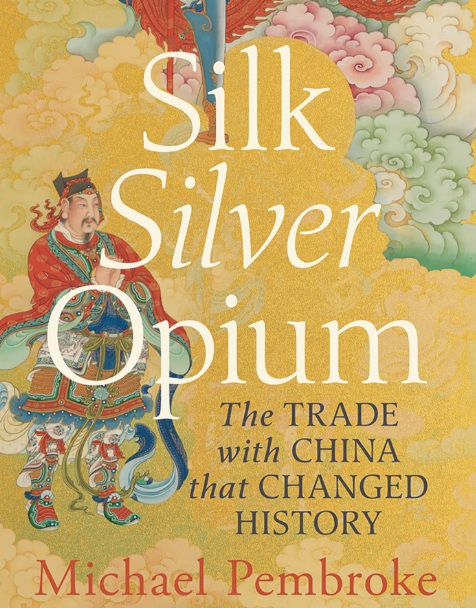
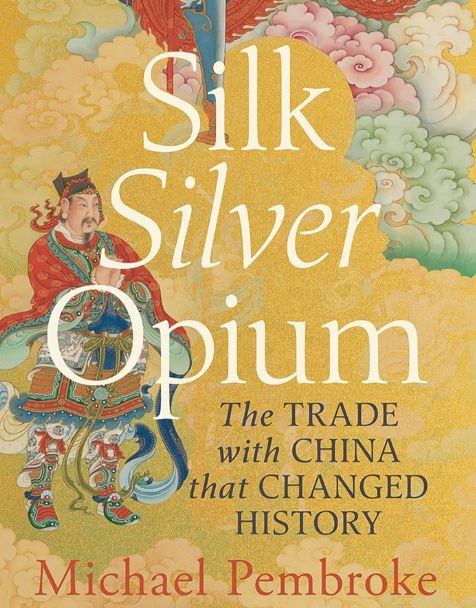
'Silk Silver Opium: The trade with China that changed history' by Michael Pembroke, was published by Hardie Grant Books, 1 July 2025 (RRP $37.99).
This book was reviewed by an IA Book Club member. If you would like to receive free high-quality books and have your review published on IA, subscribe to Independent Australia and receive your complimentary IA Book Club membership.
Anne Layton-Bennett is a writer based in Tasmania.
 This work is licensed under a Creative Commons Attribution-NonCommercial-NoDerivs 3.0 Australia License
Support independent journalism Subscribe to IA.