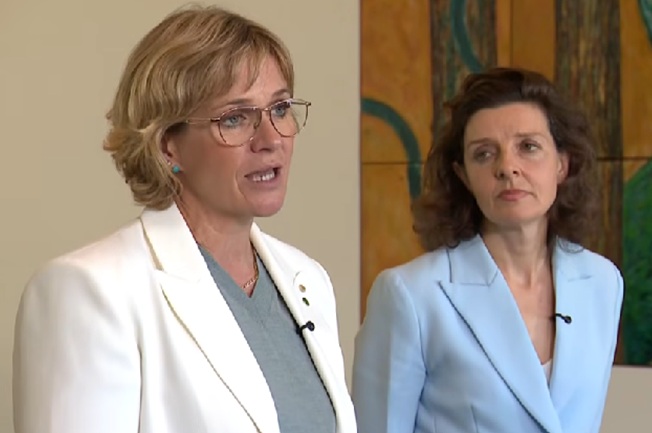
Community Strong Australia's founders appear to be creating what we might call "centrist populism", combining a populist critique of the political establishment with a broadly moderate and pragmatic policy outlook, writes Professor Carl Rhodes.
Australia’s new political party, Community Strong Australia, has emerged with a distinctive political proposition. At a time when populist movements are reshaping democracies around the world, what makes the party unusual is its seemingly paradoxical attempt to combine populist appeal with political moderation.
Contemporary political debate is often framed as a contest between progressive liberalism and an increasingly assertive populist right. Community Strong Australia, however, might just succeed in carving out a different path.
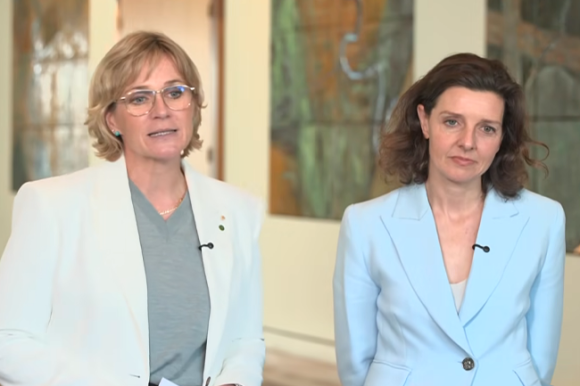
What the party’s founders and MPs Zali Steggall and Allegra Spender appear to be creating is what we might call "centrist populism". It combines a populist critique of the political establishment with a broadly moderate and pragmatic policy outlook.
Can centrist populism succeed where liberal centrism has faltered, while avoiding the anger and exclusion that have come to define populism on the right?
The right-wing populist playbook
When we think of populism, we usually imagine its right-wing variants, exemplified in Australia by Pauline Hanson and One Nation. Such movements combine hostility to political and cultural elites with attacks on immigration, multiculturalism and so-called "woke" politics.
Right-wing populism does not emerge from nowhere. It begins by identifying genuine grievances felt by many citizens, especially economic insecurity, declining living standards, distrust of political institutions and rapid social change. It then transforms those grievances into a combative political narrative that pits "ordinary people" against a self-serving elite.
In this way, legitimate concerns about economic insecurity and political disconnection are transformed into a politics of resentment and cultural conflict, often diverting attention from the underlying economic pressures driving public discontent.
What Community Strong Australia appears to be attempting is a centrist version of populist politics, but with one crucial difference. It recognises many of the same grievances that right-wing populists identify, amplify and exploit, but seeks to respond to them without the exclusionary, resentful and often racist politics that characterise much contemporary right-wing populism.
A populism of the centre?
While right-wing populists tend to redirect public frustration towards migrants, minorities and cultural elites, Community Strong Australia seems to be trying something different by channelling dissatisfaction with the political establishment into a politics of reform, participation and representation.
Zali Steggall is explicit in her populist framing.
Speaking on the day of the party’s launch on 25 June, she stated that Australians were:
“...frustrated and tired of the status quo. The major parties have contributed to the situation we are in where too many Australians feel like they are not getting ahead. The system is not listening to their concerns.”
This is unmistakably populist language, contrasting ordinary citizens with an unresponsive political establishment.

Yet Steggall also describes the party as “centrist”, emphasising:
“...sensible economic management, climate action, integrity [and] equality.”
The logic is clear: acknowledge the growing dissatisfaction bubbling up through the Australian population, identify the major parties as part of the problem, but then propose a moderate and institutional response rather than one based on extremism or exclusion.
Populism without extremism
As Allegra Spender put it this week:
“...a lot of people feel politically homeless”. Many, she argued, are “deeply cynical about the major parties” and “deeply frustrated with them”, but are also “really concerned about extremism”.
This captures the political space Community Strong Australia is seeking to occupy. What it offers is a populism without extremism or zealotry. It channels public frustration with the major parties, but without the resentment, scapegoating and culture wars that have become the hallmarks of right-wing populism both in Australia and internationally.
Community Strong Australia’s centrist populism seeks to represent citizens who feel neglected by the major parties but are reluctant to embrace political extremes. In doing so, it aims to channel dissatisfaction with conventional politics while maintaining a commitment to democratic institutions, social cohesion and economic responsibility.
Politically, the strategy is astute. It leans into a space largely vacant in Australian politics by appealing to voters disillusioned with the political status quo while rejecting polarisation and cultural conflict.

The economic test
The unanswered question is whether Community Strong Australia can deliver policies that address the economic conditions driving dissatisfaction with mainstream politics, especially wealth inequality, housing unaffordability, wage stagnation and the soaring cost of living. The party has already identified many of these economic pressures and its website argues that Australians are 'working hard and not getting ahead'.
It is too early to know whether the party represents a genuinely new form of centrist populism that can drive real change felt at the supermarket cash register, or simply a rebranding of liberal centrism. As the party develops its policy positions, the crucial test will be economic.
If Community Strong Australia can pair its language of community and political renewal with credible policies on housing, taxation and living standards, it may succeed in building a broader constituency beyond the teal-aligned voters most likely to be its initial supporters.
The real test is whether centrist populism can move beyond diagnosing economic insecurity to addressing it. Otherwise, Community Strong Australia risks settling into a formula of being socially progressive and politically reformist, but economically conservative when it comes to the pressing need to challenge the vested interests that sustain the status quo.
Carl Rhodes is Professor of Business and Society at the University of Technology, Sydney. He has written several books on the relationship between liberal democracy and contemporary capitalism. You can follow him on X/Twitter @ProfCarlRhodes.
 This work is licensed under a Creative Commons Attribution-NonCommercial-NoDerivs 3.0 Australia License
Support independent journalism Subscribe to IA.