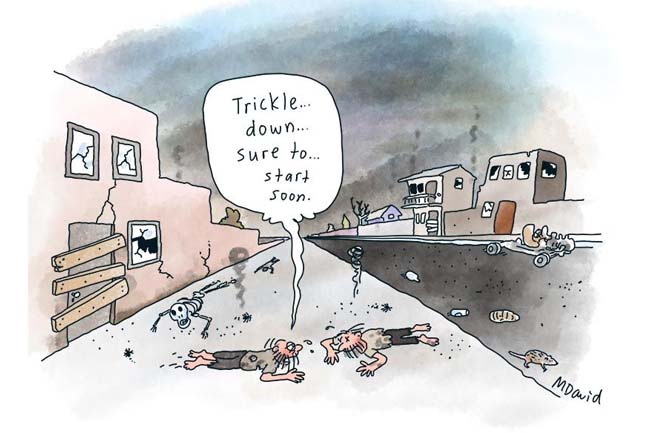
The broken nexus between education and productivity is not a mystery; it's a policy outcome, writes Dr James Schuurmans-Stekhoven.
WE DIDN'T JUST BREAK THE LINK between education and productivity. We dismantled the very idea that education produces anything other than a bill.
The con
Every March, Australian academics perform a ritual. They stand before student-customers – many already tens of thousands of dollars in HELP debt before a single lecture – and do something no 1960s professor would recognise as teaching.
They perform. They entertain. They manage feelings. They hedge every claim against the possibility of a bad satisfaction survey.
Then they return to their desks on casual contracts worth less per hour than an electrician, to produce “research” assessed not for truth but for “grant potential“.
This is not failure. This is the logical endpoint of a 40-year political project. And its architects were Bob Hawke and Paul Keating.
The Dawkins disaster
In 1987-88, Hawke’s Education Minister John Dawkins launched what was in polite circles called a “reform“. In truth it was the beginning rot of a resilient malignant mutation.
The Dawkins reforms merged colleges into universities, introduced Higher Education Contribution Scheme (HECS) fees, and imposed performance metrics. Sold to the electorate as “democratisation“, in reality it was both privatisation by stealth (to shift university funding off the Federal budget) and a more politically palatable “masking over” of dramatically rising youth unemployment resulting from their neoliberal economic restructuring.
Dawkins' Unified National System (UNS) created over 40 degree factories: more students, more debt, more metrics — and less of what degrees traditionally produce.
As one inquiry submission noted, the reforms:
'...resulted directly in the casualisation of a majority of academics.'
Even Dawkins himself later admitted his system was ”completely out of date”. A bit late for the 2.9 million Australians now carrying $81 billion in student debt.
The debt trap
HECS was sold as a fair, user-pays policy. Students would pay, but only when they could afford it. And those who swallowed this dubiously noble principle were completely betrayed by what followed.
Government grants were cut. Fees rose. The average HECS debt for people in their 20s went from $12,600 in 2006 to $31,500 now. Average repayment time jumped from 7.3 years to 9.9 years.
One Australian now owes $831,675 in student loans. That’s a fleecing, not an education. That’s a mortgage on a house never owned!
The casualisation catastrophe
Nearly half of all university academics are now casuals. They don’t know if they’ll have work next semester — or next week.
This isn’t a bug, it’s the system’s key feature working as designed. Precarious workers don’t complain. They don’t challenge management. They dare not correct the customers. They perform, they entertain, they keep students happy – with the efficiency of a Victorian Nanny – because their next contract depends on it.
Emeritus Professor of Sociology of Education, Stephen Ball, called this ”the terror of performativity“. Staff police themselves not against scholarly standards, but against whatever sophistry and sycophancy keeps their contracts renewed.
The Morrison finale (but Labor started it)
The Morrison Government’s Job-Ready Graduates Package was just the latest incarnation — hiking humanities fees to $14,500 a year, forcing some students to contribute up to 93 per cent of course costs.
The message between the lines: some knowledge, according to your political masters, is economically worthless — so much for efficient market principles, letting markets decide and respecting consumer sovereignty!!! History? Sociology? Philosophy? Politics? Useless. Never mind that we’re supposedly educating citizens for a healthy democracy.
Hawke and Keating built the machine; the Coalition kept it serviced as scheduled in the manual.

The productivity paradox
Australia now has one of the highest tertiary participation rates in the OECD. It also has one of the most persistently stagnant productivity growth records in the developed world.
We built more degree factories and got less educated!
We credentialised a generation without enlightening them. We created a skills shortage co-existing with graduate underemployment. And how did we achieve all of this? — because a credential has been quietly decoupled from capability.
The grand fraud
None of this was inevitable. Germany, Finland, the Scandinavians fund universities as public goods. They pay academics as professionals. They assess research by its contribution to knowledge.
Australia made different choices. We chose market forces — and received exactly what markets deliver when applied to things markets cannot produce: a cheap knock-off.
Mock degrees sold by corporatist ideologues cosplaying VCs at inflated prices, to consumers insufficiently educated to tell they’re being conned.
The broken nexus between education and productivity is not a mystery. It is a policy outcome. And the architects of that policy were Hawke and Keating’s Labor Party. It turns out “the clever country” was “too clever by half”.
There is such a thing as society. And its universities are central to it.
The ALP sold Australia out for a budget line item. Politically expedient myopia costing Australians far more than it saved.
Dr James Schuurmans-Stekhoven has a career defined by high-level academic rigour, a polymathic approach to research and a commitment to strategic optimisation across multiple disciplines.
 This work is licensed under a Creative Commons Attribution-NonCommercial-NoDerivs 3.0 Australia License
Support independent journalism Subscribe to IA.


Related Articles