AI is accelerating a divide that decades of economic policy and asset inflation have already entrenched, writes Dr Kim Sawyer.
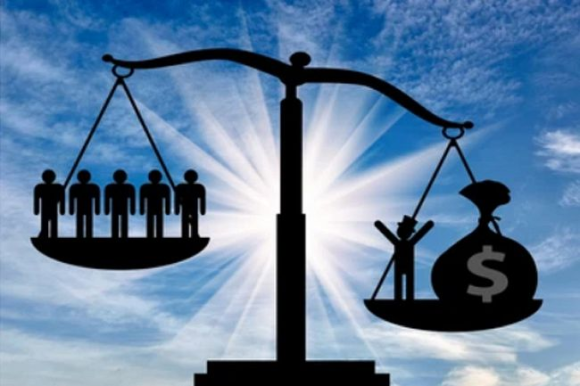
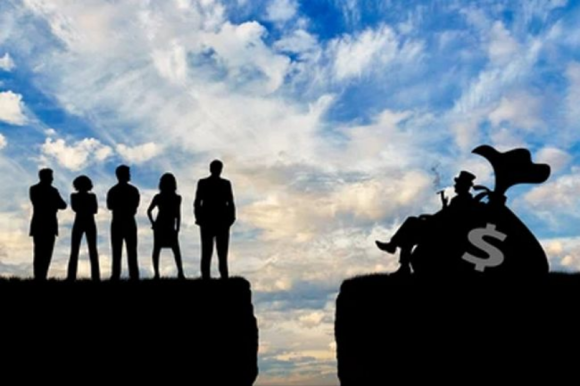
THERE HAS ALWAYS BEEN inequality of wealth, but never the inequality that we have now.
The richest 1% of the world’s population extracts nearly twice as much wealth as the bottom 99%. In Australia, the average household in the top 20% of the wealth distribution has 93 times the wealth of the average household in the bottom 20% and in the United States, the top 10% of earners account for half of U.S. consumer spending.
Why has the world become so unequal?
Economists refer to the K-shaped economy, the divergence between the haves and have-nots. Two arms, one going up, the other down; divergence that has accelerated over the last 30 years.
In 2014, Janet L Yellen, the Chairwoman of the Federal Reserve, reflected on the increase in inequality:
‘The extent of and continuing increase in inequality in the United States greatly concern me. The past several decades have seen the most sustained rise in inequality since the 19th Century after more than 40 years of narrowing inequality following the Great Depression.’
Since 2014, inequality has become worse, driven by low interest rates, the pandemic and artificial intelligence (AI).
Much of the inequality is a result of the decisions of policymakers in the late 1980s. Deregulation was supposed to generate competition; instead, it generated excessive greed. Senior managers in universities, banks and bureaucracies were able to extract monopoly rents. The public-private partnerships that were windfalls for some were often costly for consumers. The economy became leveraged to the asset economy: house prices, stock prices, bond prices. An economy dominated by asset prices.
In the early 1990s, central banks began targeting inflation without knowing the correct target. When the U.S. Federal Open Market Committee adopted a 2% target in July 1996, it was not a unanimous choice; one-third wanted 0%, one-third 3%, one-third 2%. A 2% target became the consensus when there was none — the story of economics.
Central banks use interest rates to target inflation and prevent deflation but rarely get it right. After the Global Financial Crisis, central banks kept cash rates too low for too long. Between 2008 and 2022, the U.S. Federal Funds rate never exceeded 2.5%; most of the time, the rate was less than 0.25%.
Prior to 2008, the rate was below 2.5% for two years in the 1950s and for three years 2001-4. When rates are too low for too long, savers and those on fixed incomes are disadvantaged, while those holding assets are advantaged through inflation in house prices and stock prices. Low rates increased inequality, yet did central bankers sitting around their table understand? The Reserve Bank (RBA) had both growth and inflation among its targets but never the inequality of wealth.

When inflation spiked after the pandemic, the low-income households with debt were trapped. Low interest rates widened the gap between rich and poor; rate hikes widened the gap further. Central banks should have put bounds on interest rates, to be not too high, but also not too low. However, reducing inequality was never on the walls at Martin Place.
The pandemic opened the fault lines in the economy. The K-economy has multiple fault lines. Older households have benefited from increases in house prices, superannuation fund gains and lower mortgage costs.
U.S. Federal Reserve data shows households aged 75 and older now hold wealth 55% above the national average, up from just 5% above in the early 1980s, while younger households face multiple hurdles of high house prices, high rents and student debt. They depend on intergenerational transfers of wealth, that is, if they can have access to them. No wonder the younger generation feels disconnected.
When people hear the numbers – that GDP rose by 4% and inflation was 3% last quarter – it has little effect on those on the lower arm of the K-shaped economy. They know they are wedged.
Joanne Hsu, director of the University of Michigan's Survey of Consumers, put it this way:
“The economy is not a monolith. The population is not a monolith. Some people might be thriving at the same time that other people are struggling.”
Indeed, they are.
AI is reinforcing the K-shaped economy. Technology, e-commerce and financial service industries have adapted to the challenge of AI, whereas travel, hospitality and retailing have not. AI cannot replace non-repetitive trade jobs, so plumbers and electricians may be safe. We should all hope that politicians are not.
AI is having the same effect as low interest rates. Stock indexes at record highs due to AI stocks. The value of the U.S. stock market has more than doubled over the past decade to US$75 trillion (AU$107 trillion), which represents two and a half times the annual output of the U.S. economy.
The AI bubble is like other price bubbles generated by the irrational exuberance of investors who price in expected or imaginary earnings that are often for many years ahead, but which may not happen. AI-related stocks have accounted for half of the rise in the S&P 500 this year and have lifted household wealth by 7% for U.S. consumers, but almost entirely for high-income Americans. AI has come to mean artificial inequality.
If the AI bubble bursts, the effects on the real economy could be devastating. It has been estimated that with present valuations, a 30% decline in the U.S. stock market could lead to a nearly $700 billion reduction in consumer spending. The stock market is now so leveraged to AI that even marginal changes in AI valuations may lead to large stock market declines.
Economics is a dismal science, but does it have to be this dismal? The K-shaped economy is the result of greed, but also of policy-making that allowed greed to be rewarded and unregulated. Unregulated greed has overwhelmed the interests of us all.
Dr Kim Sawyer is a senior fellow in the School of Historical and Philosophical Studies at the University of Melbourne.
 This work is licensed under a Creative Commons Attribution-NonCommercial-NoDerivs 3.0 Australia License
Support independent journalism Subscribe to IA.


Related Articles
- Australia's 'Young Rich List' is one more unneeded celebration of the elite
- Australia’s real economic challenge isn’t welfare dependency — it’s inequality
- Wealth divide seeing rich prosper at expense of millions in need
- Deteriorating health, housing and education upshot of inequality
- Taxing the super-rich a good start to ending wealth inequality