When aspiration pathways are blocked, the political rhetoric of aspiration becomes detached from economic reality, writes Professor Carl Rhodes.
SINCE TREASURER Jim Chalmers released his Federal Budget on 12 May, critics on the political right have attacked it relentlessly.
Some of this is downright comical, from The Daily Telegraph calling the budget a "big taxing communist manifesto" to The Australian accusing Chalmers of waging 'class warfare'.
One of the more serious accusations is that, by removing tax breaks for investors, Chalmers is undermining the very individual aspiration that fuels economic growth and prosperity.
The idea that tax policy can be used to encourage entrepreneurship and aspiration is a well-worn part of conservative politics. The question is whether it still fits Australia’s current economic reality.
The politics of aspiration
Central to the debate are the reforms to negative gearing and capital gains tax aimed at addressing spiralling housing prices that are locking working people out of the market.
Supporters argue that taxing wages more heavily than income from asset ownership has distorted incentives and made the system less fair, particularly for younger Australians.
The counterargument is that preferential tax arrangements encourage investment and job creation.
Among the most vocal critics has been Nationals MP Barnaby Joyce, who complained:
"I think they're destroying the inspiration of people who are entrepreneurial."

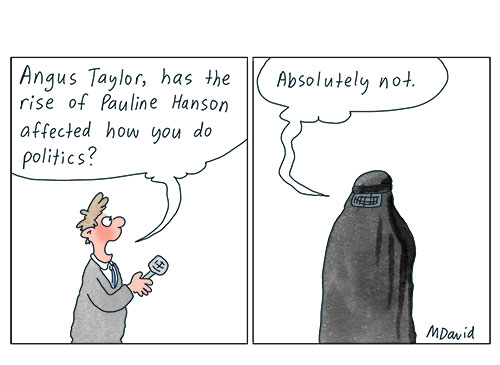
Opposition leader Angus Taylor has taken a similar line, condemning the budget as an:
“... assault on aspiration” and warning that Labor’s “toxic taxes” will “crush the reward-for-hard-work spirit that underpins our nation’s success.”
Business leaders have joined the chorus, with one group of young entrepreneurs labelling the budget an 'aspiration ambush'.
It is tempting to see this as a simple ideological divide with fairness on the Left and aspiration on the Right. The reality is more complicated.
KPMG’s "shrinking middle"
A relatively unheralded piece of research released by accounting firm KPMG the day before the Budget sheds light on what is really happening to aspiration in Australia. Notably, this is not coming from a trade union or a Left-leaning think tank, but from the heart of corporate Australia.
KPMG finds that Australia’s wealth gap has widened significantly over the past five years, driven primarily by rising asset prices, especially housing. While average household wealth increased from $1.26 million to $1.56 million, median wealth was steady at $700,000.
This means that while overall wealth has grown, the gains have been captured disproportionately by those who already own assets.
The consequence is what KPMG describes as a "shrinking middle". Households that once represented the economic mainstream are being squeezed out, as asset owners move further ahead while others fall behind.
This raises the prospect that inequality is becoming more entrenched and increasingly shaped by inherited advantage.
Making aspiration credible again
It is this "shrinking middle" that represents the real threat to aspiration, not the removal of tax breaks.
Contrary to Joyce and Taylor's claims, aspiration is not threatened by attempts to rebalance the tax system. It is threatened by an economy in which access to wealth increasingly depends on what you already own or inherit, rather than on what you do.
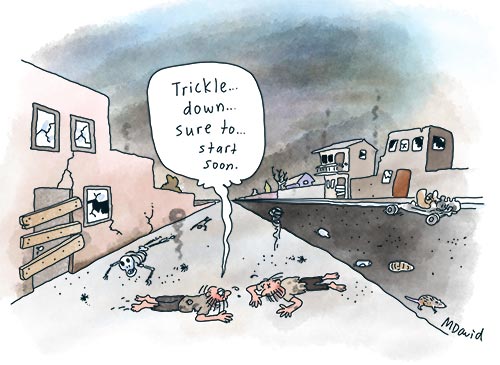
Aspiration requires credible pathways from effort to reward. When those pathways are blocked, the rhetoric of aspiration becomes detached from economic reality, as conservative politicians cling to a tired economic argument about incentives that is past its use-by date.
Tax concessions for asset owners are defended in the name of opportunity, yet the unequal system they have fuelled is steadily closing off opportunity for working people who do not already own property, particularly younger Australians.
This is where fairness and aspiration meet, not as ideology, but as lived reality.
When educated Australians with good jobs cannot afford to buy a home, or delay starting a family because of cost, aspiration is not under attack by tax reform; it is being undermined by an economy that no longer rewards effort.
When that happens, aspiration ceases to be a promise and becomes an illusion, and the legitimacy of the economic system itself begins to wear away.
Just the beginning
Joyce and Taylor are right that Australia needs aspiration to grow and prosper, but that aspiration needs to be available to everyone, especially those who do not start out in life with family wealth and privilege.
The tax changes introduced in this Budget signal a willingness to take that challenge on. But reversing the erosion of aspiration will require more than targeted adjustments to tax policy. It demands a broader program of structural reform that addresses housing affordability, wage growth, access to secure work, and the distribution of income and wealth across the economy.
Without such reforms, inequality will continue to harden into a system in which opportunity is inherited rather than earned and aspiration becomes the preserve of those who already have a stake.
The real question is not whether Australia values aspiration, but whether it is willing to rebuild the economic conditions that make aspiration credible for everyone.
Carl Rhodes is Professor of Business and Society at the University of Technology, Sydney. He has written several books on the relationship between liberal democracy and contemporary capitalism. You can follow him on X/Twitter @ProfCarlRhodes.
 This work is licensed under a Creative Commons Attribution-NonCommercial-NoDerivs 3.0 Australia License
Support independent journalism Subscribe to IA.


Related Articles
- Australia's justice system still protects the wealthy
- Churches taking funding from public schools — it's abuse
- Living standards tumbling in Australia despite booming national wealth
- Inequitable education policy worsens class divide and drives teachers away
- WA's horrid cycle of injustice must end