
Despite sensationalist claims, a close analysis of visa trends, movement data and ABS estimates shows net migration in 2024–25 is significantly lower than reported, writes Dr Abul Rizvi.
THE DAILY MAIL, various anti-immigration advocates and the usual politicians are hyperventilating that net migration in 2024-25 will be around 457,000 because that is the net permanent and long-term (NPLT) outcome for that financial year. That fails to consider that NPLT has, since COVID, often been far wide of net migration (see Chart 1) and needs to be considered in conjunction with other corroborating evidence.
The Australian Bureau of Statistics (ABS) has to date only issued its net migration estimates for the first six months of 2024-25. That shows net migration was 154,800 and NPLT was 178,100 for those six months.
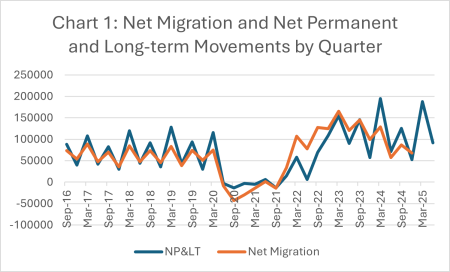
Assuming no major changes to the current ABS estimate for net migration in the first six months of 2024-25, net migration in the second six months would have to be over 300,000 to get to the Daily Mail’s declaration on net migration in 2024-25. NPLT for those six months was 279,460. Even if net migration in the second six months of 2024-25 was identical to NPLT for those six months, which it won’t be, we would already be 20,000 short of the Daily Mail’s declared level of net migration for 2024-25.
To check how close NPLT in 2024-25 may be to net migration in 2024-25, we need to check three other sets of data.
These are:
- overall net movements for 2024-25 (short-term and long-term combined);
- changes in the stock of temporary entrants in 2024-25 plus permanent migration; and
- trends in visa grants in 2024-25 for key visa types.
Overall net movements in 2024-25
Considered over a short period, overall net movements (short-term and long-term) are dominated by short-term movements where people leave and return to Australia, usually over a two to 12 week period. But over 12 months, the effect of short-term movements is largely washed out, leaving mainly long-term and permanent movements.
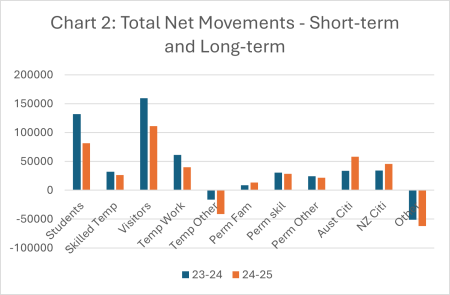
While total net movements are also an imprecise indicator of net migration, these fell from 449,880 in 2023-24 (very close to net migration in that year and only marginally less than NPLT) to 324,111 in 2024-25 (very significantly less than NPLT in 2024-25). That outcome creates significant doubts about the 2024-25 NPLT figure being a good indicator of net migration in that year.
The big surprise in the total net movements figure in 2024-25 is the increase in net arrivals of Australian citizens compared to 2023-24. That is likely the effect of rising short-term movements of Australian citizens rather than large numbers of expatriates returning or fewer Australians leaving the country long-term. It may, however, be possible that Australia’s relatively strong labour market in 2024-25 attracted more expatriates to return.
The increase in New Zealand citizen net arrivals in 2024-25 was to be expected given Australia’s relatively strong labour market, record numbers of NZ citizens leaving NZ and the change in Australian policy allowing NZ citizens a direct pathway to Australian citizenship.
Change in the stock of temporary entrants
The change in the stock of temporary entrants in Australia from end June 2024 to end June 2025 is an indicator of the contribution of temporary entrants to net migration in 2024-25.
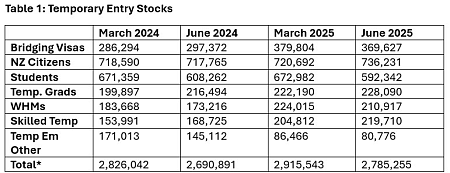
The stock of temporary entrants in Australia grew by 94,364 in 2024-25. Adding the permanent migration program of 185,000 and the 20,000 humanitarian program (and ignoring departures of permanent migrants) gives a total estimate of net migration in 2024-25 of around 300,000.
To that figure, we must add the number of temporary entrants, particularly students, who left Australia in May/June 2025 and will return in July/August 2023 (they will not be counted as a net migration departure). While that figure may be large enough to get net migration to above the Treasury forecast of 335,000, it will not be nearly large enough to get anywhere near 400,000, let alone the Daily Mail assertion of net migration at 457,000 in 2024-25.
Key visa grant data in 2024-25
The key temporary entry drivers of net migration are students, working holidaymakers, skilled temporary entrants and temporary graduates.
Students
Offshore student visa grants have fallen significantly from 2022-23 to 2023-24 and less so in 2024-25. Onshore grants also fell significantly after the peak in 2022-23 but increased again in 2024-25. That suggests students may not be departing at the rate Treasury was expecting. It indicates the student contribution to net migration in 2024-25 likely fell rather than stabilising, as the NPLT data would seem to suggest.

Working holiday visas
The number of first Working Holiday Maker and Work and Holiday visas has climbed from 85,716 in 2021-22; to 198,010 in 2022-23; 184,616 in 2023-24; and 196,463 in 2024-25. Note that the first Working Holiday Maker applications include UK nationals who now automatically get a three-year Working Holiday Maker visa and are therefore more likely to be counted in net migration.
In addition, the rising number of people getting second and third Working Holiday Maker visas is also keeping the contribution to net migration high because to be counted in net migration, the visa holder must remain in Australia for 12 months out of 16. A working holidaymaker who comes to Australia and only stays here for their first Working Holiday Maker visa is unlikely to be counted in net migration.
The number of second Working Holiday Maker and Work and Holiday visas has climbed from 3,401 in 2021-22 to 90,754 in 2024-25. The number of third Working Holiday Maker and Work and Holiday visas has increased from 8,242 in 2021-22 to 33,898 in 2024-25. It is these second and third working holidaymakers who will be counted in net migration and are most likely to apply for further onshore visas, such as skilled temporary visas and permanent visas — both of which are booming.
That would suggest the working holiday contribution to net migration in 2024-25 was strong but perhaps not significantly larger than in 2023-24.

Skilled temporary visas
Since international borders opened, offshore skilled temporary visa grants have remained relatively stable at over 60,000 per annum. That is well above pre-pandemic levels and reflects both a strong labour market as well as policy streamlining post-pandemic.
The onshore skilled temporary visa grants were also strong post-pandemic, with 29,164 visa grants in 2021-22; 35,106 in 2022-23; and 39,730 in 2023-24. However, 2024-25 was a standout year with 70,218 onshore skilled visa grants. This is likely to reflect a surge in temporary graduates as well as working holidaymakers securing skilled temporary visas, which will, in turn, put pressure on the permanent employer-sponsored category.
Skilled temporary visas will have again made a strong contribution to net migration in 2024-25, particularly by slowing the rate of net migration departures.
Temporary graduates
The stock of temporary graduates in Australia increased rapidly towards the end of 2023 as students completing courses moved to the Temporary Graduate stage.
While Temporary Graduate visa grant numbers have fallen back compared to 2022-23, they remain well above pre-pandemic levels despite significant numbers of temporary graduates now moving onto either skilled temporary visas or to permanent visas (temporary graduates can no longer return to a student visa).
Applications for Temporary Graduate visas have been well above pre-pandemic levels at over 100,000 per annum since 2021-22. These peaked in 2023-24 at over 145,000. There were just over 100,000 Temporary Graduate applications in 2024-25. The stock of temporary graduates remains near the record level of 230,000.
Temporary graduates also continue to slow the rate of departures and hence slow the rate of decline in net migration.
Conclusion
The ABS will publish its initial March quarter 2025 estimate of net migration in September 2025 and its initial estimate of net migration for the June quarter of 2025 in December 2025. It will also revise its estimate of net migration in the first six months of 2024-25.
Ahead of that, we can be sure from the corroborating evidence that net migration in 2024-25 was nowhere near the 457,000 suggested by the Daily Mail. While net migration in 2024-25 may be above the Treasury forecast of 335,000, the corroborating evidence suggests it will be well below 400,000. That still means the Government has a lot of work to do to get net migration to the pre-pandemic level promised by the Prime Minister (around 230,000), but not nearly as much as the Daily Mail is suggesting.
Getting net migration to the 160,000 promised by the Coalition would be even more difficult without a major deterioration in the labour market and very significant and politically controversial policy tightening — none of which the Coalition has yet committed to other than to cap students while opposing the power to cap students.

Dr Abul Rizvi is an Independent Australia columnist and a former Deputy Secretary of the Department of Immigration. You can follow Abul on Twitter @RizviAbul.
 This work is licensed under a Creative Commons Attribution-NonCommercial-NoDerivs 3.0 Australia License
Support independent journalism Subscribe to IA.


Related Articles
- High Court faces pressure to curb deportations of long-term residents
- Record number of working holidaymakers pushing migration higher
- Government delayed asylum report amid surge linked to visa schemes
- Treasury’s migration forecast looks shaky as long-term numbers set to surge
- Clear failures, no fixes: The Government's asylum blind spot