
The Government’s reluctance to confront mounting visa backlogs and migration pressures risks compounding Australia’s immigration challenges while leaving politically difficult decisions for another day. Dr Abul Rizvi writes.
I HAD ANTICIPATED that in the 2026-27 Budget, the Labor Government would start to tackle the major immigration policy challenges Australia faces.
While it took some small steps, the major issues have again been kicked down the road. That will simply make the challenges even bigger in the future.
The three big issues I had hoped the Government would address are:
- the massive backlog of partner and employer-sponsored visa applications;
- a formal plan for managing net migration to counter the current misinformation; and
- measures to address the incompatibility of 3 million temporary entrants, including a bridging visa backlog of over a record 430,000, with the current size of the permanent migration program.
Sadly, the Government did too little to address these challenges.

Partner backlog
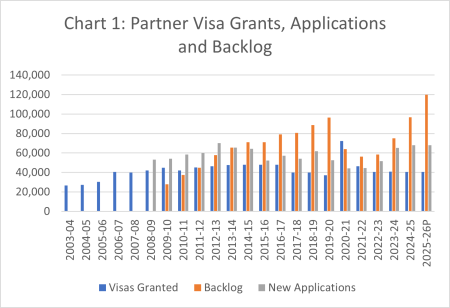
There was no mention of the partner backlog in any of the Government’s public statements (see Chart 1).
In official planning levels for the permanent migration program, the Government has repeatedly said partner visa applications are managed on a demand-driven basis as required by law.
In the official planning levels for 2026-27 (see below), the Government has stated:
‘Delivery of the Partner and Child visa categories are demand driven, with indicative planning levels only.’
Despite this obviously false statement, it is likely the partner backlog will, by end of 2025-26 (six weeks away), be around 120,000. That is against the background of an annual application rate of around 65,000 and a planning level of 41,500 — a 1,000 increase on the 25-26 planning level.
In other words, the Government is planning on the partner visa application backlog growing again by around 20,000 in 2026-27 (after allowing for a small refusal and withdrawal rate).
At some stage, there will be a class action or an Ombudsman’s Report on the Government’s illegal management of partner visa applications. That would force the Government to clear the backlog, opening up the obvious criticism that it has mismanaged immigration.

Permanent skill stream
Unlike the 25-26 planning levels, where the Government simply cut and pasted the 24-25 planning levels, the Government has made some significant changes to the 26-27 planning levels.
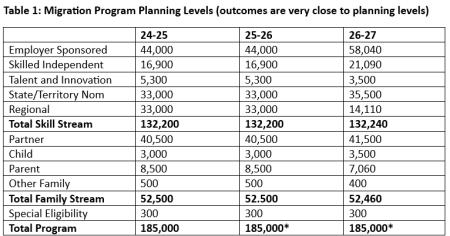
The increase in places for the permanent employer-sponsored visa is due to a massive backlog, as well as a strong application rate. With the stock of temporary employer-sponsored visa holders in Australia at record levels (255,821 at end March 2026), strong demand for the permanent employer-sponsored visa will continue to rise unless the Government tightens policy and/or there is a major weakening of the labour market.
The increase in places for the Skilled Independent category and the reduction in places for the Regional visa are both surprising decisions.
Skilled Independent migrants undoubtedly perform better in the labour market than Regional visa holders. They earn more (and thus pay more tax) and are more likely to be in occupations in national demand. However, they also tend to settle in the major metropolitan centres.
Regional visa holders, on the other hand, fill vacancies that regional Australia struggles to fill, noting the median age of regional Australia is around 42 compared to 36 for metropolitan Australia. Regional Australia desperately needs more health and aged care workers, as well as workers in the agriculture and tourism industries.
The decision to reduce places for the Regional visa will attract strong criticism from regional businesses, regional development authorities, as well as state/territory governments. The Labor Government may be happy to see those complaints as a means of flushing out the position of the National Party and One Nation Party on the Regional visa.

Net migration and temporary entrants
Not surprisingly, Treasury has increased the net migration forecast for 2025-26 from 260,000 to 295,000. That the forecast for 2025-26 was too low was obvious before the start of the financial year.
Treasury has also increased its net migration forecast for 2026-27 from 225,000 to 245,000 and then to 225,000 in 2027-28. Thus, Treasury is still forecasting net migration to decline by 50,000 and then by another 20,000.
In the Budget Papers, the Government has marginally increased the allocation of permanent residence places for temporary entrants already in Australia. That will mean a small reduction in net migration (all other things equal), but nothing like the reductions Treasury is forecasting. The Government will have to tighten policy further if it is to cut net migration to the Treasury forecasts.
At the same time, it will need a contingency plan for any legal direction for it to clear the partner visa backlog or for the ongoing pressure for permanent places from the record levels of temporary graduates, working holidaymakers, skilled temporary entrants and bridging visa holders currently in Australia.
The fact is that the size of the current stock of temporary entrants in Australia is not compatible with the size of the permanent migration program. Either the Government must reduce the stock of temporary entrants or increase the permanent migration program. It has essentially chosen to do neither.
That is dicey politics in the current environment.
Dr Abul Rizvi is an Independent Australia columnist and a former Deputy Secretary of the Department of Immigration. You can follow Abul on Twitter @RizviAbul or Bluesky @abulrizvi.bsky.social.
 This work is licensed under a Creative Commons Attribution-NonCommercial-NoDerivs 3.0 Australia License
Support independent journalism Subscribe to IA.


Related Articles
- Tony Burke signals an immigration shift as Labor confronts migration reality
- Liberal Party migration scare campaign built on the wrong data
- Suggested Cabinet submission for 2026-27 migration and humanitarian program
- No entry, no growth: Australia’s immigration pause illusion
- Australia’s migration numbers defy both camps