When even community banks start acting like the Big Four, it’s clear that regional Australia’s last lifeline is being quietly severed, writes Dale Webster.
BENDIGO BANK has hit the headlines for closing ten branches, shortly followed by an announcement that it was getting rid of all of its regional agencies. But there are another 90-odd Bendigo-branded branches and 50 agencies that have been shut over the past five years that it has managed to keep quiet.
Many of these were community franchises that have been disappearing in the dozens, with both regional and metropolitan areas impacted.
The closures appear linked to a review of the community bank business model revealed by former Bendigo Bank chief executive Marnie Baker under questioning during an investor briefing in 2022, according to Banking Day.
View Bendigo Bank - all available information in a full screen map
Ms Baker was reported to have described community banks as “deposit roving franchises” and a “customer aggregator” for Bendigo Bank.
Ms Baker said:
“Our community partners know that models need to evolve and change as the environment changes and customer preferences change. So, yes, we are reviewing that model along with our community partners to ensure it is a sustainable model well into the future.”
It will probably never be known what has been said to community bank owners behind closed doors, but the result has been the loss of 34 branches since late 2019, with the heaviest cuts in 2022.
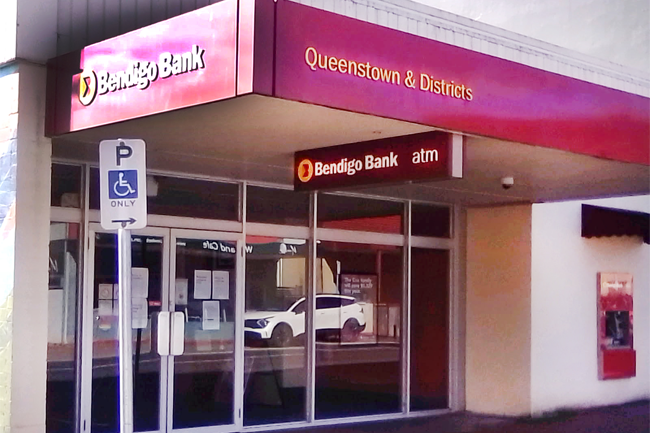
Shearwater, Sheffield and Queenstown community banks in Tasmania were sold to Bendigo Bank in 2022, resulting in the franchise agreements being cancelled and the immediate closure of the battling northern sites.
Queenstown, in the black for a decade, continued to run for another two years until Bendigo announced its closure among the group of ten corporate sites this month.
In its second last annual report as a franchise, a term was introduced for the first time – “performance obligations” – stating that margin, commission and fee income would not be paid until they were met.
The Queenstown bank’s last annual report in 2021 gives a clue to the pressure being put on franchisees:
‘Supporting structures for Community Bank companies are facing consistent review and restructure, thereby creating an increasingly testing environment for the QDFL Board to navigate. Director fatigue has become a health and well-being issue that your community company Directors are flagging as the biggest threat we face as a business.’
While the three Tasmanian community banks were run in isolation, many of the mainland closures appear to be related to a rationalisation of networks with the aim of increasing profits by companies that operated more than one branch.
One community bank owner who ran four branches reported in 2021 that accounts had increased and lending for property was at record levels with growth across all sites.
By 2022, however, it had closed two of the branches, both of which had been named in 2021 as achieving the best lending results the company had seen in years.
There have also been takeovers; franchises sold to other franchise owners, with customers transferred and the branches closed.
All very cut-throat, or more to the point, corporate.

If community banks are starting to act like this, possibly under duress, the model is clearly moving away from the reason it was set up in the first place, which was to respond to regional Australia’s bank closure crisis.
The closure of Queenstown – which, as a franchise, had long been keeping its head above water while providing the only banking services to the west coast of Tasmania – shows Bendigo has become just as ruthless in leaving towns bankless as the big four.
Of the ten corporate sites announced this month to close, five – at Queenstown, Korumburra, Yarram, Bannockburn and Malanda – are the last banks in town.
The agency closures, as Bendigo “retires” the model, will pull the last banking services out of 17 towns.
Tip of the iceberg
The announcement of the recent corporate branch closures has made national news, but an assessment of data supplied by Bendigo Bank to the Australian Prudential Regulation Authority (APRA) has revealed these are just the tip of the iceberg compared to those that have, like the community banks, mostly gone unreported over the past five years.
Along with the 33 community banks and the ten just announced, there have been at least another 42 corporate closures – possibly more – that have quietly slipped by the public’s notice since 2019.
Since 2014, 69 Bendigo Bank corporate sites and 37 community banks have been closed and one made cashless.
Bendigo has also sold four corporate sites to community companies, one of which was immediately closed.
The 38 Bendigo Bank branch and agency closures over the next six weeks, during a regional bank closures moratorium (that Treasurer Jim Chalmers forgot to include Bendigo Bank in), increase growing pressure on the Federal Government to officially respond to the final report from the Senate Inquiry into regional bank closures, tabled more than a year ago.
On 15 August, every National Party MP and senator signed an open letter to the Treasurer and Assistant Treasurer urging them to immediately table the Government’s response to the Senate inquiry into regional bank closures and to work with all sides of the floor to urgently protect regional banking services.

Nationals MP for Flynn Colin Boyce, Liberal Member for Monash Mary Aldred, Labor Member for Braddon Anne Urquhart and One Nation Senator Malcolm Roberts have all made speeches in Parliament about the need for action on banking services in regional Australia in response to the Bendigo Bank closures.
Liberal Leader Sussan Ley is believed to have flown to Adelaide to speak in person to speak to Bendigo Bank chief executive Richard Fennell over the agency closures in her own electorate of Farrer.
The glaring silence on the issue is from Prime Minister Anthony Albanese and his Treasury portfolio colleagues Jim Chalmers and Daniel Mulino.
Mr Albanese is a known supporter of a government-owned bank, which the Senate Committee found was the only reasonable solution to a growing humanitarian crisis it heard first-hand about over the 15-month inquiry.
Mr Albanese told broadcaster Neil Mitchell in 2023:
I think there is a role for state-owned enterprises in competing, in keeping the private sector a bit honest.
I wouldn’t have sold the Commonwealth Bank, probably, still, going back. I think that there would have been better behaviour by the big banks had there been a public instrumentality there competing with it.
With even community banks now turning on their customers, the time has come for Mr Albanese to stand by his words and at least agree to forming an expert panel to look at the options and costings, which was the recommendation of the tri-partisan committee.
Bendigo Bank can be thanked for giving the issue the impetus it needed to put this issue firmly back on the table.
Dale Webster is an inaugural recipient of a Walkley Foundation Grant for Freelance Journalism on Regional Australia. She publishes independently through her own title, The Regional. You can follow Dale on Twitter @TheRegional_au.
 This work is licensed under a Creative Commons Attribution-NonCommercial-NoDerivs 3.0 Australia License
Support independent journalism Subscribe to IA.


Related Articles
- Bendigo Bank axed Indigenous service weeks before reconciliation launch
- Bendigo Bank profit surges as community groups get the boot