There has been a lot of hand-wringing in the media and from a small army of vested interest groups about the economic consequences of the Federal Budget delivered by Treasurer Jim Chalmers on 12 May.
The melodrama is rather embarrassing for those peddling the downside threats to the economy from some of the tax reforms. Geoff Wilson from Wilson Asset Management and Matt Barrie, the CEO of Freelancer, a firm whose business model is effectively to export work opportunities from Australians to cheap labour overseas, have been particularly vocal in their assessment of what the tax changes will mean for the economy.
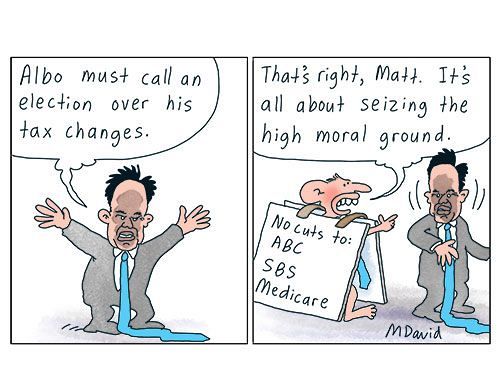
Among the unhinged claims from Geoff Wilson on X were:
[Labor] is debasing our democracy...
[Treasurer Chalmers] looks exactly like the Treasurer who knows he’s torching productive investment for ideology.
With reference to the capital gain tax changes, Wilson tweeted:
... it’s economic vandalism that smashes aspiration, kills startups, and exports our best talent and future companies to the U.S. and Asia.
Every founder now rethinking Australia. Every high-skilled job at risk. The innovation machine is being deliberately broken. This isn’t a budget. It’s a declaration of war on mobile capital...
Matt Barrie was similarly melodramatic.
Interviewed by the ABC, Mr Barrie was quoted:
“You won't have capital coming to Australia. You'll have Australia written off, if it isn't already, from the investment mandates of fund managers overseas.”
On X, Barrie said:
‘... the whole tax is punitive on the Australian spirit.’
It might be noteworthy that the share price of Wilson Asset Management (WAM), which is listed on the ASX, is around $1.50. This is not far from a fresh 15-year low and is down 40% from its 2019 peak of $2.50.
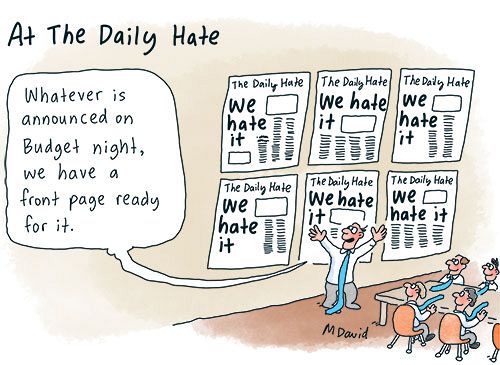
The share price of Freelancer (FLN) is even weaker. Freelancer is trading around 14 cents a share, which is down more than 90% from its 2015 peak.
Perhaps the status of the criticisms from Wilson and Barrie of the Budget should be viewed in the context of their “successes” in these two companies.
How do consumers rate the budget?
In terms of the response from consumers to the economic effects of the Budget, Roy Morgan, in partnership with the ANZ bank, produces a weekly index of consumer confidence.
The index compiled is a synthesis of questions to consumers’ views on their:
- financial situation compared to a year ago;
- the financial situation next year;
- economic conditions next year;
- economic conditions over the next five years; and
- time to buy a major household item.
On 10 May, just two days before the Budget, the index of consumer confidence stood at 64.1 index points. This was a miserably low level with interest rates, concerns over the oil shock and falling house prices all taking a toll.
On 17 May, the week after the Budget, consumer confidence rose to 66.4 points. In the most recent reading for 7 June, the index has increased to 70.8 points, some 10.5% higher than the reading immediately before the Budget and is at its highest level since March.
To be sure, there are many issues that impact consumer confidence. It might be interest rates, unemployment, petrol prices, among other factors. To attribute the rise since the Budget solely to the Budget almost certainly overstates the reaction to it.
It does, nonetheless, show that since the Budget, consumer pessimism has abated, with confidence rising from the lows. This is, interestingly, despite other economic news, including ongoing ructions in the U.S.-Iran war, higher unemployment and widespread reports about falling house prices.
What do the financial markets reveal about the Budget?
If the policy reforms announced in the Budget presented a major threat or dislocation to the economy, it would inevitably show up in the way investors treated financial assets in Australia. If the Budget was “economic vandalism” as Wilson judges, it would inevitably see investors selling their Australian stocks, bonds and the Australian dollar.
This has not been the case.
On the contrary, with the Budget more than a month old and with plenty of time to analyse and assess its effects on the economy, the ASX200 stock index is 1.5% stronger than before the Budget, the ten-year government bond yield has fallen a significant 20 basis points based on solid budget settings and the outlook for lower inflation.
At the same time, the Australian dollar has fallen just under U.S. 2 cents, but this is in the wake of some strength in the U.S. dollar. It is little changed on a trade-weighted basis.
Suffice to say, by their actions in money markets, investors are not concerned about the fallout for the economy from the Budget. On the contrary, the market moves could be painted as a vote of confidence in the economic outlook.
The 2026 Budget has delivered a range of reforms, some of which will have a negative financial effect on segments of the economy. The fact that those potentially losing out are squealing is no real surprise. Nobody likes having an unfair tax break taken from them.
But given the other reactions to the Budget from consumers and money markets, it is turning out to be the policy document that will be well accepted, especially when many of the measures announced start to impact the parts of the economy they are aimed at.
Stephen Koukoulas is one of Australia’s most respected economists, a past chief economist of Citibank and senior economic advisor to an Australian Prime Minister. You can follow Stephen on Twitter/X @TheKouk.
 This work is licensed under a Creative Commons Attribution-NonCommercial-NoDerivs 3.0 Australia License
Support independent journalism Subscribe to IA.


Related Articles
- Australia now has best-ever economy and worst-ever reporters
- Federal Budget reveals Australia’s mounting digital technical debt
- CARTOONS: Mark David is balancing his 'Budget'
- Chalmers' fair go budget a fair bet to charm
- Federal Budget in good hands with Labor's economic management